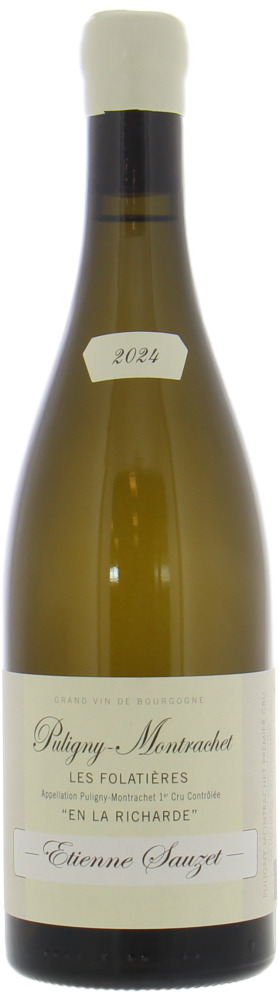
Les rendements sont environ deux fois moins élevés que d'habitude sur l'ensemble du domaine, et les résultats sont similaires pour le Puligny-Montrachet de 2024. Le 1er Cru « Les Folatières » à En la Richarde, un lieu-dit des Folatières appartenant au Domaine Sauzet, n’a pas fait exception : un temps frais et pluvieux, associant un risque élevé de mildiou, a entraîné d’importantes pertes de fruits dans les vignobles situés sur des terrains plats. Cependant, la région de la Côte de Beaune a bien résisté à cette situation grâce à des conditions légèrement plus sèches et à une meilleure floraison. Le millésime 2024 a ainsi atteint une bonne maturité, ce qui a permis à Benoît Riffault de renoncer à la chaptalisation des vins de 1er cru et de Grand Cru.
Des arômes vifs d’agrumes et des notes de fruits mûrs du verger se dégagent immédiatement, sur fond de nuances minérales. Soyeux et velouté tout en restant ferme, doté d’une structure riche et solide, il offre une finale nette et longue. Il se dégustera de préférence entre 2030 et 2040, et il est préférable de le laisser vieillir en cave plutôt que de le servir jeune.
Benoît Riffault gère un vignoble de 15 hectares et élabore ce vin en pratiquant la culture biologique. Les vendanges sont effectuées à la main. Aucune chaptalisation n’a été effectuée sur ce vin, ce qui est remarquable étant donné que ce niveau de maturité a été atteint au cours d’une année fraîche. L’élevage s’effectue dans des fûts de chêne de Bourgogne de 228 litres et dans des cuves plus grandes, notamment des foudres, de sorte que les arômes de chêne imprègnent subtilement le vin en arrière-plan plutôt que de dominer son profil. Les vins de Premier Cru et de Grand Cru sont soutirés en cuve en juillet ou en août, avant le nouveau millésime, où ils vieillissent sur lies pendant six mois maximum avant la mise en bouteille.
Robert Parker (94)
The 2024 Puligny-Montrachet 1er Cru Les Folatières En la Richarde opens in the glass with a generous bouquet of ripe citrus fruits, peach, toasted nuts and honey. Medium- to full-bodied, satiny and suave, it's deep and layered, with a pleasing sense of completeness and a long finish.
Benoît Riffault presides over this 15-hectare Pulingy-Montrachet reference point, and his 2024s have turned out very nicely. Opting not to chaptalize, with the exception of the Bourgogne Hautes Côtes de Beaune, the wines are pure and precise, with increasing texture and density as one ascends the appellation hierarchy. But what are the rudiments of winemaking at this address today? Hand-harvested fruit is pressed without crushing, the press cycle lasting around three and a half hours and performing "quite a few" rotations to crumble the marc. The must is sulfited at the end of the press and settled for 24 hours, but Riffault retains most of the lees, fermenting in wood with ambient yeasts. Larger formats, including foudres, now complement 228-liter Burgundian barrels. The wines are racked to tank in July-August before the new vintage, whereas the premiers and grands crus spend as much as six months on their lees before bottling. All of Sauzet's wines are bottled with high-quality unbleached natural cork.
Vinous (95)
The 2024 Puligny-Montrachet les Folatières En la Richards 1er Cru was an absolute knockout last year. This vintage is definitely impressive with fine tension and mineralité
Sauzet was one of my first visits during my six-week “marathon” of tastings. “The 2024 vintage is the opposite of previous hot vintages," winemaker Benoît Riffault told me in their swish tasting room overlooking a sea of yellow and ochre leaves across Puligny. “The hardest thing was fighting the mildew and keeping the cover crops under control amidst the rain. We are organic in the vineyard, so it is more challenging. It is a cooler vintage like in the past. It has purity. The wines are medium-bodied and I am pleased with their freshness. It was crazy during the season as we lost a lot of fruit in the flatter areas due to mildew. We began picking on September 12. It is close to half a normal crop, around 28 hl/ha with around 12.5% potential alcohol. I didn’t want to hold off the picking as I felt it was ripe, plus I wanted to preserve purity of fruit. There was a very little amount of chaptalisation on the regional wines but none for the Puligny cuvées. The wines are raised in used barrels, foudres and some 600-liter barrels as usual. Though it was a different kind of growing season, the resulting wines are not dissimilar to the 2023s and they seem to have natural balance.”
Jasper Morris (95)
Pale colour with a faint lime streak. Plenty of tension, more a limestone feel, perhaps less ripe, evidently a little stricter. Quite generous fruit on the palate, even a suggestion of bacon fat, and notable length. This is one of the more backward wines in the stable, but with potential. Needs time.