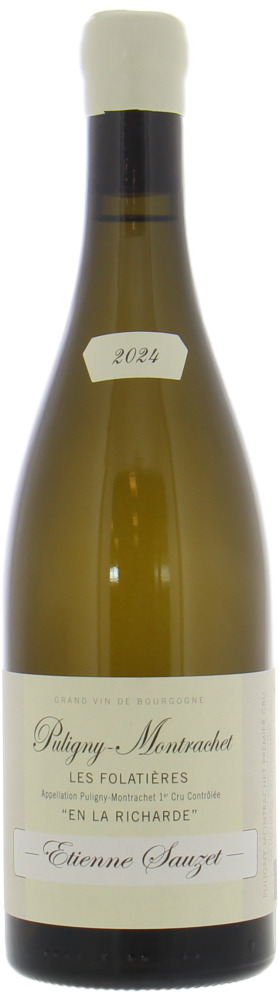
Die Erträge liegen auf dem gesamten Weingut bei etwa der Hälfte des üblichen Niveaus, und für Puligny-Montrachet im Jahr 2024 sind ähnliche Ergebnisse zu erwarten. Der 1er Cru „Les Folatières“ in „En la Richarde“, einem Lieu-dit von Les Folatières, von der Domaine Sauzet bildete da keine Ausnahme: Das kühle und regnerische Wetter, das ein hohes Mehltaurisiko mit sich brachte, führte zu erheblichen Ertragsausfällen in den Weinbergen auf flachem Gelände. Die Region Côte de Beaune konnte die Situation jedoch dank etwas trockenerer Bedingungen und einer besseren Blüte gut meistern. Dies führte dazu, dass der Jahrgang 2024 eine gute Reife erreichte, weshalb Benoît Riffault darauf verzichtete, die 1er-Cru- und Grand-Cru-Weine zu chaptalisieren.
Lebhafte Zitrusaromen und Noten von reifen Obstgartenfrüchten sind sofort wahrnehmbar, untermalt von steinigen Nuancen. Seidig weich und doch fest, mit einer reichhaltigen und dennoch soliden Struktur, hinterlässt er einen sauberen und langen Abgang. Er lässt sich am besten zwischen 2030 und 2040 genießen, und es ist besser, ihn im Keller reifen zu lassen, als ihn jung zu servieren.
Benoît Riffault bewirtschaftet einen 15 Hektar großen Weinberg und keltert den Wein unter Anwendung biologischer Anbaumethoden. Die Lese erfolgt von Hand. Bei diesem Wein wurde keine Chaptalisierung vorgenommen, was angesichts der Tatsache, dass dieser Reifegrad in einem kühlen Jahr erreicht wurde, bemerkenswert ist. Die Reifung erfolgt in 228-Liter-Fässern aus burgundischer Eiche und größeren Behältern, darunter Foudres, sodass die Eichenaromen den Wein dezent im Hintergrund durchziehen, anstatt das Profil zu dominieren. Die Premier-Cru- und Grand-Cru-Weine werden im Juli oder August vor dem neuen Jahrgang in Tanks umgefüllt, wo sie vor der Abfüllung bis zu sechs Monate auf der Hefe reifen.
Robert Parker (94)
The 2024 Puligny-Montrachet 1er Cru Les Folatières En la Richarde opens in the glass with a generous bouquet of ripe citrus fruits, peach, toasted nuts and honey. Medium- to full-bodied, satiny and suave, it's deep and layered, with a pleasing sense of completeness and a long finish.
Benoît Riffault presides over this 15-hectare Pulingy-Montrachet reference point, and his 2024s have turned out very nicely. Opting not to chaptalize, with the exception of the Bourgogne Hautes Côtes de Beaune, the wines are pure and precise, with increasing texture and density as one ascends the appellation hierarchy. But what are the rudiments of winemaking at this address today? Hand-harvested fruit is pressed without crushing, the press cycle lasting around three and a half hours and performing "quite a few" rotations to crumble the marc. The must is sulfited at the end of the press and settled for 24 hours, but Riffault retains most of the lees, fermenting in wood with ambient yeasts. Larger formats, including foudres, now complement 228-liter Burgundian barrels. The wines are racked to tank in July-August before the new vintage, whereas the premiers and grands crus spend as much as six months on their lees before bottling. All of Sauzet's wines are bottled with high-quality unbleached natural cork.
Vinous (95)
The 2024 Puligny-Montrachet les Folatières En la Richards 1er Cru was an absolute knockout last year. This vintage is definitely impressive with fine tension and mineralité
Sauzet was one of my first visits during my six-week “marathon” of tastings. “The 2024 vintage is the opposite of previous hot vintages," winemaker Benoît Riffault told me in their swish tasting room overlooking a sea of yellow and ochre leaves across Puligny. “The hardest thing was fighting the mildew and keeping the cover crops under control amidst the rain. We are organic in the vineyard, so it is more challenging. It is a cooler vintage like in the past. It has purity. The wines are medium-bodied and I am pleased with their freshness. It was crazy during the season as we lost a lot of fruit in the flatter areas due to mildew. We began picking on September 12. It is close to half a normal crop, around 28 hl/ha with around 12.5% potential alcohol. I didn’t want to hold off the picking as I felt it was ripe, plus I wanted to preserve purity of fruit. There was a very little amount of chaptalisation on the regional wines but none for the Puligny cuvées. The wines are raised in used barrels, foudres and some 600-liter barrels as usual. Though it was a different kind of growing season, the resulting wines are not dissimilar to the 2023s and they seem to have natural balance.”
Jasper Morris (95)
Pale colour with a faint lime streak. Plenty of tension, more a limestone feel, perhaps less ripe, evidently a little stricter. Quite generous fruit on the palate, even a suggestion of bacon fat, and notable length. This is one of the more backward wines in the stable, but with potential. Needs time.