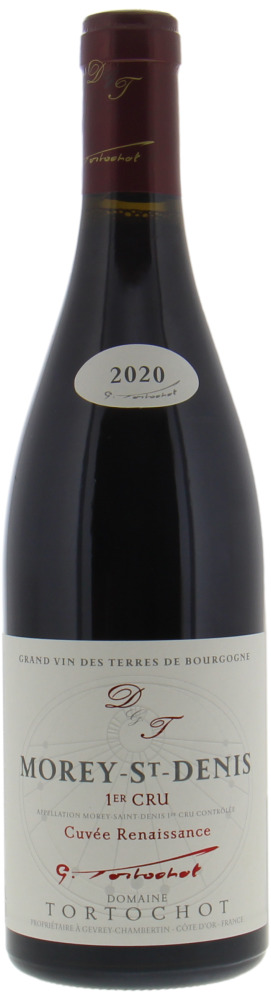

| Classification | Premier Cru Classe |
| Type | Red |
| Producer | Domaine Tortochot |
| Vintage | 2020 |
| Country | France |
| Main region | Burgundy |
| Region | Côte de Nuits |
| Appellation | Morey Saint Denis |
| Grape | Pinot Noir |
| Volume | 0,75 |
| Condition | Perfect |
| Label | Perfect |
| Drinkable | 2024-2038 |
| Stock | 18 |
The 2020 growing season in the Côte de Nuits was hot and dry. Many producers harvested early, in mid to late August, but yields were low due to the drought. For Domaine Tortochot's Cuvée Renaissance, a Premier Cru assemblage in Morey-Saint-Denis, this meant concentrated fruit and true ripeness: a denser, more intense expression than the cooler 2017, but with the silky tannins that Morey-Saint-Denis is known for.
An exuberantly fresh nose freely offers up its airy aromas of essence of red cherry, violet and a suggestion of exotic tea. The noticeably finer, indeed almost delicate, texture of the middleweight flavors contrasts markedly with the markedly firm and youthfully austere finale that also exudes a subtle minerality. Lovely and understated and a wine that should easily repay a decade plus of keeping.
The first impression is of dark fruit. There are notes of black cherry, ripe raspberry and blueberry, framed by oak spice and the faint earthiness characteristic of Morey-Saint-Denis. On the palate, the 2020 wine is voluminous, with medium weight and grippy, silky tannins typical of Morey-Saint-Denis. The finish feels warm due to the hot harvest, but there is enough acidity to keep the wine lively. Drinkable now, but it will get even better with time.
Like almost all of the Côte de Nuits, Pinot Noir is the only black grape here. So why does Pinot Noir from Morey-Saint-Denis taste different from its neighbors? Soil. Phosphate-rich limestone and clay marl give Morey its characteristic tannins. Tortochot's Cuvée Renaissance is a blend of grapes from several Premier Cru sites to give it breadth.
100% Pinot Noir.
Drink between 2026 and 2040. The 2020 vintage has the right concentration and tannin structure for aging, though it is already drinkable if you can't wait, given the maturity of the warm vintage. Store horizontally at 12-14°C, away from light. After 10 years, expect the fruitiness to give way to notes of truffle, undergrowth and gibier.
Tortochot is one of the most under-the-radar domaines of Gevrey-Chambertin, despite owning four Grands Crus, including Chambertin. So why has there been a "revival"? The Morey-Saint-Denis vineyards were leased to Domaine Georges Lignier for 18 years and Chantal Tortochot, who succeeded her father in the late 1990s, took them back when the lease expired in 1996. The naming of this cuvée signifies its rebirth. We consider Tortochot to be one of the most valuable addresses in the Côte de Nuits.
Morey-Saint-Denis sits on Bajocian and Bathonian limestone with bands of marl, and the Class 1 vineyard plots are along the mid-slopes at an elevation of 250-300 meters. Why it matters. The limestone gives Pinot Noir minerality, while the marl and clay give fleshiness. The east-facing slopes receive the morning sun. The result is a wine that bridges the gap between the power of Gevrey-Chambertin and Chambolle-Musigny, with tenacious but silky tannins.
At Domaine Tortochot, the fruit is chilled to around 10°C and undergoes a week of cold maceration before fermentation. What is this done for? To gently bring out the colors and aromas, and to do so before the yeast starts to move. Only indigenous yeasts are used and gently extracted on a pneumatic press. Aged in French oak for 12-14 months, of which about 50% new oak for the 1er Cru. No fining, no filtration, certified organic since 2013, chemical free since 2005.
Morey's firm tannins and red fruit core favor Burgundian-style cooking. Some ideas:
Serve at 16-17°C. If drinking the wine young, decant for 30 minutes before serving.
With track & trace code