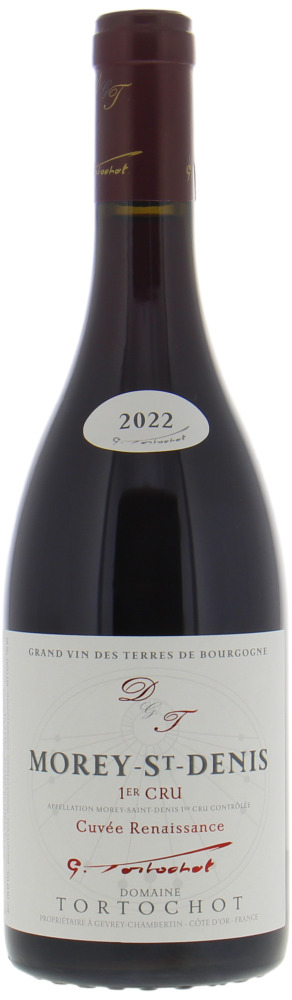

| Classification | Cru Classe |
| Type | Red |
| Producer | Domaine Tortochot |
| Vintage | 2022 |
| Country | France |
| Main region | Burgundy |
| Region | Côte de Nuits |
| Appellation | Morey Saint Denis |
| Grape | Pinot Noir |
| Volume | 0,75 |
| Condition | Perfect |
| Label | Perfect |
| Drinkable | 2026-2036 |
| Stock | 12 |
The 2022 growing season in Burgundy was hot and dry, but not severe: the vines survived the brutal frosts of 2021 to produce abundant, healthy fruit, and the harvest was early. For Domaine Tortochot's Morey-Saint-Denis 1er Cru Cuvée Renaissance wine, this meant ripe Pinot Noir with surprisingly fresh acidity. Chantal Tortochot has been working at this revitalized family vineyard since 1996, and the 2022 was one of the most balanced harvests of the decade.
The world of fine wines Sarah Marsh (MW)
A blend of two small parcels. Deeper fruit and richer, silky/satin texture. More fruit- than perfume-driven, with a slightly longer finish. 93
The first impression is fruity. Aromas of black cherry, raspberry and violet. Underneath is Morey's characteristic forest floor, hints of licorice and faint hibiscus. The palate is medium-bodied, with tannins that cling without being scratchy and a texture reminiscent of warm-vintage Pinot Noir meeting limestone. The finish is salty. Impatient drinkers can drink it young, but we prefer to wait a little longer.
100% Pinot Noir. That's the rule for almost all Côte de Nuits red wines, and Morey-Saint-Denis is no exception. So why does its flavor differ from neighboring Gevrey and Chambolle? Soil. The clay-limestone soils on these slopes give Pinot Noir more grip than Chambolle and more flavor than Gevrey. The Renaissance is somewhere in the middle.
Start drinking from 2027 and it will age until 2038, perhaps longer; the 2022 has the acidity to age and the tannins need a few years to integrate. Ideally, it should be stored in a cool, stable place at 12-14°C. Expect the fruitiness to recede and be replaced by notes of truffle and undergrowth.
Tortochot is one of the most under-the-radar domaines of Gevrey-Chambertin, despite owning four Grands Crus, including Chambertin. So why has there been a "revival"? The Morey-Saint-Denis vineyards were leased to Domaine Georges Lignier for 18 years and Chantal Tortochot, who succeeded her father in the late 1990s, took them back when the lease expired in 1996. The naming of this cuvée signifies its rebirth. We consider Tortochot to be one of the most valuable addresses in the Côte de Nuits.
Morey-Saint-Denis sits on Bajocian and Bathonian limestone with bands of marl, and the Class 1 vineyard plots are along the mid-slopes at an elevation of 250-300 meters. Why it matters. The limestone gives Pinot Noir minerality, while the marl and clay give fleshiness. The east-facing slopes receive the morning sun. The result is a wine that bridges the gap between the power of Gevrey-Chambertin and Chambolle-Musigny, with tenacious but silky tannins.
At Domaine Tortochot, the fruit is chilled to around 10°C and undergoes a week of cold maceration before fermentation. What is this done for? To gently bring out the colors and aromas, and to do so before the yeast starts to move. Only indigenous yeasts are used and gently extracted on a pneumatic press. Aged in French oak for 12-14 months, of which about 50% new oak for the 1er Cru. No fining, no filtration, certified organic since 2013, chemical free since 2005.
Morey's firm tannins and red fruit core favor Burgundian-style cooking. Some ideas:
Serve at 16-17°C. If drinking the wine young, decant for 30 minutes before serving.
With track & trace code