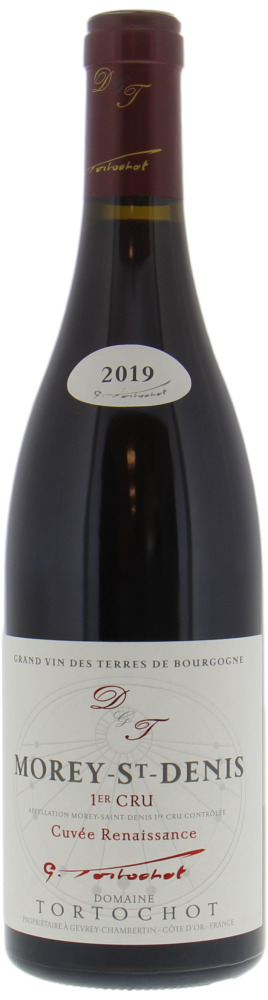

| Classification | Premier Cru Classe |
| Type | Red |
| Producer | Domaine Tortochot |
| Vintage | 2019 |
| Country | France |
| Main region | Burgundy |
| Region | Côte de Nuits |
| Appellation | Morey Saint Denis |
| Grape | Pinot Noir |
| Alcohol % | 13% |
| Volume | 0,75 |
| Condition | Perfect |
| Label | Perfect |
| Drinkable | -2038 |
| Stock | 11 |
The 2019 growing season in the Côte de Nuits was hot and dry, with spring frosts and summer drought causing a significant reduction in yield. The grapes that survived ripened beautifully. For Domaine Tortochot's Morey-Saint-Denis 1er Cru Cuvée Renaissance wine, this means fine, concentrated fruit, ripe tannins and, surprisingly, fresh acidity that remains intact. Expect a denser, fuller-bodied version of this Pinot Noir than in 2017 or 2018, but without losing the Morey lift.
Pretty and attractively layered aromas feature notes of both red and dark berries, anise, violet and a whiff of wood. There is very good intensity and vibrancy to the well-defined flavors that also possess a beguiling texture, all wrapped in a saline suffused finale.
First black cherry, then violet, notes of licorice and the forest floor that the Morey-Saint-Denis is known for. The 2019 vintage gives it extra weight. The fruit is darker and riper than usual, with a broader middle and a savory, almost iron edge in the finish. The tannins are firm but refined, pairing well with oak. Decant now, or wait. The structure suggests that things are just getting started.
100% Pinot Noir.
So why does Morey-Saint-Denis Pinot Noir taste different from Gevrey-Chambertin and Chambolle-Musigny? Soil. Limestone and marl with a high phosphate content give the grapes a unique grip and silky tannins. Tortochot is almost entirely removed, which preserves the purity of the fruit and reflects the terroir; in 2019, the heat pushed the Pinot Noir toward riper expressions, but the structure of Morey - its medium-weight elegance - is still evident.
Drink between 2026 and 2040; in 2019, the concentration, ripe tannins and acidity suggest greater ageing potential than recent Renaissance vintages; store at 12-14°C. It will truly show its potential from 2028, when the fruitiness settles down and forest floor-like nuances begin to emerge.
Tortochot is one of the most under-the-radar domaines of Gevrey-Chambertin, despite owning four Grands Crus, including Chambertin. So why has there been a "revival"? The Morey-Saint-Denis vineyards were leased to Domaine Georges Lignier for 18 years and Chantal Tortochot, who succeeded her father in the late 1990s, took them back when the lease expired in 1996. The naming of this cuvée signifies its rebirth. We consider Tortochot to be one of the most valuable addresses in the Côte de Nuits.
Morey-Saint-Denis sits on Bajocian and Bathonian limestone with bands of marl, and the Class 1 vineyard plots are along the mid-slopes at an elevation of 250-300 meters. Why it matters. The limestone gives Pinot Noir minerality, while the marl and clay give fleshiness. The east-facing slopes receive the morning sun. The result is a wine that bridges the gap between the power of Gevrey-Chambertin and Chambolle-Musigny, with tenacious but silky tannins.
At Domaine Tortochot, the fruit is chilled to around 10°C and undergoes a week of cold maceration before fermentation. What is this done for? To gently bring out the colors and aromas, and to do so before the yeast starts to move. Only indigenous yeasts are used and gently extracted on a pneumatic press. Aged in French oak for 12-14 months, of which about 50% new oak for the 1er Cru. No fining, no filtration, certified organic since 2013, chemical free since 2005.
Morey's firm tannins and red fruit core favor Burgundian-style cooking. Some ideas:
Serve at 16-17°C. If drinking the wine young, decant for 30 minutes before serving.
With track & trace code