| ohne MwSt. | € 1.595,00 |
| inkl. MwSt. | € 1.898,05 |
| Volume | Magnum |
| ohne MwSt. | € 3.450,00 |
| inkl. MwSt. | € 4.105,50 |
| Volume | Double Magnum |
| Klassifiziering | DOCG |
| Typ | Rotwein |
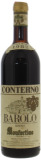
| Marke | Giacomo Conterno |
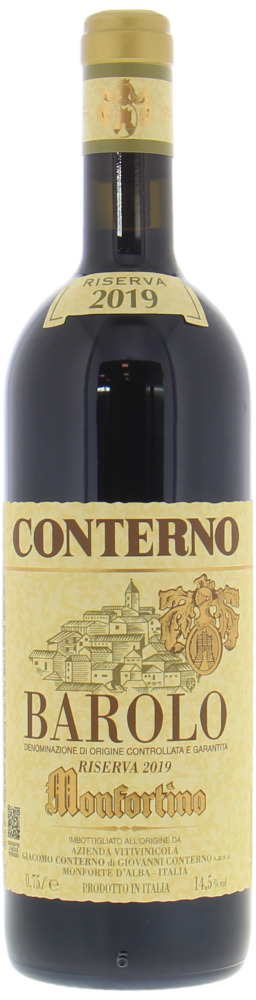
| Wein | Monfortino |
| Jahrgang | 2019 |
| Land | Italien |
| Region | Piemont |
| Appellation | Barolo |
| Rebsorte | Nebbiolo |
| Alcohol % | 14.5% |
| Inhalt | 0,75 |
| Preis pro Liter | 1.261,40 € |
| Zustand | Perfekt |
| Label | Perfekt |
| Trinkbar | 2026-2055 |
| Vorrat | 0 |
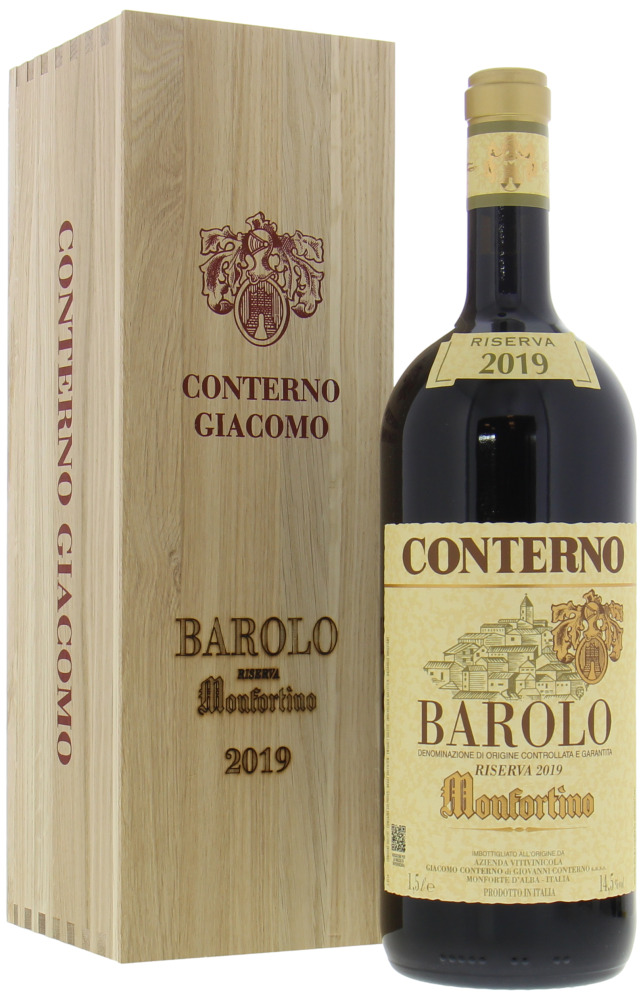
| Inhalt | 1,5 |
| Preis pro Liter | 1.265,37 € |
| Zustand | Aus Original Holz Kiste |
| Label | Perfekt |
| Trinkbar | 2030-2060 |
| Vorrat | 1 |
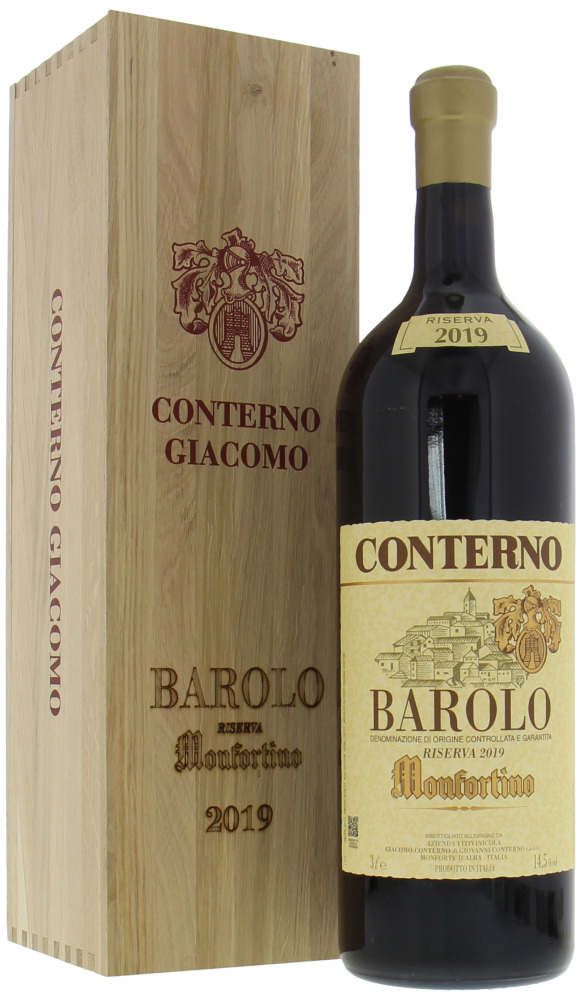
| Inhalt | 3,0 |
| Preis pro Liter | 1.368,50 € |
| Zustand | In 1er OHK |
| Label | Perfekt |
| Trinkbar | 2030-2060 |
| Vorrat | 0 |
Die Vegetationsperiode 2019 für den Barolo verlief genau so, wie es sich die Winzer erhofft hatten. Es gab einen kühlen Frühling, einen warmen, aber nicht sengenden Sommer und vor allem kalte Nächte im September, die die Säure festhielten. Die Lese fand im Oktober unter typischen piemontesischen Bedingungen statt: neblige Morgen und trockenes Wetter. Für Giacomo Conternos Barolo Riserva Monfortino brachte dieses Jahr genau das, was Roberto Conterno suchte: strukturierte Tannine, lebendige Säure und eine Konzentration, die eine siebenjährige Reifung in slawonischer Eiche erforderte.
It's been a while, alas. The last vintage of this legendary wine was 2015. Skipping forward to a year of natural richness and concentration, the Giacomo Conterno 2019 Barolo Riserva Monfortino is a magnificently executed wine. It carefully reins in the soaring power of Nebbiolo and whittles it down to extreme finesse and precision. This is the essence of the grape with no extra bells or whistles. Roberto Conterno tells me he chose not to make Monfortino in 2016 because he considered 2015 to be a superior vintage. (There is an image problem with 2015, he concedes, because 2016 was more consistent overall than 2015; however, his experience with 2015 is better.) The 2017 vintage was a contender for Monfortino, but the wine was not made. The 2018 vintage also came close to production, but a lack of diurnal temperature shifts at the end of the growing season disqualified it, Roberto Conterno explains. His heart settled on 2019, a vintage that reminds him of the tension and energy found in 2013. However, the DNA of the 2019 vintage is slightly different because this edition sees 27% fruit blended from Arione. This site adds finesse and elegance. The rest of the blend represents a special selection from Francia, and that is where this wine gets its power and age-worthy tannins. The 2019 will be released in October 2025.
A complex and deep wine that’s as graceful as it is powerful. Aromas of earth, strawberries, dried cherries, restrained orange peel, sweet dried violets, potpourri and licorice root. Full-bodied and concentrated, with graphite flavors and thick, dusty, muscular yet ripe tannins. Still youthful and vibrant, with refreshing acidity. More impressive on the palate than on the nose, suggesting it needs time to fully evolve.
Grapes come from Francia and Arione in Serralunga d’Alba. Bottled in March 2024 and will be released October 2025.
Lustrous mid ruby with orange tinges. Very fine and noble. Very closed but with real subtlety and finesse. Lots of substance underneath. With aeration, raspberry and minerality. Embryonic and super-finely balanced – fine tannins woven into the fruit. (WS)
The 2019 Barolo Riserva Monfortino has closed down considerably since I last tasted it. Then again, the 2019 is a very serious Monfortino that includes the entirety of Conterno’s production from both Francia and Arione. Today, the tannins are pretty imposing, but modern Monfortinos have shown an ability to assimilate their tannin with much less time in bottle than was once required. Production for the 2019 is on the higher side because of the blending of sites, so readers should have a relatively easy time sourcing this.
I’ve tasted the 2019 Barolo Monfortino three times before bottling at the estate, and it’s one of those vintages where no Francia was made, so all the fruit went into the Monfortino. This is a highly structured expression of the cuvée, yet it shows remarkable finesse and nimbleness in the glass. Aromas of leather, smoky earth, cherries, and floral cologne emerge with clarity and depth. The palate is tightly woven and precise, with firm yet balanced tannins, vibrant acidity, and a long, resonant finish. It’s already showing beautifully, and this is truly as good as it gets. The nobility of its structure is profound and promises decades of evolution. Speaking with Roberto Conterno during this tasting, he likened the wine to the 2013, but noted that it carries more elegance even now, something he attributes to the inclusion of Arrione in the final blend.

Der Monfortino braucht immer Zeit, um sich zu entfalten, besonders (sehr) junge Jahrgänge. Daher ist der erste Eindruck eher zurückhaltend. Die Nase ist vielschichtig, mit einem langsamen Aufbau von Noten von getrockneten Rosen, Sauerkirschen, Teer, Lakritz und feuchter Erde, die sich mit der Zeit entfalten. Am Gaumen zeigen sich die für Serralunga typischen dichten Tannine, eine schöne Säure und ein würziger, eiserner Abgang. Dies ist ein Wein für die lange Lagerung, und wir raten davon ab, eine Flasche vor 2030 zu öffnen. Er braucht Zeit.
Die Zusammensetzung dieses Weins ist einfach:
100 % Nebbiolo aus Serralunga d'Alba.
Warum also erzeugt eine einzige Rebsorte ein so komplexes Aroma? Nebbiolo hat dünne Schalen, reift spät und ist sehr standortabhängig. In Cascina Francia setzen Kalkstein und Lehm die Reben stark unter Druck. Dieser Stress verleiht dem Monfortino seine Aromen von Harz, Rosen und Trüffeln sowie seine Tanninstruktur, wodurch er 50 Jahre lang reifen kann.
Trinkreife zwischen 2030 und 2060. Die Tannine sind noch fest gebunden und die Säure messerscharf. Beides bietet Potenzial für die Reifung; lagern Sie den Wein liegend, lichtgeschützt und bei einer konstanten Temperatur von 12–14 °C. Nach 15 Jahren werden die Noten von Harz und Rosen voraussichtlich Trüffeln und Waldboden weichen.
Was macht Giacomo Conterno so besonders? Nun, sie haben ihre Weinbereitung nicht verändert. Während die meisten Barolo-Produzenten in den 1980er Jahren auf moderne Technologien umgestiegen sind, macht die Familie Conterno weiterhin das, was Giacomo 1924 begonnen hat. Das heißt: eine einwöchige Mazeration, gefolgt von jahrelanger Reifung in großen slawonischen Botti. Giacomo Conterno ist die kompromissloseste Adresse im Piemont. Monfortino wird nur in Jahrgängen produziert, die Roberto für würdig erachtet.
Cascina Francia liegt in Serralunga d'Alba an einem Westhang auf etwa 400 Metern über dem Meeresspiegel. Der Boden wird vor Ort als „Helvetian“ bezeichnet, ein dichter kalkhaltiger Lehm mit Kalkstein und Mergel aus Sant'Agata Fossili. Er ist gut drainiert und nährstoffarm. Warum das wichtig ist: Weil hungrige Reben kleine Beeren produzieren und kleine Beeren konzentrierte Weine ergeben. Serralunga ist eine der anspruchsvollsten Gegenden des Barolo. Die Weine hier sind in ihrer Jugend verschlossen, mit festen Tanninen, die die meisten ihrer Genießer überdauern werden.
Das ist es, was den Monfortino so besonders macht. Roberto Conterno lässt den Nebbiolo mehrere Wochen lang auf der Maische mazerieren. Anschließend wird der Wein in riesige Botti aus slawonischer Eiche (traditionelle große Fässer, keine kleinen Barriques) gefüllt und vor der Abfüllung etwa sieben Jahre lang gereift. Warum Botti und keine Barriques? Weil große Fässer nur sehr wenig Vanille- oder Röstnoten verleihen. Der Wein schmeckt nach Nebbiolo und Serralunga, nicht nach Holz.
Was braucht dieser Wein? Fett, Eiweiß, Umami. Die Tannine brauchen etwas, an dem sie sich festhalten können:
Mindestens 3 Stunden vor dem Servieren dekantieren; bei 16–18 °C servieren.
Mit Track & Trace Code