
Chateau Cheval Blanc
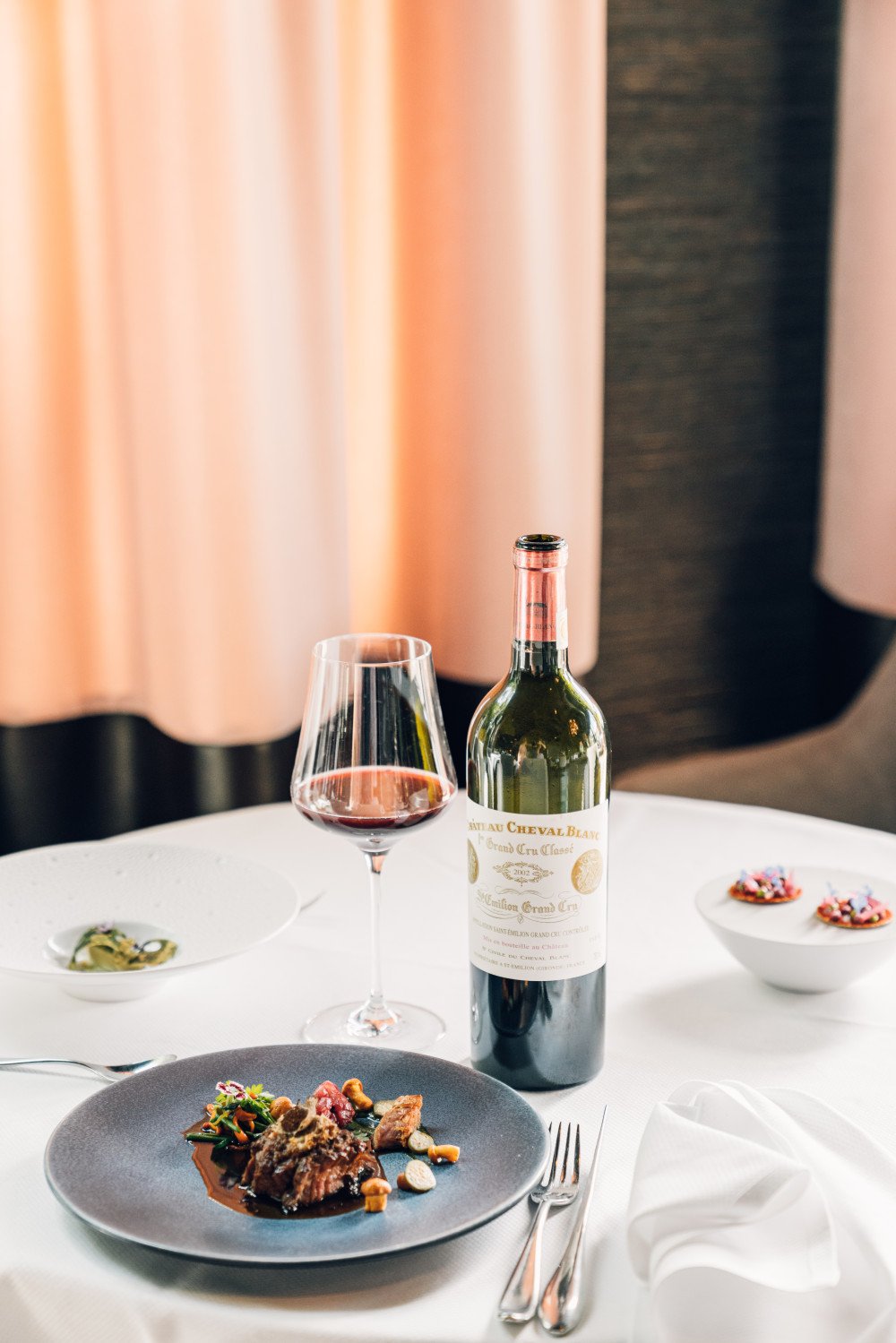
Most of Saint-Émilion is planted with Merlot. This is not the case for Château Cheval Blanc, and this fact alone says a lot about this wine. Cabernet Franc accounts for the majority of the vineyards here; in this area, located on the edge of the commune, right up against Pomerol, clay and gravel are distributed in roughly equal proportions. Ever since Saint-Emilion wine was first classified in 1954, it has maintained its Premier Grand Cru Classé A status.From the 2022 vintage the label carries only the Saint-Émilion Grand Cru appellation
This winery manages its vineyards by plot, ferments each plot separately, and only blends the wines at the very final stage. The style of this winery, which has been in the same location in Saint-Emilion for 200 years, has remained virtually unchanged. It prioritizes terroir above all else and does not follow trends.
History: a slice of Figeac that went its own way
This story begins in 1832, when the Ducasse family purchased land from Château Figeac, then a 200-hectare estate. Countess Félicité de Carle-Trajet, who was the owner of Figeac at the time, sold a portion of her property, and this sale led to the creation of numerous new Saint-Emilion estates. This is precisely why many of the neighbors' names still include Figeac.
The owners of this particular plot took a different path. Before the name change, the area was known as Le Barrail de Cailloux, meaning stony ground, and the new name symbolized a deliberate break from Figeac.
In 1852, Mlle Ducasse married Jean Laussac-Fourcaud and brought a vineyard as her dowry, which included two of the five gravelly hills that straddled the vineyards of Cheval Blanc and Figeac. It was a pretty good wedding gift. The Laussac-Fourcaud family built the château, which still stands today, and continued to purchase land, eventually expanding their holdings to 41 hectares by 1871.
Recognition came early. Château Cheval Blanc won a medal at the Universal Exhibition held in London in 1862, a fact that is still printed on the label today.
Ownership currently rests with Bernard Arnault of LVMH and Baron Albert Frère.
The vineyards
This estate spans 42 hectares and is divided into 56 plots; according to the vineyard's own tally, a total of 244,989 grapevines are planted there. Château Cheval Blanc knows in almost obsessive detail which vines are planted in each section.
Each plot is classified based on age, area, soil composition, rootstock, and grape variety. Let's take Plot 11A as an example. This plot is called Les 2 journaux des Argiles: Cabernet Franc; it was planted in 1952, and its actual cultivated area is slightly less than 1.9 hectares. This level of record-keeping is maintained across the entire estate.
Grand Vin uses grapes from 55 plots totaling 39.5 hectares. The varying sizes of the plots are due to the diversity of the soil, not because someone drew neat rectangles.
Farming methods have also changed. Château Cheval Blanc has transitioned to agroecology, clearly stating that this marks a break from traditional viticulture practices. In the summer, once the mid-season hoeing is complete, soil management ceases, and the vines are left to allow the grass to absorb water instead. When the grapes become delicate, movement through the vineyard is also restricted.
The terroir
Château Cheval Blanc belongs to the Saint-Emilion commune, but only just. This is because the boundary of Pomerol runs along the edge of this area. Some of the vineyards in Saint-Emilion have fine gravel. Other vineyards located in Saint-Emilion or Pomerol have very high-quality clay. Here, the two soil types occur in nearly equal proportions; vineyard owners explain that this is the result of pure historical coincidence rather than any grand design.
This mosaic-like soil structure ranges from finely textured clay to coarser gravel, with sand mixed in between. The clay-rich vineyard yields velvety-smooth tannins, while the gravelly vineyard produces a more aromatic and elegant flavor profile. Blending these two allows you to experience both intensity and delicacy in a single glass, and that is the essence of it all.
Nothing is left to chance. Throughout the growing season, soil temperature, water supply, and the vines' mineral nutrition are all meticulously tracked. During ripening, phenolic levels are measured daily, and small-scale winemaking experiments are conducted regularly to test soil and varietal combinations. Every possible combination of this winery's soils and its three main red grape varieties has already been tried at some point.
Cabernet Franc, and not by a small margin
On the Right Bank of Bordeaux, this planting combination is unusual. Château Cheval Blanc centers on varieties that are typically used by neighbouring estates in supporting roles.
- Cabernet Franc, 55%
- Merlot, 40%
- Cabernet Sauvignon, 5%
A small amount of Malbec also appears on this vineyard's varietal map. Furthermore, this vineyard is not exclusively dedicated to red wine production. Sauvignon Blanc and Sémillon are also grown for white wine production.
Rather than being distributed evenly, the varieties are blended to suit the soil, so the balance of the final blend varies depending on the characteristics of each vintage.
Winemaking
Cheval Blanc's winery was designed by architect Christian de Portzamparc and opened in June 2011. A wild herb garden adorns the two white, undulating concrete structures that rise from the ground, while an artificial slope curves around the rear of the château.
Inside, 67 concrete fermentation tanks are arranged in six rows, bathed in natural light. These tanks come in 14 different sizes, ranging from 12 to 113 hectoliters, and were custom-built exclusively for this winery. Each year, a single vineyard plot is assigned to each fermentation tank. Two nameplates affixed to the sides indicate the tank number and capacity on one side, and the vineyard number, grape variety, and planting date on the other.
The reason is simple: by vinifying each plot separately, the unique characteristics of every wine produced from that plot are fully reflected in the final blend, ensuring they are not lost when mixed with other wines.
The building itself has gained a reputation that extends beyond the wine industry. It was the first in its sector to obtain HQE (High Environmental Quality) certification, which covers construction materials, energy use, water management, recycling, and internal working conditions. In 2013, November received the International Architecture Award, established by the Chicago Athenaeum, Museum of Architecture and Design together with the European Centre for Architecture Art Design and Urban Studies, a first in history for a winery.
The wines
Château Cheval Blanc's stated goal is to capture the essence of a place in a single glass of wine. In other words, even as trends change, the winery maintains a consistent style and sense of place while crafting wines that faithfully reflect the terroir and the climate of each vintage.
There are four wines bearing this name. Château Cheval Blanc is the grand vin, a Premier Grand Cru Classé A wine produced from the vineyards described above. Le Petit Cheval is the estate's second red wine. Le Petit Cheval Blanc is a dry white wine produced from the Sauvignon Blanc and Sémillon vineyards within this estate.
Although they do not belong to the samne Cheval Blanc vineyards, there are two other vineyards that belong to the same wine family: Château Quinault L'Enclos and Cheval des Andes.
Frequently asked questions
What classification does Château Cheval Blanc hold?
Premier Grand Cru Classé A, the top rank in Saint-Emilion, held since the appellation's wines were first classified in 1954.
Who owns Château Cheval Blanc?
Bernard Arnault, through LVMH, together with Baron Albert Frère.
Why is Cabernet Franc so dominant here?
It suits the ground. The estate's mix of clay, gravel and sand is unusual for the Right Bank, and Cabernet Franc has proved the best match for it over generations of trials.
Is Le Petit Cheval the second wine?
Yes, Le Petit Cheval is the estate's second red. There is also a white under the Le Petit Cheval Blanc name, made from Sauvignon Blanc and Sémillon.
Regions