| ex Vat | € 595,00 |
| in Vat | € 719,95 |
| Volume | Magnum |
| Classification | Cru Classe |
| Type | Red |
| Producer | Tenuta San Guido |
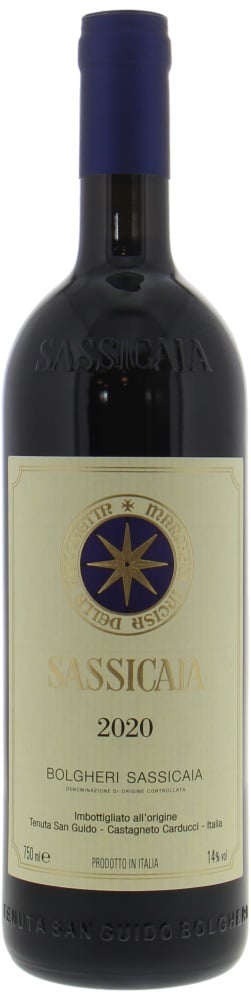
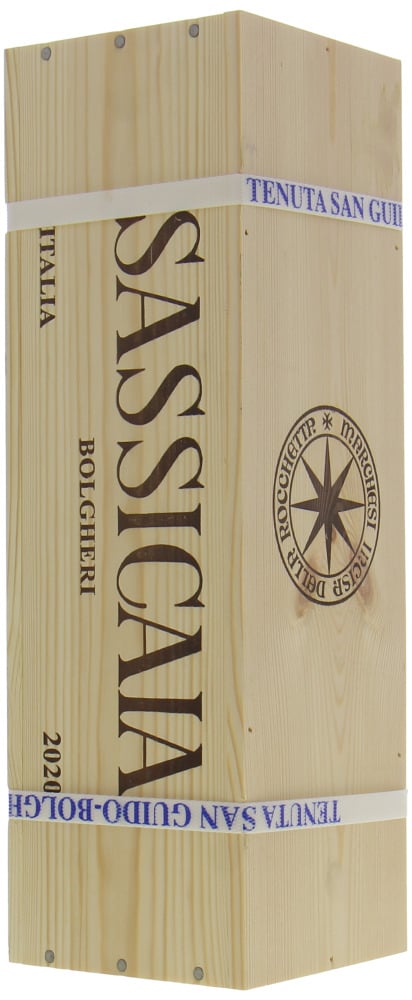
| Wine | Sassicaia |
| Vintage | 2020 |
| Country | Italy |
| Region | Tuscany |
| Appellation | Bolgheri |
| Grape | Cabernet Sauvignon, Cabernet Franc |
| Volume | 0,75 |
| Condition | Perfect |
| Label | Perfect |
| Drinkable | 2025-2050 |
| Stock | 6 |
| Volume | 1,5 |
| Condition | Perfect |
| Label | Perfect |
| Stock | 0 |
The 2020 growing season on the Tuscan coast brought what Bolgheri sorely needed: stable warmth without temperature swings. For Tenuta San Guido's Sassicaia, this means longer aging time and more concentrated flavors. Harvested later than usual, September brought ideal conditions for Cabernet Sauvignon and Cabernet Franc. And the blend reflects that patience: 85% Cabernet Sauvignon and 15% Cabernet Franc. This vintage shows Sassicaia's characteristic elegance, but with more accessible tannins than the powerful 2019 wine. Best of Wines considers it one of the most elegant recent releases.
The Tenuta San Guido 2020 Bolgheri Sassicaia speaks to those who seek a more voluptuous, opulent and, ultimately, more accessible wine. This vintage is a precise reflection of Coastal Tuscany, as opposed to a more generic "Tuscan" wine from elsewhere in this large central Italian region. You taste the ripeness and soft fruit weight that comes from a coastal appellation with especially bright luminosity and warm Mediterranean offshore breezes. Sassicaia from the cool vintages is a famously reticent or withholding wine in its earliest years, requiring a long lead time before it eases into an ideal drinking window. That's definitely not the case here. This wine is beautiful and compelling straight out of the gate, showing a lovely mix of dark fruit, oak spice, balanced freshness, textural richness, soft tannins and an expertly contained 14% alcohol content. The wine's immediate character is what distinguishes this vintage, and I wouldn't get too fussed by exaggerated cellar-aging ambitions. The wine awards sheer pleasure in its current form, with dazzling primary fruit and soaring intensity over the near and medium term.
A very perfumed Sassicaia on the nose with forest floor, citrus and deep dark fruits. Blackcurrants. Cedar and black tea. Some balsamic. Pine needles. Full and very succulent. Really long, structured and complete. Tangy and energetic with a linear line of fresh tannins and acidity. Very Sassicaia throughout. 85% cabernet sauvignon and the rest is cabernet franc. Very attractive now in a youthful and vibrant way, but this will be better in three to four years. Try after 2027.
Mid crimson; easy to see the bottom of the glass. Intense nose with a hint of iodine. Great tanginess that seems more Tuscan than bordelais. Long and really builds towards its ample finish. Bone dry. Embryonic but convincing that a fine future lies ahead. Subtle rather than flashy. I wouldn't guess it was as much as 14%. I aerated it and gave it an hour in a young-wine decanter, and it was already a delight to drink. With more immediate appeal than many earlier vintages.
The 2020 Sassicaia is a bold, rapturous wine. Dark, fleshy and expansive on the palate, the 2020 offers up scents of blackberry jam, gravel, spice, new leather, licorice and crème de cassis. Potent tannins are nearly buried by the sheer intensity of the fruit. Sassicaia is never a huge wine, the 2020 does seem to have an extra dimension of textural intensity. It's an intensity that is hugely appealing.
Estate Manager Carlo Paoli describes 2020 as a year with a long, rainy winter and a cold spring. "Temperatures warmed up in the middle of June," he explained. "July was very hot, but heat moderated in August. Even so, it was a year in which ripeness moved quickly, as opposed to 2021 when ripeness was more gradual. We picked the entire estate in 22 days instead of the 29-30 that is more typical." The 2020 spent 15-18 days on the skins, followed by 25 months in French oak, 50% new. Production is down about 30% because of selection in the vineyard.
Frosts damaged the the earlier-developing Cabernet Franc in late March, leading to reduced production but superb quality fruit. Spring was mild and summer was generally warm, but a rapid acceleration of maturation in late summer forced the team to begin picking in the first week of September to avoid any overripeness. A traditional 85% Cabernet Sauvignon and 15% Cabernet Franc blend, its blackcurranty, dusty, leafy and cedary character is brought into focus by an intense and balsamic palate. It's poised and light on its feet with super-fresh acidity and a fine-grained, almost imperceptible tannic structure. Ripe and tangy raspberry and blueberry fruits linger on the mid-palate, leading to a long, fresh finish with some cream and chocolate notes. This will reward cellaring into the 2050s, yet you'll get plenty of pleasure from it in its youth. 'We advise to keep it at least 10 months in the bottle before opening,' states third-generation Priscilla Incisa della Rocchetta.
Blackcurrant is dense and concentrated at first, followed by classic Bolgheri character of graphite and cedar. Cabernet Sauvignon dominates the flavor, but herbal notes of Cabernet Franc emerge on the finish. On the palate, the tannins are firm but refined, coating rather than gripping. Minerality is reminiscent of gravelly soils near the Tyrrhenian coast. The structure suggests aging for 20 years, but with proper decanting it can be enjoyed now.
The blend is common for Sassicaia:
Cabernet Sauvignon provides a backbone, dark black currant flavors and structured tannins that age beautifully. But why add Cabernet Franc? The 15% Cabernet Franc gives flavor lift and soft texture. In the coastal climate of Bolgheri, Franc matures beautifully with Cabernet Sauvignon, bringing violet notes and helping to balance the intensity of the Cabernet Sauvignon. The combination works well because both varieties grow on gravelly, well-drained soils near the Tyrrhenian Sea.
Best time to drink is from 2028 to 2045. It needs 8 years for the firm tannins to soften properly., and the Cabernet Sauvignon component will be the foundation for decades of development. stored ideally between 12-14°C, in the dark. With time, expect the primary fruit flavors to give way to leather, truffle, and forest floor nuances, while retaining the core of concentrated black fruit that makes Sassicaia a legendary wine.
Tenuta San Guido changed Italian wine with the release of its first commercial variety, Sassicaia, in 1968. Marchese Mario Incisa della Rocchetta had been experimenting with Bordeaux varieties since the 1940s, revolutionizing the region's obsession with Sangiovese. His nephew, Piero Antinori, convinced him to release the wine on the commercial market. The result? A new category called "Super Tuscan." Today, under the direction of winemaker Graziana Grassini, the 2,500-hectare estate produces about 180,000 bottles a year. Best of Wines considers Sassicaia the benchmark for Italian Cabernet Sauvignon.
Sassicaia's 90 hectares are located between 45 and 60 meters above sea level in Bolgheri, where clay-limestone soils mixed with galestro (loose marl) and alberese (limestone) create perfect drainage. The Tyrrhenian Sea, just a few kilometers away, moderates the temperature: there are hot days and cool nights. Why does it matter? Cabernet Sauvignon needs heat to fully ripen, but the sea breeze prevents overripening and preserves acidity. Gravelly sediments provide deep rooting and flavor concentration. This terroir received its own DOC, Bolgheri Sassicaia DOC, in 1994.
Fermentation takes place in temperature-controlled stainless steel tanks for two weeks, followed by malolactic fermentation in barriques (small French oak barrels). Then the all-important aging begins: 24 months in French oak, with about 33% from new oak. Why are only a third of the barrels new? Because Sassicaia's philosophy is to enhance, not mask, the fruity flavors. The relatively low percentage of new oak enhances the expression of Cabernet Sauvignon varietal character and terroir. After barrel aging, the wine is released after another six months of bottle aging.
In order for the tannin structure of a wine to show its best behavior, fats and proteins are needed. These are excellent options:
Serve at 18°C and decant 90 minutes before dinner. This vintage is influenced by coastal waters, so the wines open up relatively early compared to inland Tuscany.
With track & trace code