| Classification | Cru Classe |
| Type | Red |
| Producer | Tenuta San Guido |
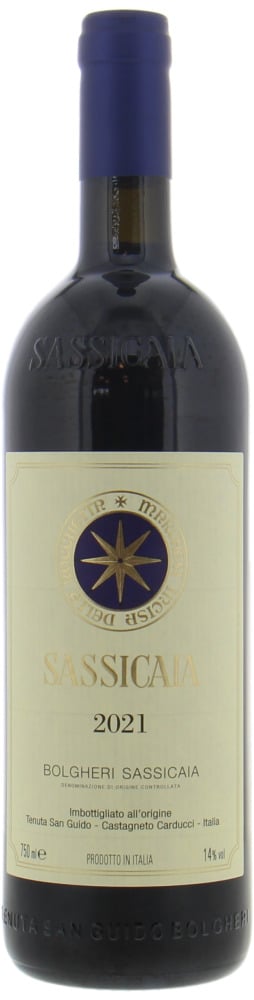
| Wine | Sassicaia |
| Vintage | 2021 |
| Country | Italy |
| Region | Tuscany |
| Appellation | Bolgheri |
| Grape | Cabernet Sauvignon, Cabernet Franc |
| Volume | 0,75 |
| Condition | Perfect |
| Label | Perfect |
| Drinkable | 2028-2060 |
| Stock | 4 |
The 2021 growing season in Bolgheri got off to an unusual start: a hot and stable summer replaced a dry spring. For Sassicaia 2021 in Tenuta San Guido, these ideal conditions meant perfectly ripe Cabernet Sauvignon and Cabernet Franc harvested in optimal conditions. As a result, Sassicaia expresses both power and elegance, with Robert Parker giving it 100 points and Wine Spectator giving it 98 points. This vintage reflects everything that makes Bolgheri special. Oceanic influences, well-drained soils, and meticulous winemaking have produced wines that are already beautiful and ready to drink, but will reward decades of cellaring.
Here it is: A quintessential Sassicaia that represents the excellence of the vintage and also respects the unique taste profile of this distinguished Tuscan blend of Cabernets Sauvignon and Franc. The Tenuta San Guido 2021 Bolgheri Sassicaia offers impeccable balance, excellent freshness and absolutely no signs of over-ripeness. The fruit balance is ideal with a hint of crunch and lasting tension from pulp and skins. The tannins are deftly managed with firm grip and enough velvetiness to add volume and length. There is no greenness on the bouquet that instead offers mulled herbs and spice, with cinnamon and clove, layered delicately between mostly red and some purple berry fruits. Redcurrant, blueberry, sweet pomegranate and Rainier cherry run strong in this vintage. A fragrant hint of heritage rose emerges with time. The oak tones are geared toward gingerbread, hazelnut, cigar, sandalwood and something like a grilled sweet red pepper. To the palate, it offers nice weight with no heavy glycerin, and a rinse of acidity that adds to the wine’s natural energy, brightness and viscosity. That marked freshness opens the wine up to long aging potential, but you still need to give it more time in bottle.
Rich yet elegant, laced with black cherry, blackberry, cedar, mineral and oak spice aromas and flavors, this resonant red builds to a long, detailed aftertaste. Shows great balance, with vibrant acidity and refined tannins, yet this should benefit from a few more years of aging. Cabernet Sauvignon and Cabernet Franc.
85% Cabernet Sauvignon, 15% Cabernet Franc. Aged for 25 months in 225-litre barriques.
Mid to dark crimson but no attempt to break any records for colour intensity. Much subtler nose than most – no obvious sweetness and certainly no oak. Savoury and saline and introvert. All tucked in for a long life. Bone-dry finish. So different from Ornellaia! Neat, confident and non showy. But so well balanced and appetising that I swallowed it! (JR)
The 2021 Sassicaia is one of the best young Sassicaias I can remember tasting, certainly on par with anything in recent memory. The preference here is picking on the earlier side relative to many neighboring properties, which is one of the reasons Sassicaia is always a wine of refinement more than opulence. At the same time, Sassicaia can be light. Not in 2021. All the elements came together during a long growing season to produce a rich, deep wine that marries textural intensity with classicism. Dark cherry/plum fruit, spice, new leather, menthol, licorice and spice all race across the palate. Time in the glass brings out the wine's textural intensity and sheer power. The 2021 is one of the most concentrated Sassicaias on record. That allowed for long macerations, as long as 20 days for some Cabernets. Aging was 25 months in French oak barrels (95% French, 5% a mix of Hungarian and Slavonian wood), 40% new, 40% once-used barrels and 20% in twice-used barrels. One of the recent developments here is some bâtonnage in aging, which is used to build texture. That approach worked well in 2021. In a word: magnificent.
The nose opens with intense aromas of blackcurrant and blackberry, followed by cedar, graphite, and Mediterranean herbs. On the palate, the wine shows remarkable concentration without being heavy. At the same time, refined tannins envelop a core of dark fruit and minerality. Cabernet Franc lends aromatic exuberance and freshness to the backbone of the blend. There are savory notes of olive tapenade and dried herbs reminiscent of coastal terroirs. Layers of dark chocolate and tobacco emerge beautifully on the finish. While drinkable now, this wine has enough staying power to add complexity over the next 20+ years.
The blend is common for Sassicaia:
Cabernet Sauvignon provides a backbone, dark black currant flavors and structured tannins that age beautifully. But why add Cabernet Franc? The 15% Cabernet Franc gives flavor lift and soft texture. In the coastal climate of Bolgheri, Franc matures beautifully with Cabernet Sauvignon, bringing violet notes and helping to balance the intensity of the Cabernet Sauvignon. The combination works well because both varieties grow on gravelly, well-drained soils near the Tyrrhenian Sea.
Drink now or age until 2035. With a firm tannic backbone and natural acidity, the 2021 wine has enough structure to age for 15+ years. Tannins that are firm but refined now will soften and integrate over time. Always store at cool temperatures. As it ages, expect the primary fruit flavors to evolve into a more complex tertiary aroma: leather, truffle, and cedar will become more prominent, and the wine will take on a silky texture.
Tenuta San Guido changed Italian wine with the release of its first commercial variety, Sassicaia, in 1968. Marchese Mario Incisa della Rocchetta had been experimenting with Bordeaux varieties since the 1940s, revolutionizing the region's obsession with Sangiovese. His nephew, Piero Antinori, convinced him to release the wine on the commercial market. The result? A new category called "Super Tuscan." Today, under the direction of winemaker Graziana Grassini, the 2,500-hectare estate produces about 180,000 bottles a year. Best of Wines considers Sassicaia the benchmark for Italian Cabernet Sauvignon.
Sassicaia's 90 hectares are located between 45 and 60 meters above sea level in Bolgheri, where clay-limestone soils mixed with galestro (loose marl) and alberese (limestone) create perfect drainage. The Tyrrhenian Sea, just a few kilometers away, moderates the temperature: there are hot days and cool nights. Why does it matter? Cabernet Sauvignon needs heat to fully ripen, but the sea breeze prevents overripening and preserves acidity. Gravelly sediments provide deep rooting and flavor concentration. This terroir received its own DOC, Bolgheri Sassicaia DOC, in 1994.
Fermentation takes place in temperature-controlled stainless steel tanks for two weeks, followed by malolactic fermentation in barriques (small French oak barrels). Then the all-important aging begins: 24 months in French oak, with about 33% from new oak. Why are only a third of the barrels new? Because Sassicaia's philosophy is to enhance, not mask, the fruity flavors. The relatively low percentage of new oak enhances the expression of Cabernet Sauvignon varietal character and terroir. After barrel aging, the wine is released after another six months of bottle aging.
In order for the tannin structure of a wine to show its best behavior, fats and proteins are needed. These are excellent options:
Serve at 18°C and decant 90 minutes before dinner. This vintage is influenced by coastal waters, so the wines open up relatively early compared to inland Tuscany.
With track & trace code