
Sassicaia
Sassicaia revolutionised the Italian wine world: when its first vintage, the 1968, was released, no one believed it was possible to produce great wine from Bordeaux grape varieties in Tuscany. Yet, in 1978, at a blind tasting organised by Decanter magazine, this ‘table wine’ actually outperformed Château Latour.
Marquis Mario Incisa della Rocchetta planted Cabernet Sauvignon and Cabernet Franc. The location at the Tyrrhenian coast seemed showed that this vision was truly unique. Sassicaia, from Bolgheri’s Tenuta San Guido, has become the benchmark for what are now known as ‘Super Tuscans’. By 1994, Sassicaia had become Italy’s only DOC appellation owned by a single estate.
To this day, Sassicaia remains the benchmark for Tuscan Cabernet blends, not only consistently receiving scores of around 95 points or better from the most influential critics, but also maintaining its exceptional quality over the decades.
History & Heritage
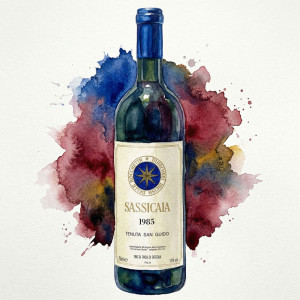
The irony of Sassicaia’s fate is nothing short of perfect. This first Italian ‘Super Tuscan’ wine was in fact more or less a project on a personal basis. Mario Incisa della Rocchetta visited Bordeaux and when returning back in 1944 he planted Cabernet Sauvignon. The gravelly soil of Bolgheri reminded him of the Bordeaux vineyards. For over twenty years, the wine he produced was intended solely for his own consumption.
In 1968, his nephew Piero Antinori persuaded him to bring the wine to market, but as the proportion of Sangiovese did not meet the legal requirements, Italian law forced him to label it simply as ‘table wine’ (Vino da Tavola). In 1978, when Sassicaia triumphed by a landslide at the famous blind tasting organised by Decanter magazine, the absurdity of the situation became glaringly apparent: this ‘table wine’ was, in fact, superior to the finest Bordeaux wines.
This achievement gave rise to the new category of ‘Super Tuscan’ and ultimately led to a revision of Italian wine regulations: in 1994, Sassicaia became the first and only Italian wine to be awarded DOC classification.
About Tenuta San Guido
Tenuta San Guido is situated in the Maremma, adjacent to the Tyrrhenian Sea, yet the origins of its history are entirely due to the tenacity of one man. Mario Incisa della Rocchetta was convinced that Bordeaux grape varieties could take root on the Tuscan coast, despite the prevailing local belief that only Sangiovese was suitable for the region. He planted the first Cabernet Sauvignon vines in 1944 and kept this wine in his private cellar for 20 years, only beginning to sell it in 1968.
The estate owns 2,500 hectares. Only 4% (100 hectares) is dedicated to viticulture. Following Mario’s passing, the family continued his vision whilst introducing modern techniques into the winemaking process. The estate produces ‘Guidalberto’ as its second label and ‘Le Difese’ as its third wine, but ‘Sassicaia’ remains its flagship. According to Best of Wines, this estate is indispensable to understanding the evolution of modern Italian wine.
Winemaking
Fermentation takes place in temperature-controlled stainless steel tanks for two weeks; whilst this may sound unremarkable, it is precisely the essence of the process. The wine is aged in French oak barrels (25% new) for 24 months. This restrained approach is of paramount importance. An excess of new oak would mask the mineral precision that gives Sassicaia its unique character. The estate uses 225-litre Bordeaux-style barrels; larger vessels are never employed. Before release, the wine undergoes a further six months of bottle ageing to allow it time to fully integrate. The reason is not for adding extra colour or tannins, but to ensure precision.
Tasting Notes
Pure blackcurrant and graphite, but with almost mineral precision, from the soils of galestro in Bolgheri. Cabernet Sauvignon (on average 85% of the blend) gives this wine classic black currant depth, while on average 15% Cabernet Franc adds the violet nuances and exuberance that distinguish Sassicaia from pure (for example Napa) Cabernet Sauvignon. On the palate, the tannins are serious but refined, and although the wine is aged for 24 months in French oak, the oak is integrated rather than flashy. The aroma shows notes of cedar, pencil sharpening and Mediterranean herbs. The finish is long, with notes of dark chocolate.
Food Pairing
The tannin structure requires protein and fat to soften. Think Tuscan classics first:
- Bistecca alla Fiorentina, simply cooked meat with a bone.
- Wild boar ragout with pappardelle
- Pecorino Toscano, aged for at least 12 months.
- Osso buco with red wine
But why does it work so well? The acidity of the wine breaks down the rich marrow and fat, while the subtle tannins need protein: serve at 16-18°C and decant for at least an hour if drinking young. A mineral base also works well with mature hard cheeses.
Serving Suggestions
Temperature is more important than most people think. Serve the wine at around 18°C, which is lower than normal room temperature. If the temperature is too high, alcohol will predominate; if too low, aromas will be lost.
Decant young wines for at least 2+ hours. Exposure to oxygen changes the wine and reveals layers hidden in the bottle. Older wines (older than 15 years) require more gentle treatment, and 1 hour of decanting is usually sufficient.
Use a large glass if available. Wines benefit from exposure to air, especially Sassicaia. Wines from recent vintages should be opened one hour before decanting.
Vintages
At Sassicaia, due to Bolgheri’s coastal location, the differences between vintages are more pronounced than in most Tuscan wines: warmer vintages, such as 2019 and 2022, produce wines with a more intense body and more mature tannins. In cooler vintages, the wines display greater structure and minerality, often becoming the most memorable, although they require a longer ageing period.
The 2018 vintage showcases Sassicaia’s classic characteristics, perfectly blending power and elegance, with a structure that suggests ageing potential of over 20 years; the 2020 vintage, meanwhile, offers greater appeal for immediate drinking whilst retaining the necessary foundations for long-term development; as for the 2018 vintage, the wine is more concentrated, with more pronounced tannins and minerality, but requires extended ageing in the cellar.
If you wish to enjoy the wine immediately, we recommend selecting vintages from the mid-2010s, as these have fully developed their secondary aromas. For extended ageing, opt for vintages with a more pronounced structure.
The best vintages of Sassicaia
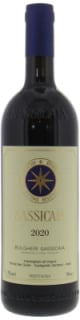
The level and quality of this wine is very high, regardless of vintage, However, some exceptional vintages are: 1985, 1990, 1997, 2001, 2009, 2010, 2013, 2016, 2018, 2020, 2021, 2023.

Cellaring Potential
This wine is made for long-term cellaring. The structure of the Cabernet Sauvignon, the mineral terroir of Bolgheri, and careful barrel aging combine to produce a wine that will improve over 20 to 30 years. Young wines show plenty of primary fruit flavors, but benefit from 5 to 8 years of aging to allow time for the tannins to integrate.
The legendary 1985 wine is now over 40 years old and still drinking beautifully. The wine's longevity is due to Bolgheri's unique ability to produce Cabernet with natural acidity and tannins, as well as power and elegance.
Store in a dark place at 12-14°C (54-57°F). Also, do not open young bottles too soon. This is one of those wines where patience pays off.
FAQ
Is Sassicaia classified as Chianti?
No, it is the Bolgheri Sassicaia DOC, a unique classification created in 1994.
How long does Sassicaia age?
The best vintages are aged for 20 to 30 years. In other vintages, it will reach its peak after 10 to 15 years of proper aging.
Why is Sassicaia more expensive than other Tuscan wines?
Limited production (about 130,000 bottles per year), consistent critical acclaim, and proven aging potential create strong collector demand.
How does Sassicaia differ from other Super Tuscan wines?
It was first made as a prototype wine in 1968. It also has its own DOC rating, the only single estate DOC rating in Italy.
