| ex Vat | € 209,00 |
| in Vat | € 252,89 |
| Volume | 0,75l |
| Classification | Cru Classe |
| Type | Red |
| Producer | Gaja |
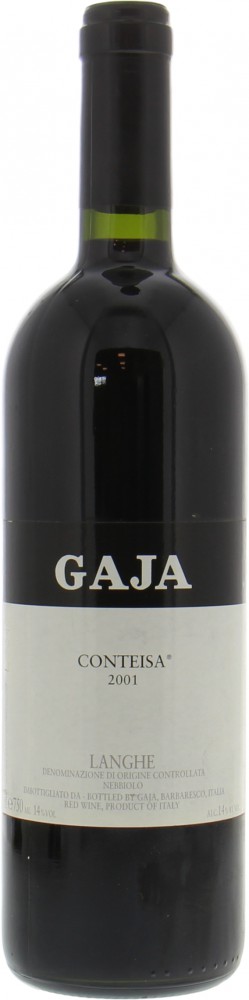
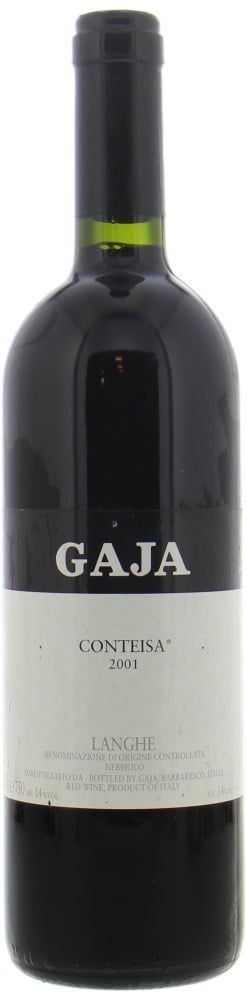
| Wine | Conteisa |
| Vintage | 2001 |
| Country | Italy |
| Region | Piemonte |
| Grape | Nebbiolo |
| Volume | 0,75 |
| Condition | Perfect |
| Label | Perfect |
| Stock | 0 |
| Volume | 0,75 |
| Condition | Perfect |
| Label | Slightly bin soiled |
| Stock | 1 |
The 2001 harvest in Piedmont was cool and late. It was truly a Nebbiolo producer's dream season. Long ripening time, high acidity, and deep concentration. For Guy's Contesa grape, grown in the Selecchio parcel in La Morra, this meant that the wines were truly dense without losing the perfumed exuberance that characterizes this aspect of Barolo. Expect a more structured, slowly evolving Contesa than the warmer 2000s and 2003s.
The 2001 Conteisa has aged beautifully. The fruit remains fresh, vibrant and beautifully delineated from start to finish. Ripe red berries, flowers, mint and licorice are all woven together in this deeply expressive, sumptuous Conteisa. The 2001 boasts fabulous density to match the layered, polished finish.
Plum, berry and dried flowers follow through to a full-bodied palate, with fine tannins and a long, caressing finish. Lovely. This is subtle and refined with wonderful balance.
Good deep red-ruby. Rather reticent aromas of plum, violet pastille and minerals, with hints of superripe fruits. Sweet on entry, then less fat and full than the Sperss; sharply delineated but dominated today by its spine. Finishes very bright and vibrant, though. I'd normally expect a Serralunga wine like Sperss to be more backward than this one from La Morra, but today it's the Sperss that's more expressive.
Elegantly perfumed, with touches of cinnamon, ground pepper, and dusty earth accenting notes of black cherries and chocolate. On the palate, there's powerful plum and black cherry flavors, but also a strong minerality that adds an extra dimension to this compelling wine. Soft enough to begin drinking around 2010, it should keep for a couple of decades after that.

Pour a glass of 2001 Contesa and the first thing you will notice is the aromas. Rose petals, dried cherries, tar and balsamic notes. The flavors are classic La Morra. Red fruit, lifted by acidity, and clinging but not tiring tannins. A small component of Barbera (about 8% in this age) gives the palate a juicy center. The finish is long and savory, with truffle and leather flavors. Drinkable now, but not rushed.
The 2001 Conteisa is predominantly Nebbiolo with about 8% Barbera. So why Barbera, which is why until 2013 this wine was bottled as Langhe Nebbiolo DOC rather than Barolo DOCG? Angelo Gaja added Barbera for fruit and acidity, softening the intensity of the Nebbiolo. The result is a Selecchio that is mellower than its single varietal neighbors.
The 2001 wines are in good condition to drink through 2030, and their structure allows for further development. The acidity is still bright, the tannins are subdued but present, and the wine should be stored horizontally at 12-14°C, away from light. Decant one hour before serving to bring out the third aroma.
If you ask any wine merchant which Italian estate shaped the modern era of Piedmont, Gaja would be at the top of the list. Why: Angelo Gaja, who joined the family business in 1961, brought international relevance to Barolo and Barbaresco through single vineyard bottling, French oak, and meticulous vineyard work. The history of the estate dates back to 1859, but it was Angelo who made it famous. Today, his children Gaia, Rossana, and Giovanni run the day-to-day operations. Best of Wine considers Gaia an essential part of an authentic Piedmontese cellar.
Contesa means "to challenge" in Piedmontese, and the winemaking lives up to its name. Cru Cerequio is located on the border of the communes of La Morra and Barolo, which were historically disputed by both. The soil is Tortona calcareous marl, gray-blue in color and younger than that found in Serralunga. The Tortona marl produces a more aromatic, flavorful, and less brooding Barolo. Altitude 300-400 m, south facing, cool nights until September. Typical conditions for late ripening Nebbiolo.
Gaggi's approach to making Conteisa is divided between modernist and traditional. Aging in French barriques (small 225 liter barrels) for about a year refines the wine, followed by two years in large Slavonian oak barrels to allow the wine to breathe and become integrated. The aging in barriques gives the wine structure, but is not dominant. During the botrytis stage, the aromas of Nebbiolo take shape. The result? A wine with grip and length, but no wood flavors. This is the balance that Gaya has been perfecting since the 1970s.
Nebbiolo's tannins and acidity need fat and umami. Pair with:
Serve at 16-18°C. young 2019 wines should be decanted for at least 1 hour.
With track & trace code