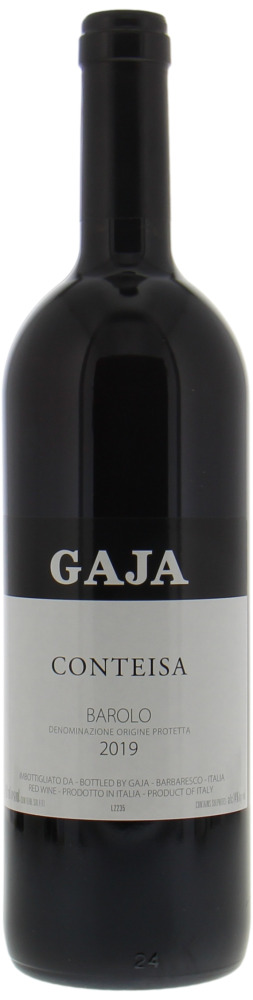

| Classification | Cru Classe |
| Type | Red |
| Producer | Gaja |
| Wine | Conteisa |
| Vintage | 2019 |
| Country | Italy |
| Region | Piemonte |
| Grape | Nebbiolo |
| Volume | 0,75 |
| Condition | Perfect |
| Label | Perfect |
| Drinkable | 2026-2038 |
| Stock | 2 |
The 2019 Barolo growing season was what many call a "challenging" for producers. A balanced spring, a warm but not scorching summer, cool nights through September, and a long, dry harvest season. For Gaja's Conteisa, grown in the Selecchio region between La Morra and Barolo, this led to Nebbiolo with the right tannic backbone and bright acidity. in 2019, expect the backbone and flavorful wines that La Morra is known for.
A powerful and tannic wine with mushroom, forest flower, bark, and black tea aromas and flavors. Full and chewy. 94
La Morra. Cerequio. Aged for 18 months in French oak barriques and tonneaux, with a tiny percentage of new oak, followed by 18 months in large Slavonian oak casks.
Just mid ruby. Brooding and still quite subdued on the nose, with savoury, spicy, salty touches. Very elegant but tightly stitched palate. Fresh acidity that is almost a little racy and with bags of coating tannins that become more upfront on the finish and that need more time. Long and focused, but still backward. (WS)
First impression: rose petals and dried strawberries, then something darker, tar, hints of leather, and a faint whiff of wood smoke. On the palate, the 2019 shows its brilliance. The tannins are present but refined, and the acidity is bright enough to keep things in check. There is a savory, almost balsamic nuance in the center of the palette, suggesting that this wine is in no hurry to go anywhere. Can you drink it now if you let it air out? Absolutely. But Conteisa 2019 will take time.
Since its return to Barolo DOCG with the 2013 vintage, Contaisa 2019 is 100% Nebbiolo. So why is this important? Nebbiolo is the only grape that truly conveys the calcareous marl of Selecchio. It brings rose, resin, high acidity, and tannins that take years to settle. No other grape variety but Nebbiolo can do this job.
Drink from 2027 to 2045; the tannins and acidity of the 2019 are worthy of patience and it would be a shame to open it earlier than 2027; store horizontally at a stable temperature of 12-14°C, away from light. Expect truffles, dried cherries and softer textures as it ages.
If you ask any wine merchant which Italian estate shaped the modern era of Piedmont, Gaja would be at the top of the list. Why: Angelo Gaja, who joined the family business in 1961, brought international relevance to Barolo and Barbaresco through single vineyard bottling, French oak, and meticulous vineyard work. The history of the estate dates back to 1859, but it was Angelo who made it famous. Today, his children Gaia, Rossana, and Giovanni run the day-to-day operations. Best of Wine considers Gaia an essential part of an authentic Piedmontese cellar.
Contesa means "to challenge" in Piedmontese, and the winemaking lives up to its name. Cru Cerequio is located on the border of the communes of La Morra and Barolo, which were historically disputed by both. The soil is Tortona calcareous marl, gray-blue in color and younger than that found in Serralunga. The Tortona marl produces a more aromatic, flavorful, and less brooding Barolo. Altitude 300-400 m, south facing, cool nights until September. Typical conditions for late ripening Nebbiolo.
Gaggi's approach to making Conteisa is divided between modernist and traditional. Aging in French barriques (small 225 liter barrels) for about a year refines the wine, followed by two years in large Slavonian oak barrels to allow the wine to breathe and become integrated. The aging in barriques gives the wine structure, but is not dominant. During the botrytis stage, the aromas of Nebbiolo take shape. The result? A wine with grip and length, but no wood flavors. This is the balance that Gaya has been perfecting since the 1970s.
Nebbiolo's tannins and acidity need fat and umami. Pair with:
Serve at 16-18°C. young 2019 wines should be decanted for at least 1 hour.
With track & trace code