

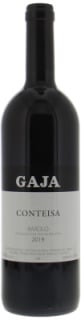
Conteisa
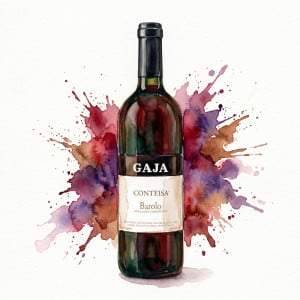
Conteisa comes from the name of one of Barolo's most famous vineyards, over which there was a dispute. The name itself means "disputed" in the Piedmontese dialect, referring to the centuries-old border dispute between the communes of La Morra and Barolo over the Cerequio hill. Gaja, known as the House of Barbaresco in Piemonte, planted its flag in the area in the mid-1990s and has been producing this wine ever since.
So what is Conteisa? It is Angelo Gaja's expression of La Morra Nebbiolo, a more aromatic, floral and less brooding wine from Serralunga than Sperss. Same producer, same grape, very different characters. That's the point of a single vineyard barolo. Place matters, and Cerequio has its own voice.
About Gaja
Ask any Italian wine merchant who modernized Piemonte and the first name that comes to mind is Gaja. The Gaja family has been bottling wine at Barbaresco since the mid-19th century, but the real shift came under Angelo Gaja, who took over the company in 1970. He was an early adopter of temperature-controlled stainless steel in the region. At a time when blending was the norm, he insisted on bottling wine from a single vineyard, and in 1978, despite his father's objections, he planted cabernet sauvignon.
Today Angelo's children, Gaia, Rossana and Giovanni, are responsible for the day-to-day management of the business. We sell Gaja wines because of their exceptional quality and they are consistently highly rated vintage after vintage. This is not as unusual as it sounds.
History & Heritage
For most of its history, Gaja has been the home of Barbaresco. Period. Its entry into Barolo came in the 1980s and 1990s when Angelo Gaja purchased vineyards in Serralunga (Marenca-Rivette, source of Sperss) and in Cerequio cru La Morra. Conteisa was born out of this second purchase.
Why is this important for wine by the glass? Because Gaja came to Barolo as an outsider with very specific ideas. It's low yields, long aging and bottling from a single vineyard. Conteisa is not a traditional La Morra Barolo. It is a Gaja wine that happens to come from La Morra. Therein lies the difference.
Terroir & Climate
Cerequio is located in the western part of the Barolo zone, which separates the communes of La Morra and Barolo, at an altitude of about 350-400 meters above sea level. The soil is calcareous marl of Tortonian age, the Sant'Agata Fossili Formation, characteristic of La Morra. And this geology says everything about the region.
Why is it important? The Tortonian marls give Nebbiolo a lighter and more flavorful character than the old Helvetian soils of Serralunga. There are more roses and red fruits and less tar and iron. The sun shines from south to southwest, so there is plenty of time for ripening, but acidity does not suffer because of the higher altitude. This is why Conteisa has a floral flavor.
Grape Varieties
Conteisa is produced from Nebbiolo. Nebbiolo is the grape that is responsible for all the great Langhe wines. Historically, Gaja blended a small amount of Barbera with it (about 8%), so for many years the wine was called Langhe Nebbiolo DOC rather than Barolo DOCG; since the 2013 vintage, Gaja has reverted to 100% Nebbiolo for its single vineyard wines. Essentially, it's a blend:
- Nebbiolo, in recent vintages, is entirely.
- Barbera, historically present but no longer.
This change is very important. It means that today Conteisa is pure Cerequio Nebbiolo and nothing more.
Winemaking
The recipe for Nebbiolo from a single vineyard is unchanged for all series. The wine is aged in barriques (225-liter French oaks) for about 12 months and then another 12 months in large Slavonian oak barrels. Why the two-stage process? Barrique gives structure and spice notes early on, when the young wine can absorb them. Botti is bigger and more neutral, allowing the wine to breathe and integrate without the oak character.
What you feel in the glass is the result: the luxury of Nebbiolo is preserved, the tannins are refined, and the oak doesn't dominate. Gaja has spent decades honing this sense of balance.
Tasting Notes
The first thing you notice is the nose. Rose, dried violets, red cherry and some orange zest. This is classic La Morra Nebbiolo, and Selecchio gives it plenty of it. There are darker notes underneath - tar, leather and notes of dried herbs - that deepen with bottle aging.
On the palate, the structure is firm but not heavy. The tannins are fine-grained, the acidity is bright (Nebbiolo always brings it), and the finish is long and flavorful, with almost iron nuances. Young vintages need air. Older vintages show what time brings: the fruit turns to compote, the tannins mellow and truffles emerge.
Food Pairing
Contesa likes dishes with heaviness and earthiness. This classic Piedmontese combination is no accident:
- Tajarine and white truffles from Alba.
- Brazato al Barolo, slow-cooked beef in red wine.
- Agnolotti del pudding with butter and sage
- Aged Castelmagno cheese or alpine hard cheese
Protein and fat are needed to soften the tannins, and Nebbiolo's high acidity will help with thick sauces. Avoid overly sweet or spicy dishes; serve at 16-18°C.
Serving Suggestions
At 16-18°C. If warmer, the alcohol will come to the fore. Decant young vintages (less than 10 years old) for at least 90 minutes. Older bottles should be decanted for less time, 30 minutes is usually sufficient. Use a large Burgundy wine bowl to enhance the flavor of the Nebbiolo. Open the bottle before guests arrive.
Vintages
Nebbiolo is sensitive to vintage, and Contesa demonstrates this: a warm, classic year such as 2019 will result in a wine with more fleshy, ripe fruit and a more approachable profile in its youth, but with structure that can withstand extended aging. The 2018 is lighter. more flavorful and ready to drink earlier. There are also mature vintages such as 2001, considered one of Barolo's great years, when truffles, leather and dried roses intertwine beautifully in the wine.
The best vintages of Gaja Conteisa
The level and quality of this wine is very high, regardless of vintage, However, some exceptional vintages are: 1997, 2009, 2010, 2015, 2019, 2020, 2021
Cellaring Potential
The latest vintages of Contesa can be drunk 8-10 years after harvest, and in good years, 25-30 years. High acidity, firm tannins, true concentration; store horizontally at a stable temperature of 12-14°C, away from light. With time, the primary fruitiness disappears and tertiary aromas (truffle, tar, leather, dried flowers) come to the fore. This is when Nebbiolo becomes interesting.
