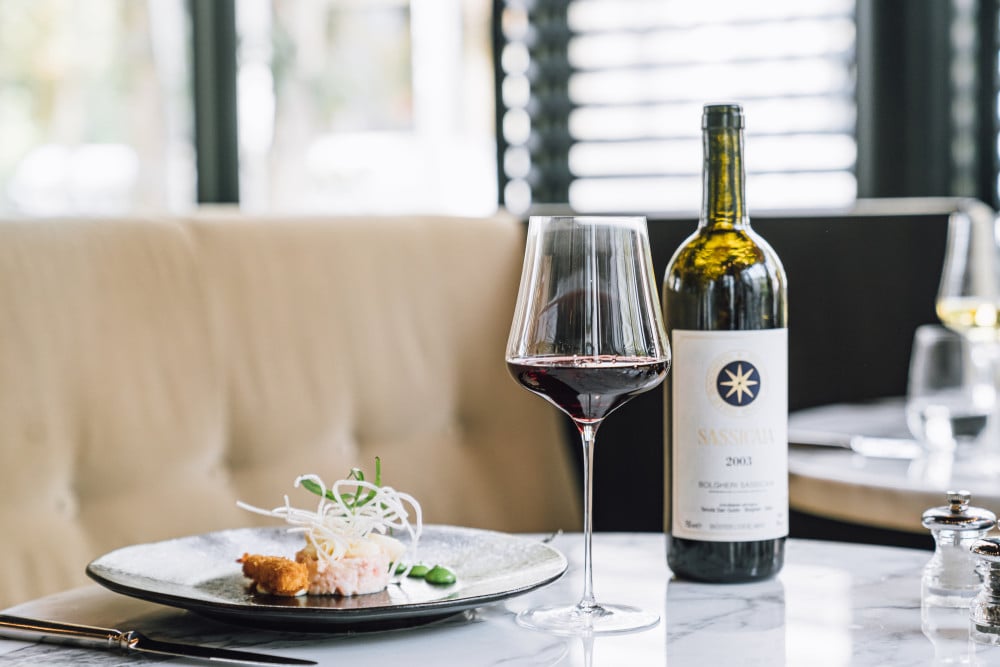

Tenuta San Guido
Tenuta San Guido is a Tuscan estate that introduced the world to Sassicaia, thereby effectively creating the entire category of ‘Super Tuscan’ wines. It is situated on the so-called Etruscan Coast in Bolgheri, in the province of Livorno, a strip of low hills sloping down to the Tyrrhenian Sea, about an hour and a half’s drive south of Florence. For decades, this part of Tuscany was considered second-rate agricultural land, unsuitable for growing serious grape varieties. One stubborn marquis decided otherwise, and ever since, the wine world has been following his lead.
History
The estate came into the family’s possession in 1930, when Mario Incisa della Rocchetta, originally from Piemonte, married Clarice della Gherardesca. Her dowry included 2,500 hectares of coastal land in Bolgheri. Mario was a fan of Bordeaux; he drank French wine at home and, whilst still a student in Pisa, had noticed that the gravelly soil of Bolgheri reminded him of the Graves region in south-western Bordeaux. In 1944, he planted just over a hectare of Cabernet Sauvignon in Castiglioncello di Bolgheri, on a slope at an altitude of around 400 metres. He named the resulting wine ‘Sassicaia’ – from a local word meaning ‘stony place’.
For more than two decades, no one outside the family had actually tasted this wine. From 1945 to 1967, the wine remained at home, served to relatives and friends and stored in the family cellar. It was Mario’s son, Nicolo, and his cousin Piero Antinori who finally persuaded him to release it for sale. The first vintage to leave the estate was the 1968, which appeared on the market in 1971. Nicolo also brought in the consultant oenologist Giacomo Tachis, who refined the wine and insisted on ageing it in 225-litre French barriques, which was almost unheard of in Italy at the time.
The turning point came at a Decanter magazine tasting in London in 1978. A panel of British critics conducted a blind tasting of 33 supposedly superb Cabernet-based wines from 11 countries. The 1972 Sassicaia, then six years old, took first place. From that moment on, the wine’s international reputation began to grow, and in 1994 the Italian wine authorities awarded it the unique designation of its own Denomination of Origin, Bolgheri Sassicaia DOC. There is no other DOC in the country that pertains to a single estate.
Vineyards and terroir
The estate’s total area remains around 2,500 hectares, but only about 100 are under vine. The vineyards are situated at three different altitudes and on varied soils, which lends the wine its complexity. The original plot in Castiglioncello is situated high up, at an altitude of around 400 metres, on cooler slopes. Further down, in the plots planted since the 1990s, there are areas with clay soil, more suited to Merlot. However, the defining feature is the gravel mixed with clay and limestone, which drains the soil perfectly and forces the vines to dig deep in search of water.
The Mediterranean climate, with sea breezes, abundant sunshine and significant temperature variations between day and night, does the rest.
Grapes and winemaking
Cabernet Sauvignon is the main variety, blended with Cabernet Franc for Sassicaia, whilst Merlot and a small amount of Sangiovese are added to the other two wines. The vines are heavily pruned to produce low yields. The grapes are harvested by hand. Fermentation takes place in temperature-controlled stainless steel tanks using indigenous yeasts, and the wines are not aged in wood for longer than necessary: before bottling,
Sassicaia spends around 24 months in French oak barriques, of which about a third are new each year.
Wines
The winery produces three wines.
The flagship wine, Sassicaia, typically consists of 85% Cabernet Sauvignon and 15% Cabernet Franc, has a complex structure and is capable of ageing for decades. Robert Parker awarded the 1985 vintage 100 points and called it the most impressive wine he had encountered in his entire career.
Guidalberto, introduced in 2000, is a blend of Cabernet Sauvignon and approximately 40% Merlot and is intended to be enjoyed young.
Le Difese, first released in 2002, is a blend of Cabernet Sauvignon and Sangiovese and serves as an entry-level wine, although it is nonetheless a serious wine in its own right.