

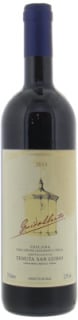
Guidalberto
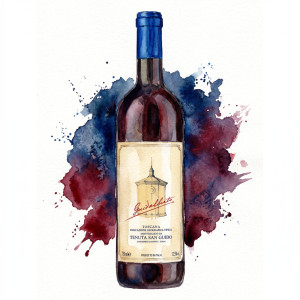
Guidalberto is the second wine of Tenuta San Guido, the Bolgheri estate behind Sassicaia. It falls a little short of being called a "second wine": since the 2000 vintage, Guidalberto has been produced as a separate wine, not as a junior version.
Why is this important? Because it gives access to the style of the house of San Guido without the queue and price tag of Sassicaia. The wine is named after Guidalberto della Gherardesca, the 19th century ancestor who planted the first vines on the estate. It is classified as Tuscan IGT rather than Bolgheri DOC, which was done intentionally to give the winemakers the opportunity to make the wine their own way.
About Tenuta San Guido
Tenuta San Guido is owned by the Incisa della Rocchetta family and is located in Maremma on the Tuscan coast, in the province of Livorno. Most people know one wine: Sassicaia. However, the estate produces three wines, the middle one is Guidalberto and the third is Le Difese.
What makes San Guido unique: since the invention of the Super Tuscans category in 1968, there has been no need to follow trends. Today, Carlo Paoli is in charge of the technical side and Graziana Grassini is the consultant. Best of Wine represents San Guido because of the consistent quality of the three brands as well as the flagship.
History & Heritage
Guidalberto's story began in 2000, the first commercial vintage. By then, Sassicaia had been world-renowned for over 30 years, having first gained international fame in a blind tasting in Decanter magazine in 1978. So why release a second wine?
The Incisa della Rocchetta family wanted to create a wine with a different personality. More Merlot, shorter barrel aging and more approachable in its youth. The name is a reference to an ancestor, Guidalberto della Gherardesca, who planted the first vines on the estate in the 1800s. Rooted in family history, this wine is free from the rules of Sassicaia. For consumers, this means that San Guido wine is ready to drink immediately upon release.
Terroir & Climate
Guidalberto is produced in Bolgheri, on the Tuscan coast between Livorno and Grosseto. Bolgheri might not seem suitable for Bordeaux varieties at all, but it is. The Tyrrhenian Sea moderates the temperature, the sea breeze keeps the vines healthy, and the Colline Metallifere hills blocks the winds from the east.
The soils are a mixture of alluvial gravel, clay, sand, limestone and sometimes marine fossil deposits. Gravelly soils drain well and clay soils retain water. Why is this important? Because Cabernet Sauvignon needs warmth to fully ripen its tannins and Merlot needs enough moisture to avoid stress. Bolgheri achieves both, which is why the region has gone from overlooked to one of Italy's most desirable regions in two generations.
Grape Varieties
The Guidalberto blend is roughly as follows:
- 60% Cabernet Sauvignon
- 40% Merlot
The proportions vary slightly from vintage to vintage. Compared to Sassicaia (which has more cabernet sauvignon and cabernet franc), Guidalberto has more merlot. Merlot brings weighty black fruit and soft tannins to the wine. Cabernet, on the other hand, retains the backbone, cassis and Mediterranean herbaceousness that distinguish Bolgheri.
Winemaking
The decisive choice for Guidalberto is the blend. Here, a blend of French and American oak is important, about 15 months in barriques (small oak barrels of about 225 liters). Sassicaia is French only. American oak is the difference. It brings sweeter, more open spices, vanilla, coconut and a softer feel. This is done intentionally.
The team wants Guidalberto to be a wine that can be tasted immediately upon release, not one that will be forgotten in a decade. A blend of new and used oak is used so that the oak supports the fruit rather than masking it. The result is a structured wine, but its rough edges are smoothed out when poured into a glass.
Tasting Notes
First impression: ripe black fruits, generous and warm. Blackcurrant, blackberry, plum and notes of Mediterranean herbs that Bolgheri Cabernet always seems to have. Sweet spices of American oak, vanilla and notes of French oak cedar. The Merlot shows up on the palate as a full, rounded mid-palate.
Tannins are present, but they are subtle and not chewy. The acidity is enough to give the wine liveliness, and notes of graphite and dark chocolate are felt on the finish. Guidalberto can be drunk immediately upon release, but the structure shows that this wine can be preserved; with 8-10 years of aging, the fruit will transform into something more savory.
Food Pairing
Black fruit and supple tannins call for red meat, but not the heaviest in the kitchen. Try this:
- Bistecca alla Fiorentina (simply grilled with salt and olive oil).
- Pappardelle with wild boar ragout (a Tuscan classic, cinghiale).
- Lamb loin with rosemary
- Aged pecorino, especially pecorino Toscano Stagionato
Why them? The fat of the meat softens the tannins of the cabernet, while the herbal note of the wine complements the rosemary and sage perfectly. Serve at 16-18°C.
Serving Suggestions
16-18°C. Most living rooms are warmer, so bottles should be put in a cool place 20 minutes before serving, rather than left on the rack. Decant young vintages within an hour. Older bottles (over 10 years old) - up to 30 minutes. Standard Bordeaux glasses will do.
Vintages
Guidalberto is fairly consistent from vintage to vintage, which is one of its strengths. However, you can see both warm and cool years in the glass: the 2022 growing season was hot and dry throughout Tuscany, but Bolgheri's coastal location helped relieve the stress of the drought that hit the interior. In such years, expect concentrated fruit and ripe tannins.
Cooler, classic vintages tend to be fresher and more structured, helped by 5-7 years of bottle aging. For weekday consumption, look for vintages aged 4-6 years, with integrated oak and primary fruit still present. For cellar storage, more structured vintages are better with patience.
Cellaring Potential
Guidalberto is made to be drinkable within the first decade, but the best varieties can easily last 12-15 years. Cabernet provides the tannin backbone, while Merlot retains its generosity during this time. Store at 12-14°C, away from light and vibrations. Over time, the basic fruit flavors are replaced by dry fig, leather and tobacco. 5-10 years after the vintage is the optimal drinking window.
