
Bibi Graetz
Bibi Graetz' winery is located In the centre of Fiesole, a small town on a hill above Florence in Tuscany, in the former Hotel Aurora Its founder, an artist by training, found himself in the world of wine more or less by chance in the late 1990s and has since been producing some of the region’s most talked-about wines.
History
Graetz grew up in a family of artists: his father, Gidon Graetz, was a Swiss-Israeli sculptor, and his mother was Norwegian. Bibi himself studied at the Academy of Fine Arts in Florence. The family owned an old estate in Castello di Vincigliata, in the hills above Fiesole, and when Graetz was faced with the choice of either letting the old vineyard lease agreements expire or doing something with them, he chose the latter.
The first vintage was released in 2000 and made such a confident impression that critics and merchants quickly took notice. The winery, officially registered as Azienda Agricola Testamatta, is located in the former Hotel Aurora on Fiesole’s main square, where Graetz himself also lives.
Vineyards
Graetz has around 80 hectares of vineyards, stretching in a wide arc across Tuscany, from plots just above Florence right through to the Chianti Classico region and beyond. The main vineyards are Vincigliata, situated directly below the family’s historic castle at an altitude of around 280 metres above sea level; Lamole, in the very heart of Chianti Classico at an altitude of 600 metres; Montefili at 400 metres; Londa, north of Florence, not far from the Rufina Valley, and a plot south of Siena.
In 2020, Graetz acquired a further 90 hectares of land directly behind the winery in Fiesole, where new vineyards are currently being planted. For the production of white wines, he cultivates terraced plots on the island of Giglio in the Tuscan Archipelago, a truly distinctive landscape where granite and the sea air create a unique atmosphere.
Terroir
The diversity of the plots is the result of deliberate effort. The soils of Vincigliata are rich in galestro, a crumbly limestone-clay shale characteristic of Tuscany, mixed with sand and stones. Lamole is situated at a high altitude in the cooler part of Chianti Classico, whilst Siena contributes a milder and warmer influence. On the island of Giglio, Ansonica vines grow on granite terraces overlooking the Tyrrhenian Sea. The variety of altitudes, plot orientations and soil types is what provides Graezu with the range of plots he needs to create his diverse wines.
Grapes
Sangiovese forms the basis of all the red wines, often made from grapes grown on vines aged between 35 and 80 years. The finest wines, ‘Testamatta’ and ‘Colore’, are now produced from 100% Sangiovese;
Graetz made this transition gradually, starting around 2015, moving away from his previous blends, which included Canaiolo and Colorino. The white wines are made from Ansonica, the local name for a grape variety known in Sicily as Inzolia, which is grown exclusively on the island of Giglio.
The winemaking process
Harvesting in each vineyard is carried out by hand in several stages, up to eight times per plot in a single growing year, to ensure that each plot is harvested at precisely the right moment. The grapes are sorted twice: once in the vineyard and once at the winery. Fermentation takes place exclusively using indigenous yeasts and is carried out in open 225-litre barriques for small plots and in larger barrels or stainless-steel tanks for larger plots. Each plot is kept separate throughout the entire fermentation and ageing process.
All wines are classified as Toscana IGT rather than under a specific appellation, which gives Graetz the freedom to work without the restrictions of a DOC.
Wines
The range extends from Casamatta, a fresh, fruity Sangiovese made from young vines across Tuscany, to Soffocone di Vincigliata, a single-vineyard wine from the original estate in Fiesole,.
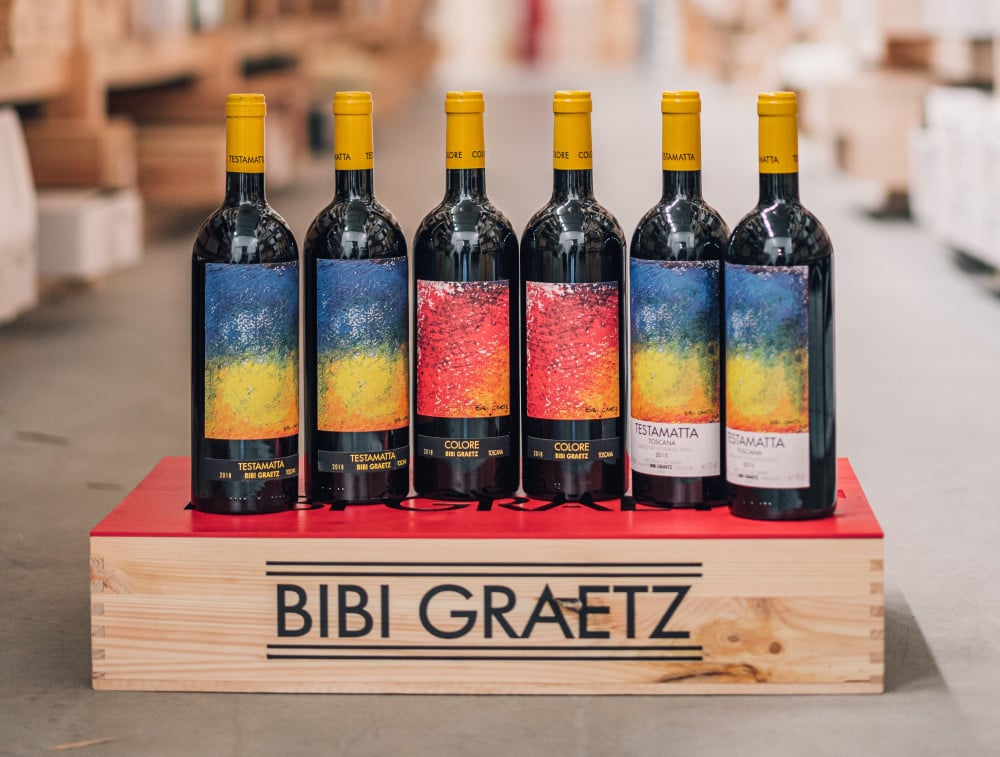
The flagship wines are Testamatta and Colore.‘Testamatta’ and are made from grapes harvested from five different plots of old vines, whilst ‘Colore’ is crafted from the finest barrels across the entire estate.
The white counterparts, ‘Testamatta Bianco’ and ‘Colore Bianco’, both made from 100 per cent Ansonica grapes from the island of Giglio, have earned a reputation of their own as some of Italy’s most unusual and appealing white wines. Each bottle is adorned with a hand-drawn label designed by Graetz himself.