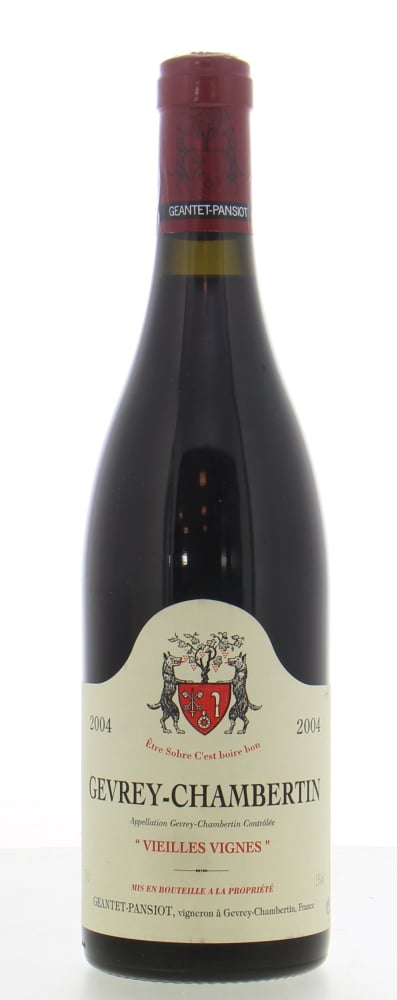

| Classification | Cru Classe |
| Type | Red |
| Producer | Geantet Pansiot |
| Vintage | 2004 |
| Country | France |
| Main region | Burgundy |
| Region | Côte de Nuits |
| Appellation | Gevrey Chambertin |
| Grape | Pinot Noir |
| Volume | 0,75 |
| Condition | Perfect |
| Label | Slightly bin soiled |
| Stock | 1 |
The 2004 vintage of Côtes de Nuits came after a difficult growing season. Late spring rains delayed flowering and a wet summer brought disease to the Gevrey-Chambertin vineyards. Under these conditions, only the healthiest old vines were carefully selected for the Gevrey-Chambertin Vieilles Vignes 2004 from Geantet-Pansiot. The result is a restrained wine, characteristic of this vintage, that requires patience to reveal its hidden concentration. This vintage, which received some good reviews by amongst others Jancis Robinson, suggests that 2004 was a challenging and ultimately rewarding year for those involved in cultivation.
Dark crimson. Very rich and beguiling nose. Sweet, scented, gentle texture. More evolved than most at this stage. Still some fine tannins, but masses of ripe fruit, too.
The nose shows classic Gevrey character: dark cherry and blackberry with earthy nuances reminiscent of the forest floor; the 2004 vintage brings a certain restraint, the fruit flavors more muted than in more exuberant years. In the mouth the wine has a firm structure, the tannins are not pronounced. On the finish there is a mineral tinge characteristic of calcareous soils and a light grip that suggests this wine is still in its formative stages. The wine is more than 20 years old and ready to drink, but with proper storage, the wine should last for another decade or more.
This is pure Pinot Noir, the only grape recognized in the classified vineyards of Gevrey-Chambertin. However, the flavor of Pinot Noir here is different from the rest of Burgundy. Why? Gevrey's limestone and clay soils create wines that are more structured and powerful than those of neighboring Chambolle-Musigny. 'Vieilles Vignes' refers to older vines, over 40 years old, which penetrate deeper and produce more concentrated fruit flavors. It is this age that gives the wine the strength needed to withstand the harsh terroir of Gevrey.
This 2004 wine is drinking well now, but it has many years ahead of it. Because of its structure, it will last until 2030, maybe longer, and should be stored in a dark place at 12-14°C. What changes over time? The earthy, woody notes become more pronounced and the fruit character changes from fresh to dried. The tannins soften and become more accessible.
Vincent Geantet took over the domaine from his father in 1989 and expanded the estate from the original 3 hectares to about 13 hectares. While most of their neighbors have modernized their methods, Pansiot remained committed to traditional methods. Hand harvesting, local yeast and minimal intervention. ..... Since Edmond and Bernadette founded the estate in 1954, the approach has remained the same, and Vincent's son Fabien joined them in 2006, continuing the family's restrained approach. Wine critics consider this estate an excellent choice in a region where price can often outweigh quality.
Gevrey-Chambertin is located in the northern part of the Côte de Nuits, about 15 kilometers from Dijon. The limestone rocks are overlain by iron-rich clayey marl. This clay component gives the wines of Gevrey more body and structure than those from villages further south. The vineyards face east and are illuminated by the morning sun. The Geantet-Pansiot village plots are spread across different plots, allowing for a combination of different micro-terroirs. The vines, which are on average 40 years old, are rooted deep into the limestone to extract the minerality, which manifests itself in the form of a characteristic stony ridge.
Hand harvesting leads to careful selection on a vibrating table. This is very important for difficult harvests such as 2004, when rigorous selection had to be carried out due to disease. After complete stem removal, the grapes are cold macerated and spontaneous fermentation with indigenous yeasts begins, with daily punchdowns and pumpovers during 10 days of fermentation, followed by 20-22 days of post-fermentation maceration. The wine is then aged in French oak barrels for 13-14 months. The wine is neither fined nor filtered before bottling. This traditional method preserves the true character of the wine, which is why its bottles age so gracefully.
The earthiness of aged Gevrey-Chambertin calls for a mushroom dish. We would start with:
The wine's moderate tannins pair well with the fatness of the duck and umami of the aged cheese; serve at 16-18°C. If you have a properly stored bottle, decant for 30 minutes to bring out the earthy flavors.
With track & trace code