| ex Vat | € 4.995,00 |
| in Vat | € 6.043,95 |
| Volume |
| Classification | Cru Classe |
| Type | Red |
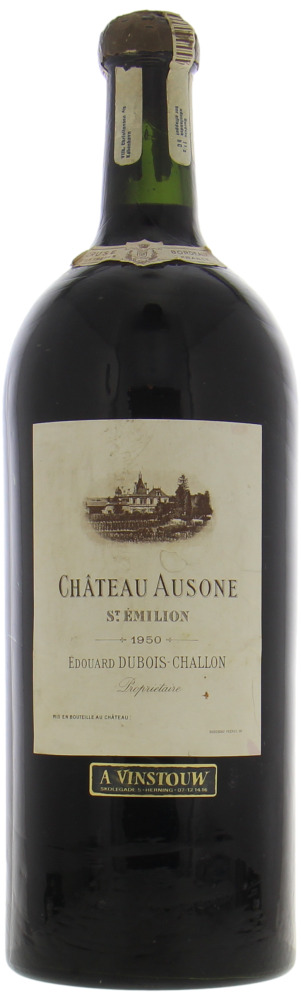
| Producer | Chateau Ausone |
| Vintage | 1950 |
| Country | France |
| Main region | Bordeaux |
| Region | Saint-Emilion |
| Grape | Merlot, Cabernet Franc, Bordeaux Blend |
| Volume | 4,5 |
| Condition | Damaged wax capsule |
| Label | Bin soiled |
| Stock | 1 |
The 1950 harvest at St. Emilion came after a difficult growing season that tested even the most experienced vignerons. Spring frosts threatened early budbreak, and a cool and wet summer delayed ripening throughout the right bank. However, Château Ausone's privileged location on a limestone plateau proved its worth once again. The south-facing and well-drained slopes allowed the Merlot and Cabernet Franc varieties to fully ripen despite the difficult conditions. This harvest demonstrated the resilience of Ausone's terroir, creating wines of outstanding concentration and structure that reward decades of patience in the cellar.
The 1950 Ausone, born in a vintage that favoured the Right Bank, was surprisingly dark in colour. It feels a little withdrawn at first, atypically austere although well defined, eventually if reluctantly offering cedar and woodland scents with aeration though not the fruit intensity of say, the 1950 Cheval Blanc. After ten minutes, that leitmotif of mint gradually unfurls. The palate is pretty with black cherry and boysenberry fruit and here things get more interesting. Like other vintages of this era there is a Left Bank personality to this Saint-Émilion, hints of blueberry coming through with graphite and bay leaf and hints of Earl Grey. It is a fascinating Ausone and though the Cheval Blanc was better this year, this 1950 still has plenty to offer. Tasted at the Ausone vertical in London. Tasted 2018.
Sheer perfection. Such an incredibly dense, complex wine aristocrat with fine herbal notes and incredible length, intense minerality, tremendous structure, fine sweetness, a wine of the brand "Speechless"
When you open this bottle, Ausone's characteristic violet and graphite aromas immediately open up to reveal an element of Cabernet Franc. Underneath that aromatic top note is concentrated dark fruit, cedar and a mineral thread that continues through to the finish. On the palate, there is surprising depth for a complex vintage, with fine-grained tannins that integrate beautifully over 70 years. Most striking of all is the sense of place: limestone minerality underpins the entire wine. Notes of dried herbs and tobacco linger on the finish, indicative of both the grape variety and the wine's aging potential.
Blends of this vintage utilize roughly equal proportions of both varieties:
Why does this blend work? The answer lies in Ausone's unique terroir. Merlot thrives on clay soils and retains moisture even during dry periods. Cabernet Franc, on the other hand, benefits from limestone rock and creates the herbal and mineral notes characteristic of Ausone. Together they produce wines that are approachable and can age for long periods of time.
This aged 1950 wine is wonderful to drink now as the primary fruitiness moves into complex tertiary notes of leather, earth and dried flowers. The tannins have completely dissolved, leaving a silky texture that is a real pleasure to drink. Consistent low temperatures and minimal vibration are important for storage at this stage. This vintage has already exceeded expectations for long aging, but in properly stored bottles it can continue to develop for another decade.
What sets Château Ausone apart? First of all, it's the size. At just seven hectares, they are small even by Bordeaux standards. But what really sets them apart is the approach of the Vauthier family, who have owned the estate for 11 generations since the late 1800s and still farm it as if every vine matters. They don't have a fixed schedule; they decide when to act based on the taste of the fruit. Then, in the mid-1990s, when the Vauthier family bought out the co-owners, everything changed. The quality improved dramatically. This single-mindedness is evident in every bottle. In 2022, they abandoned the Saint-Émilion grading system, preferring to let the wines speak for themselves.
Ausone is located on a plot of land that locals call Roc Blancan, literally "white rock." The vineyard is divided into a limestone plateau and a clay-limestone slope, each contributing different elements. On the plateau, the vines are deeply rooted in weathered limestone, creating the mineral backbone for which Ausone is famous. The slopes are clay-limestone soils, where the clay holds water during drought and the limestone forms the framework. The east and southeast facing sites receive morning sun, but are protected from harsh winds by the surrounding cliffs. The nearby river mitigates temperature fluctuations. This combination paid off during the severe frosts of 1956 and other historical frost events.
Important decisions at Ausone are made after harvest. They vinify each plot in small wooden vats. Why wooden vats and not stainless steel? Because they are easier to control the temperature and the extraction is gentler. No pumps are used to move the wine, and gravity is used to preserve the subtle flavors. Once fermentation is complete, the wine is moved to the underground cellar, which was converted from an 18th century limestone quarry. The wines are aged for 16-18 months in French oak barrels. This limestone cellar naturally maintains perfect humidity and temperature, and much of the ageing takes place without human intervention.
The mineral backbone of this wine demands structured food. The delicate fleshiness does not overpower Ausone's refined tannins, and rosemary and thyme enhance the wine's herbal notes. For a richer flavor, serve the duck breast with a cherry sauce. The fruitiness of the sauce reflects the dark berry character of the wine, while the duck fat softens the firm tannins. For aged bottles, a risotto with porcini mushrooms will be magical: serve it at 18°C and decant the young wines for at least an hour.
With track & trace code