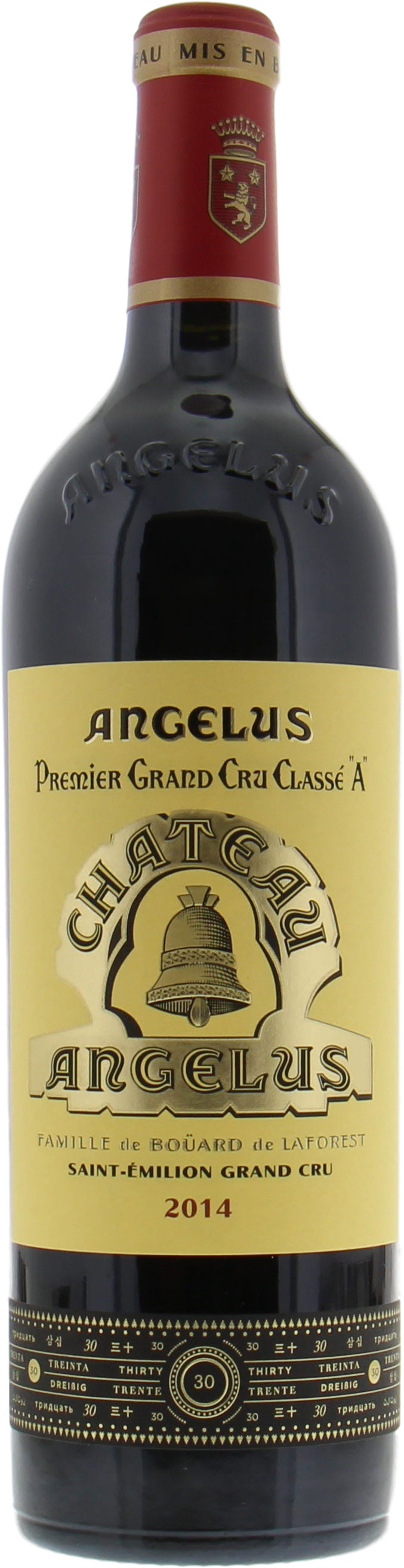
| Classification | Cru Classe |
| Type | Red |
| Producer | Chateau Angelus |
| Vintage | 2014 |
| Country | France |
| Main region | Bordeaux |
| Region | Saint-Emilion |
| Grape | Merlot, Cabernet Franc, Bordeaux Blend |
| Volume | 0,75 |
| Condition | Perfect |
| Label | Perfect |
| Drinkable | -2055 |
| Stock | 12 |
In 2014, Saint-Émilion had ideal conditions for growing Merlot. Warm, dry days were followed by cool nights that preserved acidity. At Château Angelus, this led to surprisingly fresh and concentrated fruit. Harvesting began in late September, with each parcel carefully sorted and only the fully ripe grapes placed in tanks. Initially underrated by many critics, the 2014 Angelus has proven its worth over the past decade, showing the backbone and balance that defines a great Bordeaux.
Medium to deep garnet in color, the 2014 Angélus needs a fair bit of coaxing to begin to reveal very pretty aromas of lilacs, kirsch, redcurrant jelly and Black Forest cake plus nuances of graphite and menthol. The palate is delicately intense with soft spoken floral and earth notes complimenting the black fruits, supported by ripe, rounded tannins and oodles of freshness, finishing long with compelling restraint. Sporting a good amount of tertiary nuances, it can be enjoyed right now, but make sure to decant it a good 1.5 to two hours prior to drinking.
This has a dense, muscular core of warm blackberry, black currant and fig paste flavors, shrouded under a cloak of tobacco and loam. Not shy on toast and balanced by a hefty ganache edge, this isn't heady at all, just a terrific expression of the muscular, loamy style.
Ripe damson-plum, candied-orange and spice aromas pour from the glass of this ripe and generous St.-Emilion. Impressive tannin structure behind all the richness, the bitter-chocolate and expresso notes at the warm and long finish underlining the ripe fruit very neatly. Still so much life and so many years ahead of it.
Tasted blind. Youthfully dark. Deep aroma of ripe, dark and just evolving fruit and a leafy edge. Rich, firm, fresh with great balance. Tannins are almost chalky but it’s a complete wine with length.
The 2014 Angélus is now really beginning to blossom. It has an outstanding bouquet with plush but delineated black cherry and cassis fruit, crushed violet and just a hint of pencil lead. There is wonderful focus here. The palate is medium-bodied with tightly knit black fruit, graphite and spice. There is weight and presence, but it is effortlessly counterbalanced by the freshness and acidity, whilst the finish if extraordinarily long. Tasted blind at the annual Southwold tasting.
Rene Gabriel rates this wine 18/20 points.
Effectively half-and-half Merlot and Cabernet Franc, this is a tremendous wine. With very fine tannins, spice from a touch of wood and swathes of ripe fruits give this wine its concentration and its huge potential. The wine has weight and a dark, dense structure that will allow it to age for many years.
On the nose, dark cherry and black currant dominate, complemented by cedar and the characteristic minerality of Saint-Emilion's clay-limestone soils. On the palate, the Merlot immediately adds richness, while the Cabernet Franc brings spicy, almost peppery flavors and adds liveliness. The tannins are firm but refined, a testament to the success of careful extraction during fermentation. The wine has a savory feel to it, opening to reveal notes of graphite and tobacco leaf. The finish reveals dark chocolate and subtle oak spice. This wine is concentrated enough to age, but is already showing great promise.
Merlot is the main grape here, typically making up about 50% of the final wine. Merlot gives Angelus its trademark velvety texture and approachable personality. Cabernet Franc plays a very important role, sometimes making up 47% of the blend. The high percentage of Cabernet Franc gives the wine an aromatic lift and structural backbone that sets it apart from the Merlot-heavy Pomerol domaines. The remaining 3% Cabernet Sauvignon gives the blend ample tannins and length.
Drinkable now, but why rush, the 2014 wines will continue to improve through 2035 or even longer. It will need a few more years for the persistent tannins we mentioned to fully integrate, and the Cabernet Franc element will become more complex in flavor over time. Store in the dark at 55-60°F. As it ages, the primary fruit flavors will evolve into the realm of classic aged Bordeaux: leather, earth, and forest floor. If opened immediately, decant for at least one hour.
The de Boüard de Lafollet family has shaped the estate since 1782, but it was the modernization of Hubert de Boüard at the end of the 20th century that transformed Angélus into what it is today. In 2012, Angélus was classified as Premier Grand Cru Classé A, joining the three other top-ranked Saint-Emilion vineyards in the region. The estate was then classified as a Premier Grand Cru Classé A, joining the other three estates at the pinnacle of Saint-Emilion's classification. What sets Angelus apart, however, is that it voluntarily relinquished that title in 2022. We at industry observers believe that this decision is truly a sign of confidence in their ability to produce great wines.
Angelus is located in what locals call a natural amphitheater on the southern slopes of Saint-Emilion. This position concentrates the summer heat and promotes early ripening. The soil is divided into two zones: the upper zone is clay-limestone, which grows Merlot, and the lower zone is sandy clay-limestone, which grows Cabernet Franc. Why is this important? Clay retains moisture during droughts, so the vines are not stressed even in hot summers like those of the 2020s. And the underlying limestone provides a mineral backbone that can be felt in every bottle. The slopes are always well drained, which is essential to prevent waterlogging during the rainy season.
Angelus is characterized by the use of open tanks for fermentation, a method pioneered by Hubert de Boüard in the 1990s. This allows for better extraction while maintaining the elegance that is essential for blends with a high Cabernet Franc content. After fermentation, the wine is aged on its lees to give it texture without masking the fruit. In recent vintages, the use of larger oak barrels in addition to traditional barriques (small French oak barrels) has softened the heavy oak notes of earlier vintages. The result is a fresher, more transparent wine, which is exactly what we see in this 2020 vintage.
Protein is needed to soften the hard tannins in the wine, which explains why Bordeaux and beef have been partners for centuries. Try Côte de Beef with shallot confit. The fat of the beef softens the tannins and the minerality of the wine breaks up the richness. Duck breast would also work well with a cherry sauce, especially in response to the dark fruitiness of the wine. If you want to try something more regional, try herb-fried rabbit, served at 16-18°C and decanted for at least an hour to allow the flavors to develop.
With track & trace code