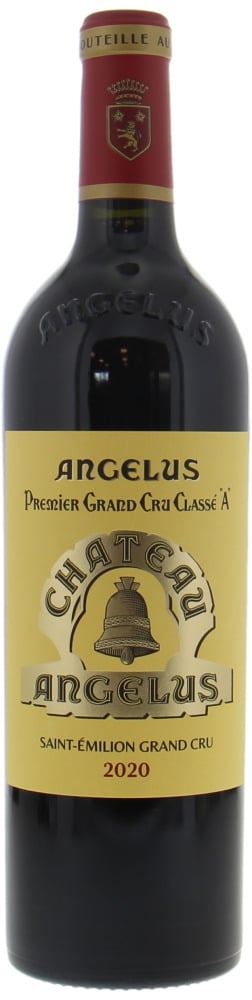

| Classification | Cru Classe |
| Type | Red |
| Producer | Chateau Angelus |
| Vintage | 2020 |
| Country | France |
| Main region | Bordeaux |
| Region | Saint-Emilion |
| Grape | Merlot, Cabernet Franc, Bordeaux Blend |
| Alcohol % | 14.5% |
| Volume | 0,75 |
| Condition | Perfect |
| Label | Perfect |
| Drinkable | 2027-2060 |
| Stock | 4 |
The 2020 growing season in Saint-Emilion was one of those rare combinations that winemakers dream of. Warm, dry conditions with just enough rain at just the right time. For Château Château Angélus, this meant that the Merlot and Cabernet Franc grapes reached optimum ripeness without being stressed, which would have robbed them of their elegance. Harvesting began on September 14 and continued through early October, allowing each parcel to be picked at the perfect moment of ripeness. Poured in the glass is the 2020 vintage, which shows both the power of a great year and the finesse that characterizes this estate.
The 2020 Angélus has turned out superbly and underlines this estate's continuing shift to a more elegant, integrated style that offers a purer expression of its terroir. A blend of 60% Merlot and 40% Cabernet Franc, it unwinds in the glass with aromas of cherries, wild berries, rose petals, mint and subtle hints of licorice, followed by a medium to full-bodied, beautifully layered and vibrant palate that's deep, precise and penetrating, concluding with a mouthwateringly chalky finish. Some 120 hectoliters of Cabernet Franc, amounting to around 20% of the blend, were matured in foudre this year, which no doubt helps to account for the significantly reduced oak impact in the 2020.
Blackberry and plum character with chocolate, too. Oyster shell. Full and very firm with a linear sensibility. Tight and powerful. Very pure fruit. Tension and energy there. Polished tannins. Some coffee bean and chocolate. Give this at least five or six years. 60% merlot and 40% cabernet franc.
This blend perfectly reflects the terroir of Angélus:
But why does Cabernet Franc play such an important role? The sandy clay-limestone soils at the foot of the slopes are ideal for Cabernet Franc, and older vines can produce surprisingly concentrated fruit despite relatively low yields. It is the Cabernet Franc that gives Angélus its characteristic flavor, more structured and complex than typical Right Bank wines, which are dominated by Merlot alone.
Dark cherry and black currant flavors from the Merlot and distinctive violet tones and pencil sharpening from the Cabernet Franc. There is also a chalky minerality due to the limestone soils. In the mouth, the wine is dense but not heavy, with tannins that don't cling. The finish feels characteristically Angélus floral, almost exotic flavors. Skeleton. This wine has the structure to age gracefully for decades; the 2018 wine is in fine shape now, but deserves patience.
The de Boüard de Lafollet family has shaped the estate since 1782, but it was the modernization of Hubert de Boüard at the end of the 20th century that transformed Angélus into what it is today. In 2012, Angélus was classified as Premier Grand Cru Classé A, joining the three other top-ranked Saint-Emilion vineyards in the region. The estate was then classified as a Premier Grand Cru Classé A, joining the other three estates at the pinnacle of Saint-Emilion's classification. What sets Angelus apart, however, is that it voluntarily relinquished that title in 2022. We at industry observers believe that this decision is truly a sign of confidence in their ability to produce great wines.
Best aging time: 2028-2045, but could be longer. Due to the age of the Cabernet Franc vines, the tannin structure is firm but balanced, with enough acidity to keep the wine fresh. Store patiently at cellar temperature (12-15°C). With time, expect the fruit to become more complex, tertiary notes of truffle, leather and forest floor to emerge, and floral elements to become more pronounced.
Angelus is located in what locals call a natural amphitheater on the southern slopes of Saint-Emilion. This position concentrates the summer heat and promotes early ripening. The soil is divided into two zones: the upper zone is clay-limestone, which grows Merlot, and the lower zone is sandy clay-limestone, which grows Cabernet Franc. Why is this important? Clay retains moisture during droughts, so the vines are not stressed even in hot summers like those of the 2020s. And the underlying limestone provides a mineral backbone that can be felt in every bottle. The slopes are always well drained, which is essential to prevent waterlogging during the rainy season.
Protein is needed to soften the hard tannins in the wine, which explains why Bordeaux and beef have been partners for centuries. Try Côte de Beef with shallot confit. The fat of the beef softens the tannins and the minerality of the wine breaks up the richness. Duck breast would also work well with a cherry sauce, especially in response to the dark fruitiness of the wine. If you want to try something more regional, try herb-fried rabbit, served at 16-18°C and decanted for at least an hour to allow the flavors to develop.
Angelus is characterized by the use of open tanks for fermentation, a method pioneered by Hubert de Boüard in the 1990s. This allows for better extraction while maintaining the elegance that is essential for blends with a high Cabernet Franc content. After fermentation, the wine is aged on its lees to give it texture without masking the fruit. In recent vintages, the use of larger oak barrels in addition to traditional barriques (small French oak barrels) has softened the heavy oak notes of earlier vintages. The result is a fresher, more transparent wine, which is exactly what we see in this 2020 vintage.
With track & trace code