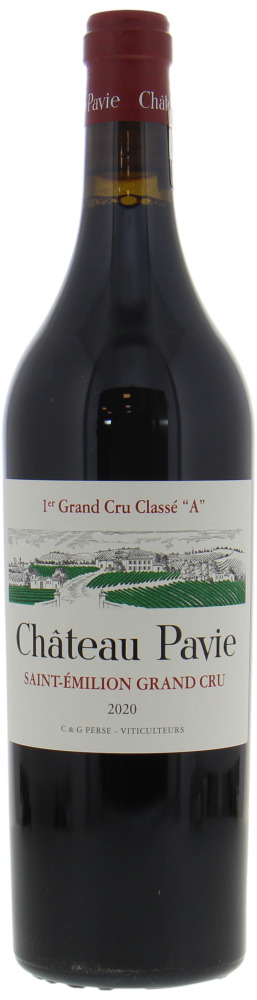
| Classification | Grand Cru Classe |
| Type | Red |
| Producer | Chateau Pavie |
| Vintage | 2020 |
| Country | France |
| Main region | Bordeaux |
| Region | Saint-Emilion |
| Grape | Merlot, Cabernet Franc, Bordeaux Blend |
| Alcohol % | 14.5% |
| Volume | 0,75 |
| Condition | Perfect |
| Label | Perfect |
| Drinkable | 2027-2062 |
| Stock | 36 |
he 2020 growing season in Saint-Emilion brought the concentration and intensity that Merlot needs on the limestone slopes. A warm, dry summer and perfectly timed September rains allowed Château Pavie to harvest at the optimal time. This harvest demonstrates the power of Gérard Pérus' low-yield philosophy: 30 hectoliters per hectare. With Michel Rolland's advice on blending, the 2020 wines combine Pavie's characteristic richness with a surprising elegance for such a structured year.
Composed of 50% Merlot, 34% Cabernet Franc and 16% Cabernet Sauvignon, the 2020 Pavie weighs in with an alcohol of 14.82% and a pH of 3.61. It is aging in French oak barriques, 75% new. Opaque purple-black colored, notes of plum pudding, blueberry pie and dark chocolate-covered cherries charge out of the gate, followed closely by hints of eucalyptus, star anise, unsmoked cigars and fertile loam with a hint of cedar chest. The full-bodied palate is built like a brick house, offering very firm yet wonderfully ripe, velvety tannins and seamless freshness to support the densely laden, muscular black and blue fruits, finishing very long and with loads of mineral-laced layers. As hedonic as it is cerebral this year, it is a beautiful paradox.
Number 28 in the top 100 from 2023
This opens up on your palate like a butterfly. It takes your breath away. Purity of blackberry, raspberry and black cherry. Lavender. Very, very impressive. Full and chewy with tight and polished tannins that go on and on. Energetic and structured. Crisp and vivid. Superb finish.
The blend is:
Why is Merlot predominant? Clay-limestone soils can retain moisture during droughts. The percentage of Cabernet Franc is 30% and on average higher than neighbouring chateaux. Cabernet Franc planted in warm sandy soils develops more aromatic notes such as violet and pepper, which accentuate the richness of Merlot.
Intense aromas of blackberry and cassis are initially detected, complemented by cedar and the limestone minerality characteristic of plateau soils. On the palate, this wine shows the concentration of its 30 hectoliter yield. The tannins are firm but fine, showing the influence of Michel Rolland, who managed the extraction during the three weeks of skin contact. Underneath the fruity flavors are savory, almost graphite-like nuances typical of Cabernet Franc. The finish reveals dark chocolate and espresso notes. It needs at least five years to fully integrate.
Gérard Perse bought Pavie in 1998 and changed everything. Before him, the estate was making decent Saint Emilion. After him? In 2012, it was rated Premier Grand Cru Classé A. What did Pels change? He reduced yields from 55 hectoliters per hectare to 30 hectoliters per hectare, brought in Michel Rolland as a consultant, and restored the historic stone cellar in the former Bordeaux train station. This approach, which initially caused controversy, has proven that Saint-Emilion can produce concentrated wines that rival the best Pomerol wines.
Pavie is situated on three different soil types on an area of 37 hectares. A limestone plateau at 85 meters above sea level, this is where Merlot grows, deeply rooted in white friable limestone, with starfish limestone beneath. Why is this important? Limestone stores water and releases it slowly, preventing stress on the vines and creating a deep root system. These deep roots draw in minerals, which appear as a chalky structure in the wine. The clay-limestone soils below 55 meters elevation are soft and easily penetrated by the roots. Its southern orientation provides ample sunshine, and the westerly winds from the Dordogne prevent frost.
Protein and fat are needed to soften the tannin structure. The rich fat matches the concentration of the wine, and the gibier notes in the meat complement the earthy aromas. A more traditional dish, simply grilled Cote de Boeuf, allows the minerals of the limestone to show through in the wine. Also recommended is an aged Comté cheese, whose nutty complexity is matched by its oak aging. Rabbit meat is also good, according to regional tradition; serve at 17-18°C and decant within an hour.
Hand-harvesting on a double selection table. Fermentation in 20 temperature-controlled fermenters allows vinification to be done on a site-by-site basis, separating the best batches before the blending decision is made. The key selection is skin contact, which takes three weeks to extract tannins and color from the concentrated fruit. The wine is then aged in new oak barrels (French oak, 225L capacity) for 18-24 months. This new oak ratio sounds aggressive, but the high concentration of the wine allows it to age without overheating. The result is an integration of vanilla and spice rather than the dominance of oak.
Best time to drink: 2028-2045.Why it's worth the wait: The tannins from three weeks of skin contact and aging in new oak need time to soften and integrate. But there is enough concentration and acidity in this wine to make it worth patience.Store in a dark place at 12-14°C. Over the next 10 years, the fruit aromas will evolve from primary blackberry to secondary leather and tobacco, and the limestone minerality will become more pronounced.
With track & trace code