| Classification | Cru Classe |
| Type | White |
| Producer | Bibi Graetz |
| Vintage | 2018 |
| Country | Italy |
| Region | Tuscany |
| Grape | Ansonica |
| Alcohol % | 13.5% |
| Volume | 0,75 |
| Condition | From Original Wooden Case |
| Label | Perfect |
| Drinkable | -2035 |
| Stock | 1 |
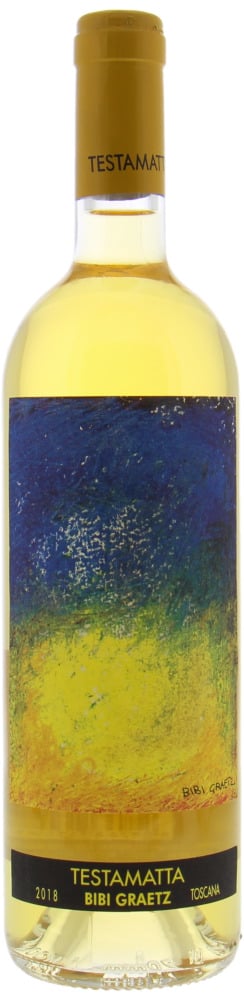
The 2018 growing season on the island of Giglio, unlike previous hot vintages, was a cooler and more balanced year for Bibi Graetz. For the “Testamatta Bianco” wine, made from 100% Ansonica grapes grown on granite terraces overlooking the Tyrrhenian Sea, this meant slower ripening and a more intense aroma. The 2018 vintage offers a fresher and cleaner taste than warmer years, while the saltiness and herbal notes characteristic of Giglio remain distinctly pronounced.
This wine is really quite terrific, and with 6,500 bottles made, it is easier to find (and more affordable) than Bibi Graetz's new single-vineyard expression of Ansonica, Colore Bianco. The 2018 Testamatta Bianco Isola del Giglio sees fruit blended from three bigger vineyard sites on Giglio Island and some smaller ones as well (Vigneto del Corvo, Scopeto, Ulivello, Radice and Le Grotte). In contrast to the Colore Bianco that revealed more consistency, the two bottles I sampled of this wine (one opened in the morning and one in the afternoon) showed very different results between them. The morning bottle was more fleshy and ample, while the just-opened bottle offered very linear notes of citrus, apple and white peach. Some of the grapes are harvested early, in order to maintain that total acidity, and used as a blending agent with the rest of the wine. Green harvesting is not practiced here, as each vine is left on its own to ripen. Bibi Graetz tells me that the 2018 vintage was much easier and gave more satisfaction compared to the difficult 2017 growing season. Of course, like any white wine from the Tuscan Coast, you get a distinctive layer of sea salt on the close—in this case, mixed in with some freshly milled white pepper.
This is another fantastic white and continues to be one of the best from Tuscany. It’s so perfumed with sliced apples, pears and kiwis, as well as cream, hot stone and sea. Granite. Full-bodied yet energetic and layered with red-wine sensibility. Extremely long finish. Great wine.
The aroma is dominated by notes of salted almonds and yellow stone fruits, along with distinct aromas of Mediterranean herbs and nuances reminiscent of a sea breeze. On the palate, this white wine with such pronounced salinity possesses a surprisingly broad bouquet: the Ansonica grape variety lends “Testamatta Bianco” a rich fullness, while the mineral notes derived from granite give the wine a firm structure. The long and aromatic finish is accompanied by a zesty note reminiscent of citrus zest.
“Testamatta Bianco 2018” is made from 100% Ansonica (known as Inzolia in Sicily). This grape variety:
The wine can be enjoyed until 2035. The 2018 vintage possesses the acidity and briny structure necessary for further aging, and Ansonica, grown in old terraced vineyards, retains its qualities much longer than many would expect from a white wine. Store the wine horizontally at a temperature of 12–14 °C. The initial fruity notes will gradually fade, giving way to waxy aromas and honeyed nuances.
Bibi Graetz studied art at the Florence Academy of Fine Arts and had no formal training as a winemaker. In the second half of the 1990s, when it was time to renew the lease on the historic family vineyard in Castello di Vincigliata, he chose to take them on rather than let the leases expire. When the first vintage was released in 2000, people immediately took notice. The winery is located in the building of the former Hotel Aurora on the main square in Fiesole, where Graetz himself lives.
Giglio is different from the Tuscany that many people imagine. There is neither galestro soil nor the gentle hills of Chianti here. Instead, granite terraces stretch down toward the Tyrrhenian Sea, and a salty breeze blows over the vines every day. Granite provides good drainage and heats up quickly, so even in hot years, the Ansonica grape retains its acidity. The sea breeze plays the rest of the role, layering on aromas of the sea and herbs that cannot be recreated during winemaking. This is one of the few places in Tuscany where the production of true white wine is justified from a geological standpoint.
At Bibi Graetz, the grape harvest on Giglio is done by hand and carried out in several stages. Sometimes they return to the same plot up to 8 times to harvest the grapes. Only natural yeasts are used. Fermentation in small plots takes place in open 225-liter barriques (small French oak barrels), while in larger plots it occurs in more spacious stainless steel tanks or vats. Each plot is monitored separately from fermentation through aging, and the wines are blended during the final stage. Texture plays an important role. The rich and almost “chewy” mid-palate for which Testamatta Bianco is famous is the result of fermentation in barriques.
Thanks to its saltiness and texture, this wine has a rich body and pairs well with dishes that evoke the sea. We recommend:
Serve at 11–12 °C. If chilled any further, the wine will lose its aroma. For the 2018 vintage, we recommend decanting the wine for 30 minutes to allow it to breathe.
With track & trace code