

Testamatta
Bibi Graetz never intended to become a winemaker. He trained as an artist at the Academy of Fine Arts in Florence, but the Testamatta winery came into being precisely because he decided not to renew the lease on his family’s old vineyard, located in the hills of Fiesole. The first vintage was released in 2000. It immediately attracted attention.
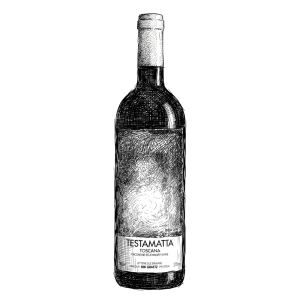
“Testamatta” is a wine made from 100% Sangiovese, but it is neither a Chianti Classico, nor a Brunello, nor a wine bearing the DOCG designation on its label. By his own choice, this Tuscan wine is classified as IGT. Graetz uses grapes harvested from old vines across five different plots scattered throughout Tuscany, and vinifies each one separately. The wine’s name translates to “crazy head,” and it reflects both him and the essence of this wine.
About Bibi Graetz
Bibi Graetz, a trained artist running a winery out of a former hotel, works and lives in the former Hotel Aurora building located in the central square of Fiesole, the hill town above Florence. In the late 1990s, as the lease on an old vineyard on his family's property in Castello di Vincigliata was about to expire, he stumbled into the wine business and decided to use the land for wine production.
His first vintage was in 2000. Currently, the winery cultivates approximately 80 hectares across a broad, crescent-shaped area stretching across Tuscany, ranging from Vincigliata at 280 meters above sea level to Lamole at 600 meters above sea level in Chianti Classico, and the terraced Ansonica vineyards on the granite island of Giglio. Sangiovese is the primary grape variety for red wines (Testamatta and Colore are currently produced from 100% Sangiovese), and the grapes are primarily harvested from vines ranging in age from 35 to 80 years. Furthermore, all labels are hand-drawn by Graetz.
History & Heritage
The Graetz family owned the historic Castello di Vincigliata estate, located in the hills of Fiesole. In the second half of the 1990s, as the deadline for renewing the vineyard lease approached, Graetz had two options: either leave or take action. Graetz decided to take action. The result was the 2000 “Testamatta” vintage, which caused a huge sensation.
This winery (officially known as Azienda Agricola Testamatta) has grown to cover an area of about 80 hectares, spread throughout Tuscany. In 2020, Graetz acquired another 90 hectares of land behind the winery in Fiesole. The style of the wine itself has also evolved alongside these changes, and the transition to using 100% Sangiovese, which began around 2015,has been particularly notable.
Terroir & Climate
“Testamatta” is not a single-vineyard wine. It is made from old Sangiovese vines ranging in age from 35 to 80 years, growing on five plots in different parts of Tuscany, located at significantly varying altitudes. Vincigliata is situated at an elevation of about 280 meters above sea level, and the soil here consists of galestro (crumbled limestone and clayey shale mixed with sand and stones, common throughout Tuscany). The “Lamole” vineyard rises to an elevation of 600 meters in the cool central part of Chianti Classico. The “Montefili” vineyard is located at an elevation of 400 meters. The “Londa” vineyard, located north of Florence, and the vineyard south of Siena give the wine a warmer and softer fruity flavor.
The goal of this wide distribution of vineyards is to achieve balance. From the high-altitude, cool areas, we obtain acidity and freshness, and from the low-lying, warm areas, ripeness and richness.
Grape Varieties
The current blend is simple: 100% Sangiovese, from old vines ranging in age from 35 to 80 years.
However, “Testamatta” was not always a single-varietal wine. Until about 2015, it included Canaiolo and Colorino, traditional secondary varieties for Chianti. Mr. Graetz gradually phased them out of each plot. The reason for his success in producing a single-varietal Sangiovese lies in the diversity of the plots. Lamole, located at high altitude, contributes acidity and floral freshness, Vincigliata, structure thanks to its galestro soil, and the southern plots, rich flavor. Many single-varietal Sangiovese wines are often perceived as monotonous, but this issue is resolved through blending, which combines different terroirs.
Winemaking
The harvest is done by hand and is not completed in a single pass. Each plot is walked through up to 8 times per season, picking only the fully ripe berries. The berries are sorted twice: first in the vineyard, then at the winery.
Fermentation occurs exclusively using wild yeasts present on the surface of the berries. Wine from smaller plots is fermented in 225-liter open barriques, while wine from larger plots is fermented in larger barrels or stainless steel tanks. Importantly, all plots are managed separately, from harvest through aging. The final blend of “Testamatta” is determined not at the beginning, but at the end of the winemaking process. This results in a harmonious wine that retains the individual character of each plot.
Food Pairing
Since “Testamatta” has the high acidity and firm tannins characteristic of the Sangiovese variety, it requires richness and saltiness to achieve balance. Here are a few dishes that pair well with it:
- “Bistecca alla Fiorentina” (Tuscan bone-in steak) — crispy on the outside, medium-rare on the inside
- Wild boar ragù with pappardelle
- Aged Pecorino Toscano — the saltier, the better
- Roast duck with cherries and figs
Its acidity, just as with Chianti during dinner, perfectly balances the richness of the dishes. In other words, this is the ideal way to enjoy it.
Serving Suggestions
Serve at 16–18 °C. At higher temperatures, the alcohol comes to the forefront, and at lower temperatures, the aroma doesn’t fully develop. Young vintages (less than 10 years old) should be decanted for at least 90 minutes to allow contact with air. For aged wines, 30 minutes is sufficient, but if there is sediment in the bottle, pour the wine carefully. In this case, standard Burgundy-style glasses are better suited than Bordeaux glasses, since Sangiovese benefits from contact with air across a wider surface area.
Vintages
Testamatta’s flavor varies significantly depending on the vintage. This is due not only to the fact that the vineyards are widely scattered, but also to the fact that pure Sangiovese has nowhere to hide. Warm years in Tuscany, such as 2020, give the wine richness, deep fruit flavors, and soft acidity, allowing it to reach its peak drinking window more quickly. Cooler years and more classic vintages produce a more austere, piquant Testamatta with sharp acidity, which is worth aging for a long time. The 2012 vintage serves as a good example of what an aged “Testamatta” becomes, as secondary notes (leather, dried herbs, tobacco) begin to emerge in the aroma. The 2021 vintage is in the early stages of its maturation period. If you plan to drink the wine right now, it’s best to choose a vintage that has been aged for at least 8–10 years. For cellar aging, vintages from recent years are a reliable choice.
The best vintages of Testamatta are, amongst others: 2006, 2012, 2016, 2018, 2020, 2021.

Cellaring Potential
Recommended drinking window till 25 years after release, depending on the vintage. The wine’s structure is a classic Sangiovese in all its glory. It has high natural acidity and dense, slightly astringent tannins, and it takes time for these two components to blend harmoniously. Old vines give the wine a richness that does not diminish over time. Store the wine at a stable temperature of 12–14 °C, in a dark place if possible.
FAQ
Is “Testamatta” a Chianti Classico?
No. It is a Tuscan IGT wine, which allows Mr. Graetz to pursue winemaking freely, without being bound by DOC or DOCG regulations.
Is “Testamatta” made from 100% Sangiovese?
Yes, it has been since 2015. Prior to that, the blend included Canaiolo and Colorino.
How long can “Testamatta” be aged?
Given the acidity and tannic structure characteristic of Sangiovese from old vines, in a good vintage the wine can age for over 20 years without any issues.
Is “Testamatta” considered a “Super Tuscan” wine?
Yes. This wine falls under the IGT category, created for high-quality Tuscan wines that do not fall under the rules of a designated appellation of origin—which is the typical definition of a “Super Tuscan.”
