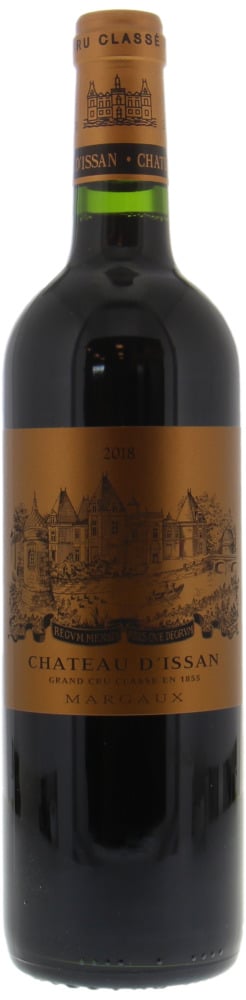

| Classification | Troisième Cru Classé |
| Type | Red |
| Producer | Chateau D'Issan |
| Vintage | 2018 |
| Country | France |
| Main region | Bordeaux |
| Region | Margaux |
| Grape | Cabernet Sauvignon, Merlot, Bordeaux Blend |
| Volume | 0,75 |
| Condition | In Original Wooden Case |
| Label | Perfect |
| Drinkable | -2048 |
| Stock | 5 |
The 2018 growing season in Margaux was completely different in its first and second halves. Spring, marked by heavy rains and the threat of grey mould, forced us to constantly monitor the condition of the vineyards; however, the situation changed dramatically in the summer, with intense heat and drought setting in. For Château d'Issan, this resulted in highly ripe, concentrated fruit notes and surprisingly fresh acidity. The result is one of d'Issan's most intense vintages of the past 10 years. It exhibits a higher degree of ripeness than the 2016 vintage and a more robust structure than the 2017 vintage. Here are reviews by Robert Parker, James Suckling, and our team at *Best of Wines* magazine.
The 2018 D'Issan is composed of 60% Cabernet Sauvignon and 40% Merlot, aging in 50% new and 50% second year barrels for an estimated 18 months. With 13.97% alcohol and a deep garnet-purple color, it features baked berries, warm cherries and cassis with spice box and fragrant earth plus tea hints. Medium to full-bodied, it has a great core of muscular fruit with firm, fine-grained tannins, with nice freshness, finishing layered with mineral notions.
Aromas of blackberry, plum, cocoa, iodine, clove and graphite. It’s medium-to full-bodied with firm, silky tannins. Tightly wound and mineral at the moment, with dusty gravel and graphite notes, yet with focus and precision. Such balance and harmony for the vintage.
Aromas of black currant and rich plum come to the forefront, complemented by the freshness of violets and the graphite-like sharpness characteristic of Margaux. The cedar aroma, imparted by the oak barrels, remains in the background and does not dominate.
Aromas of black currant and rich plum come to the forefront, complemented by the freshness of violets and the graphite-like sharpness characteristic of Margaux. The cedar aroma, imparted by the oak barrels, remains in the background and does not dominate. On the palate, the 2018 vintage is smooth, with the sweetness of fruit ripened during a hot summer, but the tannins are firm and have a fine-grained, almost powdery texture. A metallic minerality lingers in the finish. The wine can be enjoyed now after decanting, though its structure suggests it should be given time to age. It is recommended to age it for at least another 5 years.
In the 2018 vintage, Cabernet Sauvignon makes up about 60% of the blend, with Merlot accounting for the remaining 40%. Cabernet brings to the wine the robust foundation, blackcurrant aroma, and structure capable of withstanding long-term aging that are characteristic of Margaux with its gravelly soils. Merlot adds roundness to the mid-palate and softens the sharpness of the tannins. This blend ratio is ideal for the d'Issan, as the deep layer of gravel allows the Cabernet roots to penetrate deeply, while the clay subsoil prevents the Merlot from drying out.
Best enjoyed between 2026 and 2045. The 2018 vintage possesses a density of tannins and concentration that will easily withstand 20 years of aging; however, this does not mean that this wine requires excessive patience. Store in a room with constant humidity at a temperature of 12–14 °C. As it matures, the fruit notes are expected to evolve from black currant to dried plum and tobacco, while the cedar notes will deepen.
Wine has been produced at d'Issan since the Middle Ages, and the current château, surrounded by a moat, was built in the 17th century. The walled "Clos" vineyard was completed in 1644. However, d'Issan's modern history truly began in 1945, when the Cruz family acquired the neglected estate and replanted the vineyards. In 1998, management passed to Emmanuel Cruz, who achieved a significant improvement in quality, and in 2012, the Lorenzetti family joined the business as co-owners. We offer d’Issan wines because, despite their third-growth-level pricing, they always deliver the aromas of Margaux.
The vineyards are located on a gravelly hill in the very heart of the Margaux AOC, between Château Palmer and Château Margaux. The croupe (a gravelly rise) is well-drained and warms up quickly, forcing the vines to send their roots deep into the underlying clay layer in search of moisture. This is precisely where the wine’s richness comes from. The mouth of the Gironde River moderates temperature fluctuations, and since this estate is located almost exactly on the 45th parallel north, it enjoys long, warm summers and mild winters. For the Cabernet Sauvignon variety, these are, in essence, the typical conditions of the Left Bank.
The hand-harvested grapes undergo a two-stage sorting process (first by hand, then on a vibrating sorting table) and flow by gravity into stainless steel tanks, separated by vineyard plot. Fermentation and maceration last between 18 and 24 days. The blend is determined in January and February in consultation with consultant Éric Boissenot, after which the wine is aged in French oak barriques (225-liter Bordeaux barrels) for 16–18 months. About half of the barrels are new. This proportion of new barrels is sufficient to impart structure and spicy notes to the wine without detracting from the floral nuances characteristic of Margaux. Each year, the chateau ships approximately 100,000 bottles of grand vin.
Tannins require proteins and fats. Examples of successful pairings:
Serve at 16–18 °C. Young vintages, such as the 2022, should be decanted for at least an hour before serving to allow them to breathe.
With track & trace code