| Price from | € 479,00 |
| ex Vat | € 449,00 |
| in Vat | € 543,29 |
| Volume | Magnum |
| Price from | € 979,00 |
| ex Vat | € 899,00 |
| in Vat | € 1.087,79 |
| Volume | Double Magnum |
| Classification | Cru Classe |
| Type | Red |
| Producer | Tenuta dell' Ornellaia |
| Vintage | 2023 |
| Country | Italy |
| Region | Tuscany |
| Appellation | Bolgheri |
| Grape | Cabernet Sauvignon, Merlot, Cabernet Franc, Petit Verdot |
| Volume | 0,75 |
| Condition | Perfect |
| Label | Perfect |
| Drinkable | 2027-2050 |
| Stock | 0 |
| Volume | 1,5 |
| Drinkable | 2030-2050 |
| Stock | 0 |
| Volume | 3,0 |
| Drinkable | 2030-2050 |
| Stock | 0 |
The 2023 growing season in Bolgheri was a challenging one. Spring rains caused significant downy mildew damage throughout the Tuscan coast, forcing the vineyards to be treated with extra care and reducing yields. For Tenuta dell'Ornellaia, this meant rigorous selection at every stage: 2023 is a wine of precision, not abundance. It was also the last vintage created under the leadership of Axel Heinz, who stepped down as estate director before Marco Balsimelli took over.
The Ornellaia 2023 Bolgheri Superiore Ornellaia is a blend of 55% Cabernet Sauvignon, 26% Merlot, 12% Cabernet Franc and 7% Petit Verdot, and it is worth noting that Merlot remains present at nearly the same percentage as previous years, despite the greater challenges faced by early-ripening varieties in this mildew-prone vintage. Careful fruit selection made the difference. The wine shows impressive richness and concentration with a bouquet that leans botanical and complex, marked by dark fruit, Mediterranean thyme and rosemary. The nose was slightly closed when I tasted the wine, but it will open. The texture is velvety and polished, delivering beautiful richness with a sense of succulence that feels expansive on the palate. According to proprietor Lamberto Frescobaldi, the goal is to establish a clear through line focused on freshness and balancing fruit and spice while avoiding excess ripeness. This is a meticulously made Ornellaia that captures the vintage with remarkable elegance. The wine was bottled in July 2025 and is scheduled for release in March 2026.
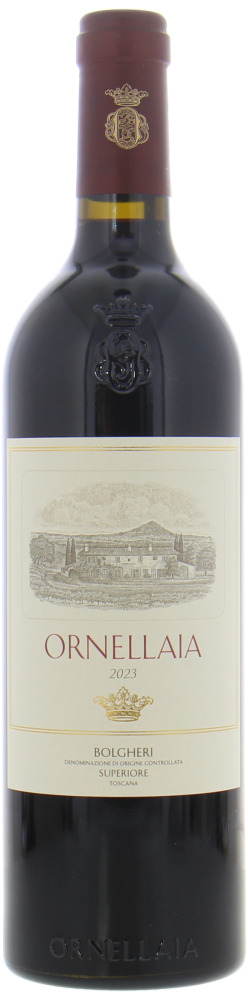
Full bottle 1,318 g. This edition, illustrated by Marina Abramovič, no less, for their artists series, is dubbed La Vitalità for the vitality of the fruit. Newish technical director Marco Balsimelli explains: ‘the mild winter encouraged early vine growth, which was monitored non-stop by our technical team. Then the spring brought abundant precipitation, which on the one hand helped build up water reserves for the summer, while also requiring extra work in the vineyard to keep the growth under control and to prevent any disease. The ensuing summer in Bolgheri was hot, without ever reaching extreme peaks in temperature. There was no water stress among the vines, which ripened gradually with the right levels of concentration. Late August rain and cool September nights favoured the development of aromatic complexity and preserved the acidity in the bunches, ensuring balance between expression and elegance, which is the hallmark of Ornellaia.’ So now you know. The Merlot harvest started in the last week of August, Cabernet Franc in the first week of September and Cabernet Sauvignon on 10 September. Final blend after a cool fermentation was 55% Cabernet Sauvignon, 26% Merlot, 12% Cabernet Franc and 7% Petit Verdot. To be released in April 2026.
Very deep crimson. Very rich and sweet on the nose and then with balsam dryness on the palate. Trademark opulence. So much richer than Sassicaia 2023! Horses for courses. Classicists should head for Sassicaia; hedonists for Ornellaia.(JR)
The 2023 Ornellaia is elegant and supremely finessed right out of the gate. Dark cherry, plum, mocha, dried herbs, licorice and lavender all meld together in the glass. There are no hard edges or awkward contours. Readers will find an Ornellaia that speaks to understatement and finesse more than power. This is impressive.

The first thing you sense in Ornellaia 2023 is a riot of flavor. Black currant and dark plum are juxtaposed with graphite, cedar and Mediterranean herbs. The palate features fine-grained tannins, less weighty than the broader 2019, more nervous and tense. Cabernet Franc lends a floral note, while Petit Verdot provides color and spice. This wine will need another five to seven years to unfold, but if you can't wait, decanting is a good idea.
Cabernet Sauvignon forms the backbone of Ornellaia, usually accounting for just over half of the blend, along with Merlot, Cabernet Franc and a small amount of Petit Verdot. Cabernet brings structure and cassis. Merlot fills out the mid-palate. And the Cabernet Franc, which is about 10%, gives the wine fragrance and exuberance.
Drink between 2028 and 2045. Ornellaia 2023 needs at least 3-5 years to develop structure (firm tannins, lively acidity and concentrated fruit from low yields); store horizontally at a stable temperature of 12-14°C and away from light. As the fruitiness subsides, notes of graphite and tobacco deepen.
Lodovico Antinori founded Tenuta dell'Ornellaia in 1981. He planted Cabernet Sauvignon, Merlot and Cabernet Franc on coastal soils composed of mixed clay-limestone and marine sediments, more like Bordeaux than Chianti. By 2005, the Frescobaldi family took full ownership and now produces Le Volte, Le Serre Nuove, the white Poggio alle Gazze and the flagship Bolgheri Superiore. We believe that this first bet still defines what Ornellaia is today.
Bolgheri is located on the Tyrrhenian coast, in the Maremma region, where Bordeaux grapes thrive, but Sangiovese, the classic Tuscan variety, does not. Why is soil so important here? Because Ornellaia's vineyards are dotted with alluvial gravel, clayey limestone, sand and old marine sediments, all within walking distance of each other. This diversity of soils allows each grape variety to find its own plot. Add to this a maritime climate with warm days and cool nights drawn from the sea, and it is for this reason that Bolgheri DOC, founded in 1994, has become home to the Super Tuscans.
Each variety, and often each site, is fermented separately in stainless steel and temperature-controlled concrete. This separation is crucial and allows the blending team to select only the very best from dozens of individual batches, which become the Grand Vin. Aging takes place in 225-liter French oak barriques (a traditional size for Bordeaux, with an optimal oak-to-wine ratio) for 18 months. First, the grapes are hand-picked and sorted on the table. There is nothing exotic about this. Just strict sorting at every stage.
Tannins look for protein and fat. Bistecca alla Fiorentina is an obvious combination, the charring of the T-bone echoes the oak, and beef fat softens the grip. Brasato al Barolo, cooked over low heat and arranged in layers, works for the same reason. Pappardelle with wild boar ragù brings out savory notes. The aged pecorino Toscano creates a lovely contrast; decant an hour before serving; serve at 16-18°C.
With track & trace code