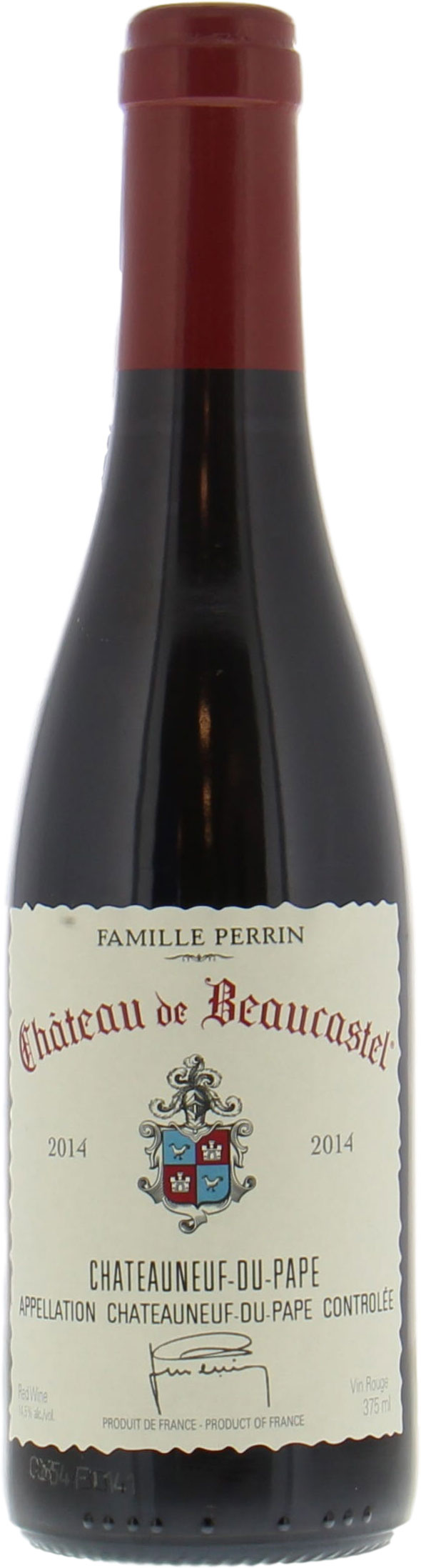
| ex Vat | € 34,00 |
| in Vat | € 41,14 |
| Volume | Half bottle |
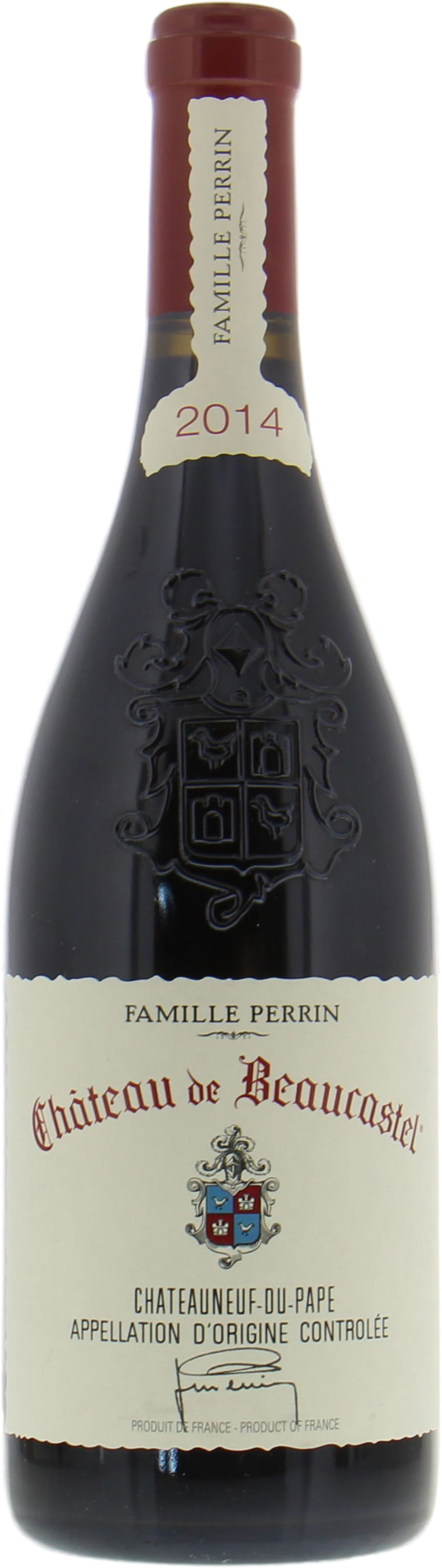
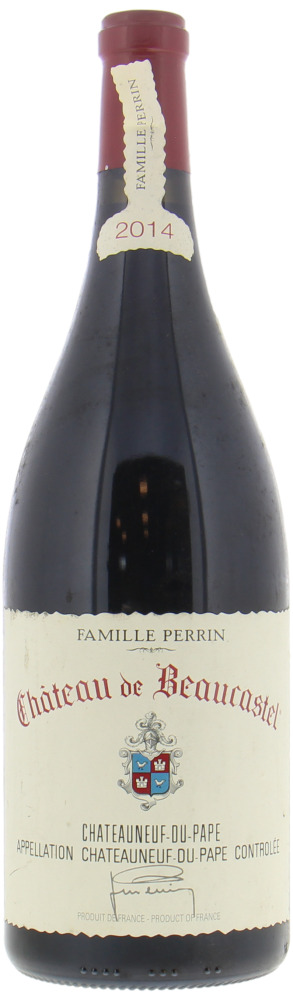
| ex Vat | € 169,00 |
| in Vat | € 204,49 |
| Volume | Magnum |
| Classification | Cru Classe |
| Type | Red |
| Producer | Chateau de Beaucastel |
| Vintage | 2014 |
| Country | France |
| Region | Rhone |
| Appellation | Châteauneuf-du-Pape |
| Grape | Rhone Blend |
| Volume | 0,75 |
| Condition | Perfect |
| Label | Perfect |
| Stock | 0 |
| Volume | 0,375 |
| Condition | Perfect |
| Label | Perfect |
| Stock | 0 |
| Volume | 1,5 |
| Condition | Perfect |
| Label | Slightly bin soiled |
| Stock | 1 |
The 2014 harvest in Châteauneuf-du-Pape brought typical conditions: a warm, dry summer and a strong mistral wind that concentrated the flavors without sizzling the fruit. At Château de Beaucastel, this resulted in a wine that expresses their characteristic style: the structure due to mourvèdre is balanced by the rich fruitiness of grenache. The Perrin family's approach to organic viticulture bore fruit this year: the 50-year-old vines on the estate yielded grapes of surprising concentration. Robert Parker gave this vintage 94 points, noting that this growing season allowed all 13 permitted varieties to contribute significantly to the final blend.
The 2014 Châteauneuf du Pape is one of the few inky colored wines in the vintage. Medium to full-bodied, concentrated and ripe with notable tannin, it offers beautiful notes of blackberry, shitake mushrooms, licorice and pepper meats. It plays in the 2014 vintage’s forward, supple nature, but has real depth and concentration. I don’t think it will be the longest lived Beaucastel, but it will have 15-20 years of overall longevity.
A solid core of kirsch and raspberry compote stands out here, with light savory, pepper and shiso leaf notes peeking in. Stays fresh and sleek through the finish, revealing an echo of warm stones at the very end.
The 2014 Chateau de Beaucastel Chateauneuf du Pape has evolved considerably since its release roughly two years ago and is utterly delicious at this point in its evolution. The wine shows best following a one hour decant. Once aroused this beautiful wine opens with a bright bouquet of Provencale herbs, green peppercorns, cigar box and copious dark fruits that all marvelously mingle together in the glass. Deep and seductive, the wine has a gloriously rich texture and a silky smooth mouthfeel as it gracefully glides across the mid-palate. The wine unveils intense flavors of green olive tapenade, red currant, bacon fat, blackberry cobbler and green peppercorn with herbal and peat moss undertones that build on the palate. The combination of weight and minerality is stunning here. Highly pleasurable now, the wine will have an exceedingly long life in the cellar.

The flavors of dark fruit and Mediterranean herbs characteristic of the Garrigue bushland in Châteauneuf-du-Pape are immediately apparent. In the nose, grenache gives way to blackberries and plums, but it is mourvèdre that provides the backbone of the wine. On the palate, the tannins are firm and structured, suggesting that this wine deserves patience. The savory finish is long, with notes of olives and dried thyme. This wine already shows the complexity that makes Beaucastel special among Châteauneuf-du-Pape producers, but it will need another three to five years to fully integrate.
All 13 varieties recognized in Châteauneuf-du-Pape are grown in Beaucastel. Grenache is used extensively in most wine domains, but the main variety here is Mourvèdre, usually about 30% of the blend, with Grenache accounting for 30%. The remaining 40% is Syrah, Cinsault and Cunoise, along with a small amount of other authorized varieties. Why this particular approach? Mourvèdre brings more structure and length. And in a warm year like 2023, its tannin support becomes very important.
Best time to drink: 2024-2040. Mourvèdre's tannins need a few more years to fully soften. If the wine is opened now, decanting is recommended; store in the dark at 12-14°C. Over the next 10 years, the fruitiness is expected to shift from primary berry notes to more complex leather, gibier and woodsy notes. This vintage has sufficient balance to age gracefully for at least another 20 years.
The Perrin family has owned Beaucastel since 1909, but it was Jacques Perrin who shaped the modern look of the estate. His philosophy was simple and straightforward: organic farming (started in 1950, decades before it became fashionable), blending predominantly Mourvèdre and never compromising the character of the wine for the sake of convenience. When he died in 1978, his sons Jean-Pierre and François adopted this approach. Today, the four Perrin brothers manage 130 hectares of land. Best of Wines considers them one of the most consistent producers in Châteauneuf-du-Pape.
The 70-hectare Beaucastel vineyard in Châteauneuf-du-Pape is located in the northeast of the region, near Courzon. The distinctive feature of this site is the galets roulés (large rounded stones that cover most of the vineyard surface). During the day, these stones absorb the heat of the Provencal sun. At night, the accumulated heat is returned to the vines, prolonging the ripening period of the grapes at lower temperatures. Beneath the stones is a Miocene marine molasse covered by alpine alluvium. It is well drained, which is very important in rainy years.
Beaucastel ferments each of the 13 authorized varieties separately in concrete tanks. Before fermentation, the grape skins are briefly heated to 80°C and quickly cooled. This allows the color and aroma to unfold without the harsh tannins often associated with prolonged maceration. Aging takes place in large oak fouders (rather than small barriques), which provide gentle oxygenation without masking the fruity flavors. The result is more terroir and less oak flavor.
The structure and level of spice in this wine demands persistent flavors. Braised shoulder of lamb with rosemary blends beautifully with the fat, which does a great job of softening the tannins. Paired with mature Roquefort and walnuts, the saltiness of the cheese harmonizes with the fruitiness of the wine. Wild boar ragout also pairs well, especially with its herbal complexity; serve at 18°C and decant 30 minutes if drinking young. Delicate dishes can be overpowered.
With track & trace code