| ex Vat | € 179,00 |
| in Vat | € 216,59 |
| Volume | Magnum |
| ex Vat | € 289,00 |
| in Vat | € 349,69 |
| Volume | Double Magnum |
| ex Vat | € 599,00 |
| in Vat | € 724,79 |
| Volume | Imperial |
| Classification | Cru Classe |
| Type | Red |
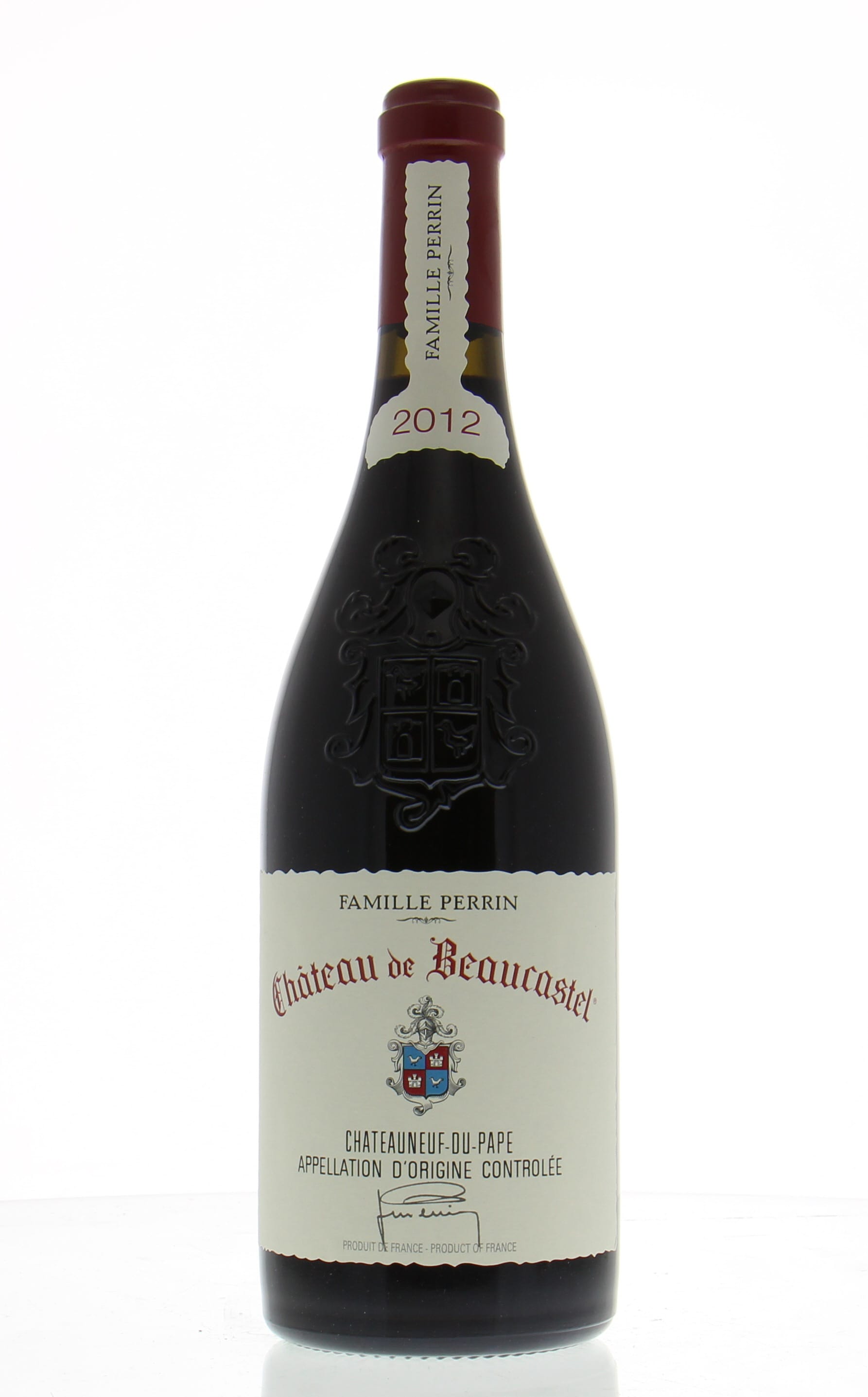
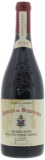
| Producer | Chateau de Beaucastel |
| Vintage | 2012 |
| Country | France |
| Region | Rhone |
| Appellation | Châteauneuf-du-Pape |
| Grape | Rhone Blend |
| Volume | 0,75 |
| Condition | Perfect |
| Label | Perfect |
| Drinkable | 2017-2032 |
| Stock | 0 |
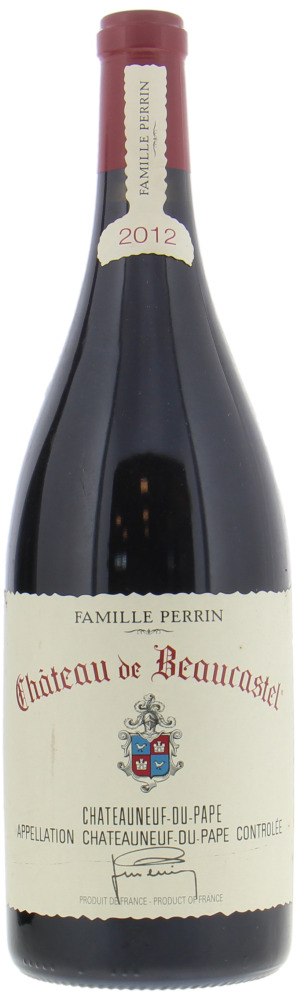
| Volume | 1,5 |
| Condition | Perfect |
| Label | Slightly bin soiled |
| Drinkable | -2032 |
| Stock | 1 |
| Volume | 3,0 |
| Condition | Perfect |
| Label | Perfect |
| Drinkable | 2017-2032 |
| Stock | 0 |
| Volume | 6,0 |
| Condition | Perfect |
| Label | Perfect |
| Drinkable | 2017-2032 |
| Stock | 0 |
The 2012 growing season at Châteauneuf-du-Pape was both challenging and rewarding in equal measure. A cool and wet spring delayed bud break, but the summer heat came just when the vines needed it most. For Château de Beaucastel, this meant extended ripening time, essential for a producer whose blend is based on late-ripening Mourvèdre. Harvesting extended into October, allowing the Perrin family to select only fully ripe fruit. The result was a wine of power and elegance, which showed the Domaine's distinctive style and conveyed the special character of the vintage.
What I think might end up being the best Beaucastel since the 1990 or 2001, the 2012 Châteauneuf du Pape offers a full-bodied, decadent style to go with awesome black and blue fruits, garrigue, licorice, crushed flowers and violets. The purity here is truly something, and it has fabulous mid-palate concentration, building tannin and massive texture. Given all of the fruit and texture here, it will no doubt drink well in its youth, but it should still be alive and kicking after two decades as well.
Warm raspberry and boysenberry confiture aromas and flavors are dominant in this lush, inviting style, but there's plenty of dried star anise, bay leaf, licorice root, worn leather and roasted juniper notes to fill out the chorus. The finish turns youthfully grippy, with a tarry edge holding sway and adding serious length. Try now, but cellar for maximum effect.
Very dark crimson. Vibrant colour is almost black. Black olives and smoked bacon. Extremely vibrant on the nose too. Luscious ripe fruit on the front palate almost completely covers the tannins. Really quite remarkable. What a different wine from the 2011! Sumptuous. (JR)
With a hint of candied violet underlaid black forest berries, but also ripe plum and nougat, candied orange zest, intense and at the same time very attractive bouquet. Very full, almost opulent, extract sugar and a pleasant savouriness, powerful tannins that promise a long life, pleasant herbal touch on the long finish, but still shows some baby fat. Here some patience is still required.

Aromas of dark cherry and blackberry are the first to be revealed, but underneath are more complex notes of leather, dried herbs and the garrigue character typical of the Southern Rhône. Mourvèdre provides the backbone, while Grenache adds warmth and glycerin richness. On the palate, the tannins still feel integrated after nearly 30 years of aging, but still structured. A savory, almost meaty texture develops from the middle of the palate, followed by notes of black olive and dried lavender. The finish is long, with notes of spice and minerals from the famous galets roulés. At 28 years old, this wine is ready to drink.
All 13 varieties recognized in Châteauneuf-du-Pape are grown in Beaucastel. Grenache is used extensively in most wine domains, but the main variety here is Mourvèdre, usually about 30% of the blend, with Grenache accounting for 30%. The remaining 40% is Syrah, Cinsault and Cunoise, along with a small amount of other authorized varieties. Why this particular approach? Mourvèdre brings more structure and length. And in a warm year like 2023, its tannin support becomes very important.
The wines from this vintage are fully mature and will drink well into the 2030s. With Beaucastel's emphasis on Mourvèdre, this wine is well structured and will age well for a long time. If stored in bottle, it should be kept in a dark place at 55-60°F. The complex tertiary aromas of leather, earth and dried herbs that are the charm of the aged Châteauneuf-du-Pape are already showing.
The Perrin family has owned Beaucastel since 1909, but it was Jacques Perrin who shaped the modern look of the estate. His philosophy was simple and straightforward: organic farming (started in 1950, decades before it became fashionable), blending predominantly Mourvèdre and never compromising the character of the wine for the sake of convenience. When he died in 1978, his sons Jean-Pierre and François adopted this approach. Today, the four Perrin brothers manage 130 hectares of land. Best of Wines considers them one of the most consistent producers in Châteauneuf-du-Pape.
The 70-hectare Beaucastel vineyard in Châteauneuf-du-Pape is located in the northeast of the region, near Courzon. The distinctive feature of this site is the galets roulés (large rounded stones that cover most of the vineyard surface). During the day, these stones absorb the heat of the Provencal sun. At night, the accumulated heat is returned to the vines, prolonging the ripening period of the grapes at lower temperatures. Beneath the stones is a Miocene marine molasse covered by alpine alluvium. It is well drained, which is very important in rainy years.
Beaucastel ferments each of the 13 authorized varieties separately in concrete tanks. Before fermentation, the grape skins are briefly heated to 80°C and quickly cooled. This allows the color and aroma to unfold without the harsh tannins often associated with prolonged maceration. Aging takes place in large oak fouders (rather than small barriques), which provide gentle oxygenation without masking the fruity flavors. The result is more terroir and less oak flavor.
The structure and level of spice in this wine demands persistent flavors. Braised shoulder of lamb with rosemary blends beautifully with the fat, which does a great job of softening the tannins. Paired with mature Roquefort and walnuts, the saltiness of the cheese harmonizes with the fruitiness of the wine. Wild boar ragout also pairs well, especially with its herbal complexity; serve at 18°C and decant 30 minutes if drinking young. Delicate dishes can be overpowered.
With track & trace code