| ex Vat | € 229,00 |
| in Vat | € 277,09 |
| Volume | Magnum |
| Classification | Cru Classe |
| Type | Red |
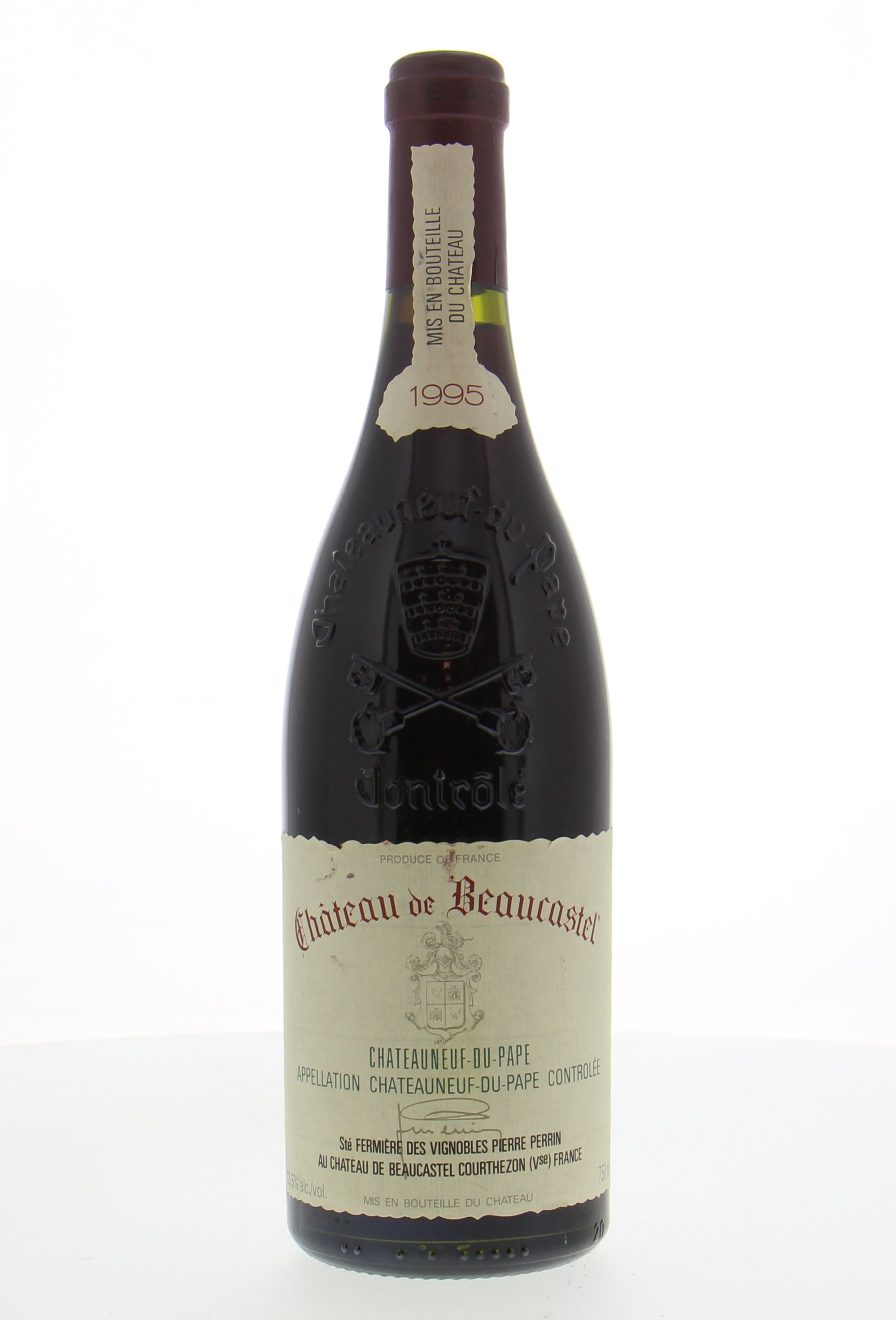
| Producer | Chateau de Beaucastel |
| Vintage | 1995 |
| Country | France |
| Region | Rhone |
| Appellation | Châteauneuf-du-Pape |
| Grape | Syrah/Shiraz, Grenache, Mourvedre, Cinsault, Rhone Blend |
| Volume | 0,75 |
| Condition | Perfect |
| Label | Slightly bin stained |
| Stock | 0 |
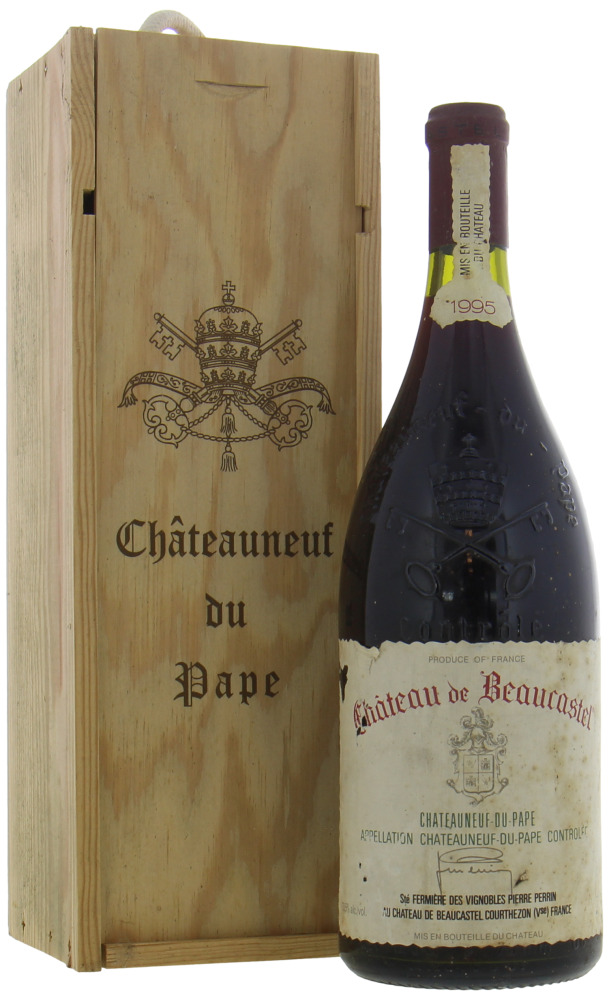
| Volume | 1,5 |
| Condition | In single OWC |
| Label | Bin soiled |
| Stock | 1 |
The 1995 growing season at Châteauneuf-du-Pape brought exceptional conditions - a hot, dry summer that concentrated flavors without stressing the vines. For Château de Beaucastel, this meant that the Mourvèdre-rich blend reached phenolic ripeness while retaining its natural acidity. The mistral winds kept the vineyards cool at the peak of the heatwave, allowing for extended aging time. Jean-Pierre and François Perrin, who have just succeeded their father Jacques, have created a vintage that many consider a benchmark. The wines showcase the domaine's signature style: structured yet approachable, with depth that can endure for decades.
The classic 1995 Chateauneuf du Pape will require discipline. Like most top vintages of Beaucastel, a decade of patience will be warranted before this wine will be enjoyable to drink. Given how tight and closed the 1993 and 1994 are, it is the rare vintage of Beaucastel (1989, 1990, and 1995) that is accessible in its youth, yet they will remain capable of aging for 20-25 years. In some ways, proprietors Francois and Jean-Pierre Perrin might be accused of trying to make the wine too long-lived, as if this is the primary merit to a great red wine. The 1995 will have three decades of longevity, but it will not be approachable before 2006. It exhibits a deep dark ruby/purple color, and a provocative (probably controversial) aromatic profile of animal fur, tar, truffles, black cherries, cassis, licorice, and minerals. A medium to full-bodied wine, with a boatload of tannin, considerable grip and structure, and a weighty feel in the mouth, this appears to be a classic vin de garde made in the style of the 1978 Beaucastel (which is still not close to full maturity). Prospective purchasers over the age of forty should be buying this wine for their children.
Very youthful, with a ripe core of red currant and raspberry fruit and licorice flavor surrounded by creamy tannins. Plenty of smoke, mineral and tobacco notes chiming in, but this still has a ways to go, with plenty of grip still on the finish.--1995 Châteauneuf-du-Pape retrospective. Drink now through 2025.
Aromas of dark cherry and blackberry are the first to be revealed, but underneath are more complex notes of leather, dried herbs and the garrigue character typical of the Southern Rhône. Mourvèdre provides the backbone, while Grenache adds warmth and glycerin richness. On the palate, the tannins still feel integrated after nearly 30 years of aging, but still structured. A savory, almost meaty texture develops from the middle of the palate, followed by notes of black olive and dried lavender. The finish is long, with notes of spice and minerals from the famous galets roulés. At 28 years old, this wine is ready to drink.
All 13 varieties recognized in Châteauneuf-du-Pape are grown in Beaucastel. Grenache is used extensively in most wine domains, but the main variety here is Mourvèdre, usually about 30% of the blend, with Grenache accounting for 30%. The remaining 40% is Syrah, Cinsault and Cunoise, along with a small amount of other authorized varieties. Why this particular approach? Mourvèdre brings more structure and length. And in a warm year like 2023, its tannin support becomes very important.
The wines from this vintage are fully mature and will drink well into the 2030s. With Beaucastel's emphasis on Mourvèdre, this wine is well structured and will age well for a long time. If stored in bottle, it should be kept in a dark place at 55-60°F. The complex tertiary aromas of leather, earth and dried herbs that are the charm of the aged Châteauneuf-du-Pape are already showing.
The Perrin family has owned Beaucastel since 1909, but it was Jacques Perrin who shaped the modern look of the estate. His philosophy was simple and straightforward: organic farming (started in 1950, decades before it became fashionable), blending predominantly Mourvèdre and never compromising the character of the wine for the sake of convenience. When he died in 1978, his sons Jean-Pierre and François adopted this approach. Today, the four Perrin brothers manage 130 hectares of land. Best of Wines considers them one of the most consistent producers in Châteauneuf-du-Pape.
The 70-hectare Beaucastel vineyard in Châteauneuf-du-Pape is located in the northeast of the region, near Courzon. The distinctive feature of this site is the galets roulés (large rounded stones that cover most of the vineyard surface). During the day, these stones absorb the heat of the Provencal sun. At night, the accumulated heat is returned to the vines, prolonging the ripening period of the grapes at lower temperatures. Beneath the stones is a Miocene marine molasse covered by alpine alluvium. It is well drained, which is very important in rainy years.
Beaucastel ferments each of the 13 authorized varieties separately in concrete tanks. Before fermentation, the grape skins are briefly heated to 80°C and quickly cooled. This allows the color and aroma to unfold without the harsh tannins often associated with prolonged maceration. Aging takes place in large oak fouders (rather than small barriques), which provide gentle oxygenation without masking the fruity flavors. The result is more terroir and less oak flavor.
The structure and level of spice in this wine demands persistent flavors. Braised shoulder of lamb with rosemary blends beautifully with the fat, which does a great job of softening the tannins. Paired with mature Roquefort and walnuts, the saltiness of the cheese harmonizes with the fruitiness of the wine. Wild boar ragout also pairs well, especially with its herbal complexity; serve at 18°C and decant 30 minutes if drinking young. Delicate dishes can be overpowered.
With track & trace code