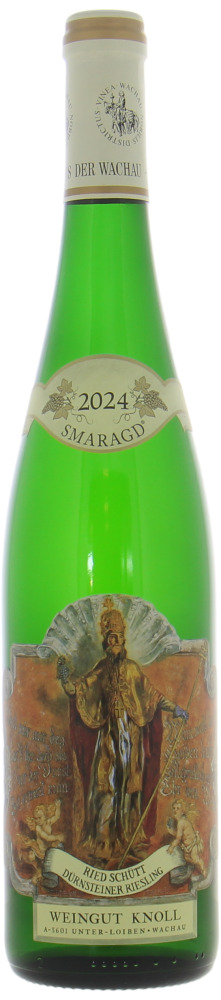
Ried Schütt est situé sur un cône alluvial formé de gneiss de Gföhl érodé. Ce Riesling sec, produit par Weingut Emmerich Knoll, appartient à la catégorie Smaragd et provient de Dürnstein, dans la région de la Wachau. Il reflète clairement les caractéristiques de son sol caillouteux. Il s'agit de la catégorie de vin sec la plus mûre de cette région. Les vignes ont ici plus de 30 ans.
Bien que l'été 2024 ait été chaud, il n'a pas été aussi sec que les autres années, si bien que les vignobles en terrasses n'ont pratiquement pas nécessité d'irrigation. Les vignes ont poussé à un rythme étonnamment rapide, et les vendanges ont débuté le 2 septembre.
Les grappes entières sont récoltées à la main, foulées, macérées, puis pressées. Elles sont ensuite élevées sur lies fines pendant 6 à 8 mois avant d'être filtrées et mises en bouteille. Grâce à cette période d'élevage sur lies, le vin présente une texture douce et ronde tout en conservant au cœur une fraîcheur éclatante.
Les arômes initiaux révèlent des notes de pêche mûre et de mandarine, avec une pointe de silex qui persiste en arrière-plan. Concentré mais bien équilibré, il offre une finale nette et alléchante qui persiste longtemps en bouche après la déglutition.
Le domaine Emmerich Knoll est certifié durable. Bien qu'il puisse être dégusté immédiatement après décantation, compte tenu de ses saveurs concentrées, il est recommandé de le laisser vieillir. Il se dégustera idéalement entre 2028 et 2045.
James Suckling (98)
Enormously complex fruit on the nose with every shade of peach, plus a ripe and concentrated palate. The depth is fantastic, but this doesn’t influence the weight of the wine. The beautifully balanced finish is extremely long. Exceptionally elegant and polished for the 2024 vintage. Drink or hold.
Jancis Robinson (17)
Dürnstein. Alluvial fan of pure, eroded Gföhler gneiss. Vines over 30 years old. Hand-picked whole bunches are crushed, macerated and then pressed. Fermented in large old casks of 10–40 hl, mostly with selected yeast at 24–27 °C, first rack after about 2 to 3 weeks. The wines stay on the fine lees for 6–8 months, then filtered and bottled. Certified sustainable.
This is super-reduced, flinty and clenched shut. The main event right now is the texture, round and smooth as mineral oil. It’s all size and promise right now, needing time to realise its potential. Tasting it again at the end of the day from a bottle that had been opened many hours, it was much juicier and more open. If you open it now, decant, but better to cellar for another couple years or ten. Tara Q Thomas
Vinous (97)
The 2024 Riesling Schütt Smaragd, from gneiss, still shows flintiness on the nose. The palate brings creaminess and considerable zestiness, with mandarin juiciness emerging on this linear, taut and bright wine. It is superbly clean cut, mouthwatering and intensely zesty.
Emmerich Knoll described 2024 as “relatively hot in summer but not as dry.” He observed that there “was little need for irrigation in the terraces, but it was incredibly fast vegetation. We started picking on 2 September, one day later than in 2018.”
Knoll said, “The weather was warm, the grapes were warm, so there was some worry about how this would play out stylistically.” On 12 September, the rain and floods arrived. Knoll had to clear his cellar and expected the water to reach 50 cm. While the Knolls have dealt with flooding before, this was the first time it happened during harvest. Electric sockets are placed higher in anticipation of water, but there was concern it would rise even further. Ultimately, it did not, but the rain caused many dry-stone walls to collapse. Despite the chaos, Knoll noted how lucky it was that the ripe grapes developed neither green (Penicillium expansum) nor sour rot (acetobacter). Rapidly cooled temperatures helped prevent the spread of rot and preserved acids. The last grapes, after a week’s pause following the rain, were picked on 22 October. There was almost no botrytis and certainly none for making sweet wine. The 2024 wines show a much greater step up between Federspiel and Smaragd than usual—the Smaragde are pictures of purity.