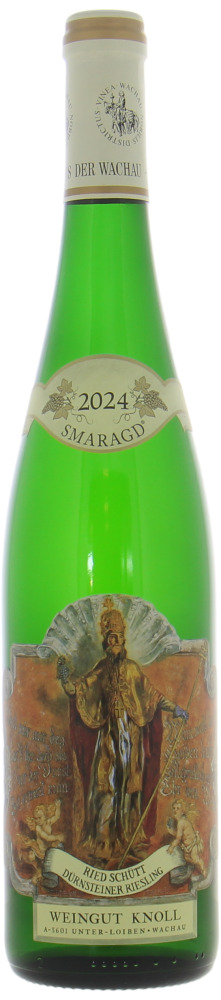
Ried Schütt liegt auf einem Schwemmkegel aus erodiertem Gföhler-Gneis, und dieser trockene Riesling, hergestellt vom Weingut Emmerich Knoll hergestellt wird, gehört zur Kategorie Smaragd und stammt aus Dürnstein in der Wachau. Er spiegelt deutlich die Eigenschaften seines steinigen Bodens wider. Dies ist die reifste Kategorie trockener Weine in dieser Region. Die Rebstöcke sind hier über 30 Jahre alt.
Obwohl der Sommer 2024 heiß war, war er nicht so trocken wie in anderen Jahren, sodass die terrassierten Weinberge fast keine Bewässerung benötigten. Die Reben wuchsen erstaunlich schnell, und die Lese begann am 2. September.
Ganze Trauben werden von Hand geerntet, zerkleinert, mazeriert und anschließend gepresst. Danach reifen sie 6 bis 8 Monate auf der Feinhefe, bevor sie gefiltert und in Flaschen abgefüllt werden. Dank dieser Reifezeit auf der Hefe hat der Wein eine weiche, runde Textur und behält gleichzeitig eine lebendige Frische in seinem Kern.
Die ersten Aromen zeigen reifen Pfirsich und Mandarine, mit einem Hauch von Feuerstein, der im Hintergrund nachklingt. Er ist konzentriert und dennoch gut ausgewogen und hinterlässt einen klaren, köstlichen Abgang, der noch lange nach dem Schluck nachklingt.
Das Weingut Emmerich Knoll ist nach den Grundsätzen der Nachhaltigkeit zertifiziert. Obwohl der Wein bereits unmittelbar nach dem Dekantieren genossen werden kann, empfiehlt es sich angesichts seiner konzentrierten Aromen, ihn über einen längeren Zeitraum reifen zu lassen. Seine optimale Trinkreife erreicht er zwischen 2028 und 2045.
James Suckling (98)
Enormously complex fruit on the nose with every shade of peach, plus a ripe and concentrated palate. The depth is fantastic, but this doesn’t influence the weight of the wine. The beautifully balanced finish is extremely long. Exceptionally elegant and polished for the 2024 vintage. Drink or hold.
Jancis Robinson (17)
Dürnstein. Alluvial fan of pure, eroded Gföhler gneiss. Vines over 30 years old. Hand-picked whole bunches are crushed, macerated and then pressed. Fermented in large old casks of 10–40 hl, mostly with selected yeast at 24–27 °C, first rack after about 2 to 3 weeks. The wines stay on the fine lees for 6–8 months, then filtered and bottled. Certified sustainable.
This is super-reduced, flinty and clenched shut. The main event right now is the texture, round and smooth as mineral oil. It’s all size and promise right now, needing time to realise its potential. Tasting it again at the end of the day from a bottle that had been opened many hours, it was much juicier and more open. If you open it now, decant, but better to cellar for another couple years or ten. Tara Q Thomas
Vinous (97)
The 2024 Riesling Schütt Smaragd, from gneiss, still shows flintiness on the nose. The palate brings creaminess and considerable zestiness, with mandarin juiciness emerging on this linear, taut and bright wine. It is superbly clean cut, mouthwatering and intensely zesty.
Emmerich Knoll described 2024 as “relatively hot in summer but not as dry.” He observed that there “was little need for irrigation in the terraces, but it was incredibly fast vegetation. We started picking on 2 September, one day later than in 2018.”
Knoll said, “The weather was warm, the grapes were warm, so there was some worry about how this would play out stylistically.” On 12 September, the rain and floods arrived. Knoll had to clear his cellar and expected the water to reach 50 cm. While the Knolls have dealt with flooding before, this was the first time it happened during harvest. Electric sockets are placed higher in anticipation of water, but there was concern it would rise even further. Ultimately, it did not, but the rain caused many dry-stone walls to collapse. Despite the chaos, Knoll noted how lucky it was that the ripe grapes developed neither green (Penicillium expansum) nor sour rot (acetobacter). Rapidly cooled temperatures helped prevent the spread of rot and preserved acids. The last grapes, after a week’s pause following the rain, were picked on 22 October. There was almost no botrytis and certainly none for making sweet wine. The 2024 wines show a much greater step up between Federspiel and Smaragd than usual—the Smaragde are pictures of purity.