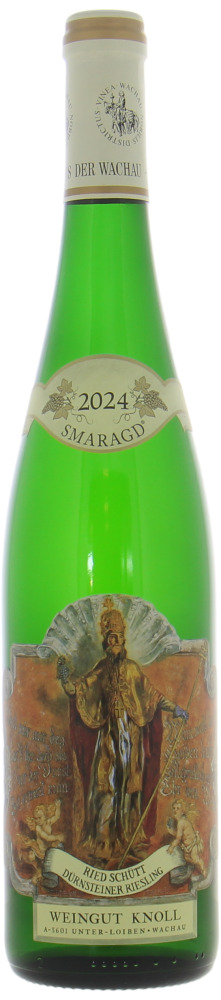
Ried Schütt ligt op een alluviale waaier van geërodeerd Gföhler-gneis, en deze droge Riesling, geproduceerd door Weingut Emmerich Knoll, behoort tot de Smaragd-categorie en is afkomstig uit Dürnstein in de Wachau. Deze wijn weerspiegelt duidelijk de kenmerken van de steenachtige bodem. Dit is de rijpste categorie droge wijn in deze regio. De wijnstokken zijn hier meer dan 30 jaar oud.
Hoewel de zomer van 2024 heet was, was het niet zo droog als in andere jaren, waardoor de terrasvormige wijngaarden vrijwel geen irrigatie nodig hadden. De wijnstokken groeiden in een verbazingwekkend snel tempo en de oogst begon op 2 september.
Hele trossen worden met de hand geoogst, geplet, gemacereerd en vervolgens geperst. Daarna rijpen ze 6 tot 8 maanden op fijne droesem, voordat ze worden gefilterd en gebotteld. Dankzij deze rijpingsperiode op de droesem heeft de wijn een zachte, ronde textuur, terwijl hij in de kern een levendige frisheid behoudt.
De eerste aroma's bestaan uit rijpe perzik en mandarijn, met een vleugje vuursteen op de achtergrond. De wijn is geconcentreerd maar toch goed in balans en laat een zuivere, verrukkelijke afdronk achter die nog lang na het doorslikken blijft hangen.
Het landgoed Emmerich Knoll is gecertificeerd als duurzaam. Hoewel de wijn direct na het decanteren kan worden gedronken, wordt het, gezien de geconcentreerde smaken, aanbevolen om hem enige tijd te laten rijpen. Hij komt het best tot zijn recht tussen 2028 en 2045.
James Suckling (98)
Enormously complex fruit on the nose with every shade of peach, plus a ripe and concentrated palate. The depth is fantastic, but this doesn’t influence the weight of the wine. The beautifully balanced finish is extremely long. Exceptionally elegant and polished for the 2024 vintage. Drink or hold.
Jancis Robinson (17)
Dürnstein. Alluvial fan of pure, eroded Gföhler gneiss. Vines over 30 years old. Hand-picked whole bunches are crushed, macerated and then pressed. Fermented in large old casks of 10–40 hl, mostly with selected yeast at 24–27 °C, first rack after about 2 to 3 weeks. The wines stay on the fine lees for 6–8 months, then filtered and bottled. Certified sustainable.
This is super-reduced, flinty and clenched shut. The main event right now is the texture, round and smooth as mineral oil. It’s all size and promise right now, needing time to realise its potential. Tasting it again at the end of the day from a bottle that had been opened many hours, it was much juicier and more open. If you open it now, decant, but better to cellar for another couple years or ten. Tara Q Thomas
Vinous (97)
The 2024 Riesling Schütt Smaragd, from gneiss, still shows flintiness on the nose. The palate brings creaminess and considerable zestiness, with mandarin juiciness emerging on this linear, taut and bright wine. It is superbly clean cut, mouthwatering and intensely zesty.
Emmerich Knoll described 2024 as “relatively hot in summer but not as dry.” He observed that there “was little need for irrigation in the terraces, but it was incredibly fast vegetation. We started picking on 2 September, one day later than in 2018.”
Knoll said, “The weather was warm, the grapes were warm, so there was some worry about how this would play out stylistically.” On 12 September, the rain and floods arrived. Knoll had to clear his cellar and expected the water to reach 50 cm. While the Knolls have dealt with flooding before, this was the first time it happened during harvest. Electric sockets are placed higher in anticipation of water, but there was concern it would rise even further. Ultimately, it did not, but the rain caused many dry-stone walls to collapse. Despite the chaos, Knoll noted how lucky it was that the ripe grapes developed neither green (Penicillium expansum) nor sour rot (acetobacter). Rapidly cooled temperatures helped prevent the spread of rot and preserved acids. The last grapes, after a week’s pause following the rain, were picked on 22 October. There was almost no botrytis and certainly none for making sweet wine. The 2024 wines show a much greater step up between Federspiel and Smaragd than usual—the Smaragde are pictures of purity.