Trimbach
While Alsace is teeming with family-run wineries, few have adhered as steadfastly to a single philosophy as Trimbach. A dry, straightforward, and refined style, this is the hallmark of this winery, and it is consistently applied regardless of whether the bottle is a simple Pinot Blanc or a Grand Cru Riesling (except for the sweet wines). Based at their wine cellar on Route de Bergheim in Ribeauvillé, this family has been working here for 13 generations. Riesling accounts for about half of the production, and Gewurztraminer, Pinot Gris, Pinot Blanc, Pinot Noir, Sylvaner, and Muscat round out a lineup spread across five ranges, ranging from everyday classic wines to Vendanges Tardives and Sélection de Grains Nobles. In 2025, La Revue du Vin de France, the French magazine, named Trimbach Brand of the Year. Balance is a word this family constantly emphasizes, and their wines are a clear testament to this.
The history of Trimbach
Trimbachs did not start out in the wine business. They migrated from Switzerland in the 16th century to work in the silver mines of Ste-Marie-aux-Mines, and in 1626, Jean Trimbach was recognized as a bourgeois in Riquewihr and established himself as a winegrower.
Two figures from the 19th century took the business to the next level. Jean-Frédéric, born in 1811, made a name for himself in the wine-growing sector of Alsace, while his relative Frédéric Emile, born in 1839, took over management shortly after the vineyard moved to Hunawihr in 1840. The Diploma of Honour at the Brussels International Fair in 1875 marked the moment when this house gained international renown.
Born in 1898, Frédéric Théodore was one of the founders of Syndicat des Négociants et Viticulteurs d'Alsace. The Clos Ste Hune label was introduced in 1919 and has remained virtually unchanged since then. It was in 1920 that the estate moved to Ribeauvillé, where Maison Trimbach still resides today.
In 1953, Bernard Trimbach took over the vineyards, management, and winemaking, while his younger brother, Hubert, later handled sales. In 1967, Cuvée Frédéric Emile succeeded Riesling Grande Réserve.
Pierre Trimbach graduated from Beaune's winemaking school and joined the company in 1979 after working with Famille Hugel and with Robert Mondavi in Napa Valley. He ran the wine cellar across 46 vintages before passing away in 2026 at the age of 69 in a traffic accident in January. His younger brother, Jean, has been in charge of sales and exports since 1985, and the 13th generation of the family has already established itself: Anne has held the position since 2008, Julien since 2014, Frédérique since 2016, and Pauline since 2021. Currently, Julien is the sole winemaker.
Sixty hectares on a fault line
The Trimbach vineyard is located along the Ribeauvillé fault zone, a geological fault that runs north-south through the vineyard from Rodern to Turckheim. Approximately 70% of the vineyard's vines are concentrated in three villages: Ribeauvillé, Bergheim, and Hunawihr.
The estate directly owns slightly more than 60 hectares of land. All of this land has been certified organic since 2023, as have the grapes purchased from 35 partner growers. However, organic farming itself began about ten years ago.
It all began with Clos Ste Hune, a 1.67-hectare, walled vineyard located in Hunawihr, where organic grape cultivation started in 2008. The average age of the vines across this entire vineyard is approximately 45 years, which is old enough for the root systems to be well-established.
The vineyard is situated on south-, southeast-, and southwest-facing slopes along the foothills of the Vosges. The soil is well-drained, poor in nutrients, and receives ample sunlight. These are simple factors, but they play the most significant role.
The terroir
Alsace lies in the less rain influenced part of the Vosges, and its figures are striking. In 2020, Colmar recorded 424 mm of precipitation, while Lorraine recorded 758 mm and France as a whole recorded 778 mm. Cold winters, hot and dry summers that can bring storms, and long, dry autumns: this is a semi-continental climate with abundant sunshine but a severe shortage of water.
The Ribeauvillé fault runs beneath the vineyards, creating a mosaic-like terrain where various soil types are intermingled rather than a single uniform soil type. Complex limestone strata are distributed here, including the shell limestone known as Muschelkalk, marl (a mixture of limestone and clay), Vosges sandstone, and migmatite (a mixture of gneiss and granite).
Trimbach selects the grape varieties suited to each vineyard, and each plot possesses its own unique microclimate. As a result, even wines made from the same grape variety can vary significantly in flavor from one vineyard to another, and the vintage adds yet another dimension to this complexity.
The grapes
Riesling accounts for about half of Trimbach's production, and the family firmly believes that Riesling is the finest white grape variety in existence. The remaining vineyards consist of typical Alsace varieties:
- Gewurztraminer: Characterized by spicy notes; here, it is vinified as a dry wine
- Pinot Gris
- Pinot Blanc: Blended with Auxerrois
- Pinot Noir: The only red wine
- Sylvaner
- Muscat
The winemaking
Before each batch of grapes is sent to the press, it undergoes an inspection to measure its potential alcohol content, a task the winemaker performs personally rather than delegating it to others. After being crushed, the white grapes are gently pressed in four pneumatic presses that operate at full capacity throughout the approximately four-week harvest period.
The juice flows by gravity into a storage tank located directly below the winery building, where it undergoes a settling process via a centrifuge. Fermentation then takes place separately in temperature-controlled fermentation tanks for each vineyard block; the classic Pinot Blanc, Riesling, and Gewurztraminer wines undergo blending.
White wines do not undergo malolactic fermentation. Only the Pinot Noir undergoes this process, which is one of the main reasons why the Trimbach's white wine has such a robust flavor.
After fermentation is complete, the wine is aged on the fermentation lees for several weeks, followed by several months of aging on the fine lees; this period is determined based on tasting results rather than calendar dates. Filtration is performed using a tangential flow method with ceramic filters. In the cellar, old oak barrels and stainless steel fermentation tanks stand side by side.
Bottling begins in the spring following the harvest and continues until the end of July, and sometimes even into September. Additionally, since the wine does not undergo cold stabilization, tartaric acid crystals are occasionally found in the bottle. These are harmless, and the winery openly discloses this fact.
The wines
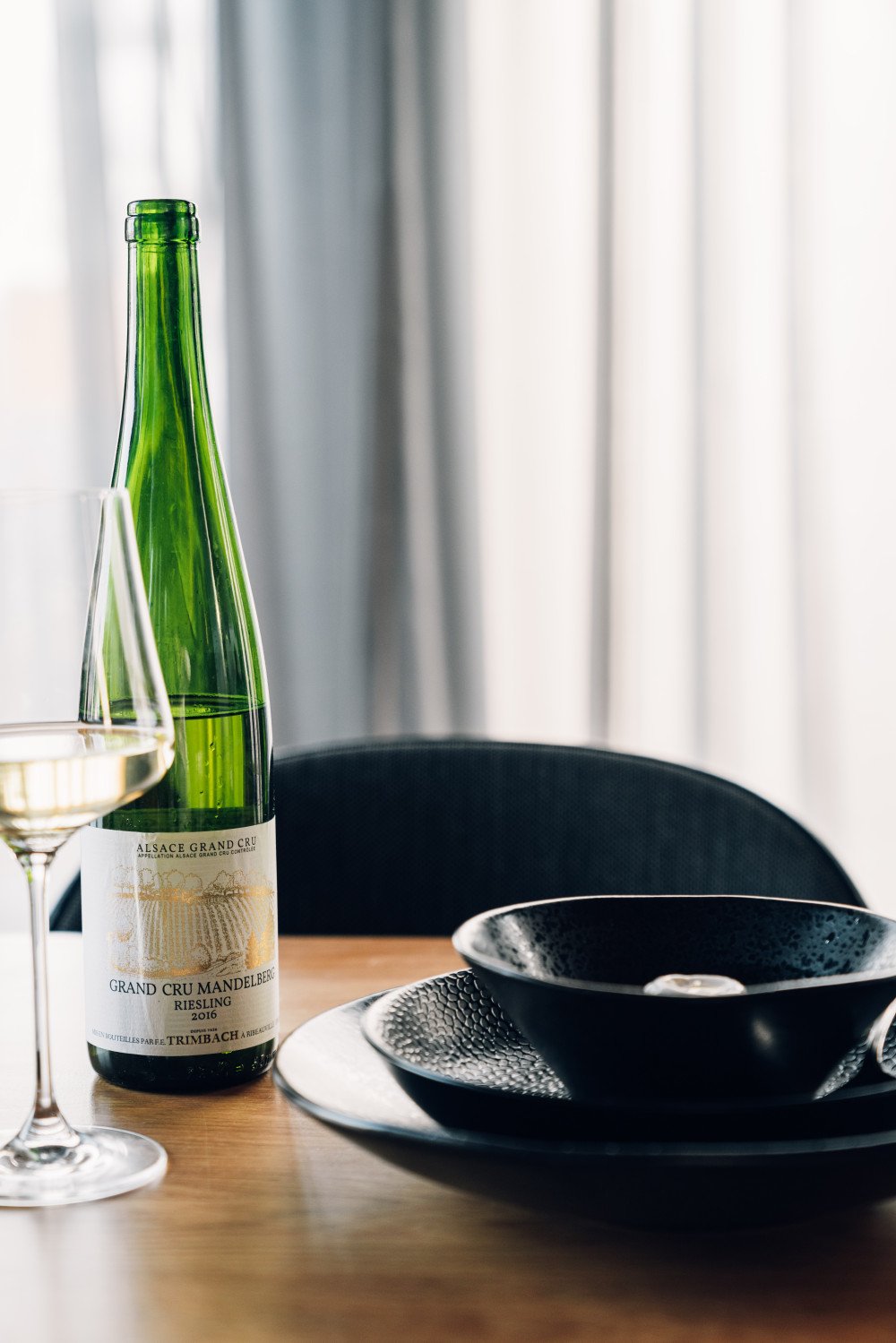
Trimbach categorizes its products into the following five lines: Classic wine, Réserve wine, Réserve Personnelle, the Riesling & Grands Crus Collection, and the sweet wines Vendanges Tardives and Sélection de Grains Nobles. The winery takes a consistent approach across all grades, maintaining a dry and refined style, while stricter selection processes and the unique character of each vineyard become more pronounced as the grade increases.
At the very top is the Riesling Clos Ste Hune, produced from a single vineyard enclosed by a wall within the Hunawihr estate; in exceptional vintages, a Vendanges Tardives version is released alongside it. Cuvée Frédéric Emile is named after the person who brought this winery to the world stage. Gewurztraminer Sélection de Grains Nobles is the sweet-style offering.
Trimbach is well-known for setting aside the finest Rieslings and releasing them only after nearly 10 years have passed since the vintage. This is highly unusual and signifies that these older bottled wines are not simply leftover stock, but rather represent the optimal drinking window as intended by the house.
Frequently asked questions
Where is Trimbach based?
In Ribeauvillé, in Alsace, at 15 route de Bergheim. The family has been at that address since 1920, after earlier spells in Riquewihr and Hunawihr.
Is Trimbach organic?
Yes. The estate's own vineyards and the grapes it buys from 35 partner growers have been certified organic since 2023, after more than ten years of organic farming.
What is Clos Ste Hune?
A 1.67 hectare plot in Hunawihr owned by the Trimbach family, bottled as a single-vineyard Riesling under a label first used in 1919.
Are Trimbach wines dry?
Almost all of them. Even Gewurztraminer, which many Alsace producers leave with residual sugar, is vinified dry here. The exceptions are the Vendanges Tardives and Sélection de Grains Nobles bottlings.
Regions