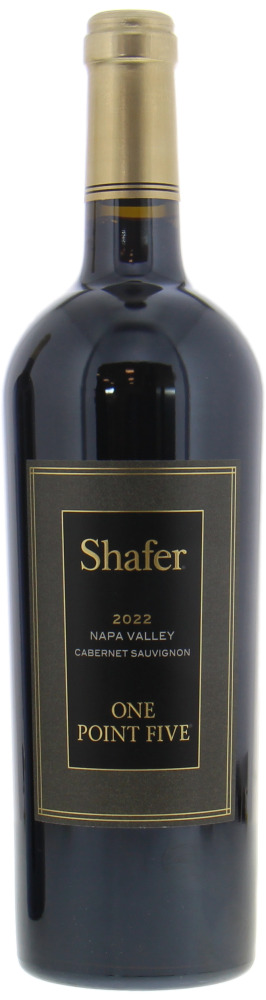

| Classification | Cru Classe |
| Type | Red |
| Producer | Shafer |
| Vintage | 2022 |
| Country | United States |
| Region | California |
| Appellation | Napa Valley |
| Grape | Cabernet Sauvignon, Merlot, Malbec, Petit Verdot |
| Alcohol % | 15.3% |
| Volume | 0,75 |
| Condition | Perfect |
| Label | Perfect |
| Drinkable | -2040 |
| Stock | 7 |
The 2022 growing season in Napa Valley will be remembered as one of the hottest in the region, with temperatures exceeding 40°C on several days in early September. Shafer's team from the Stags Leap District carefully selected and harvested each site to ensure that freshness was not compromised. As a result, One Point Five 2022 leans toward ripe, dark-fruited Cabernet, but retains the perfumed lightness that characterizes the estate. A compact, full-bodied wine.
While the 2022 Cabernet Sauvignon One Point Five includes some purchased fruit, the aim is for it to become fully estate once new plantings come into production. It's an incrementally richer, darker and more concentrated wine than Shafer's TD-9, with black cherries wrapped in a subtle cloak of almost ephemeral cedar and vanilla. Full-bodied and velvety textured, with a lingering finish, it should drink well for at least 15 years.
This bottling brings a slightly lighter aromatic touch to the Shafer reds, with its red cherry and strawberry aromas over a very full body. Broad, ripe and generous red fruit is wrapped in moderate tannins for good structure and some aging potential.
Dripping ripe plums and other dark fruits are spun through with aromas of cracked pine and pitch for a complex Cabernet Sauvignon from Napa icon, Shafer Vineyards. Succulent and mouthwatering with melting tannins and a persistent finish, this is a wine with plenty of potential to age.
Crushed black cherry at first, followed by black currant, mocha and notes of cedar from the French oak. This is exactly what characterizes Stag's Leap. Silky flavors in the mouth, followed by a wave of fine-grained tannins that fill the mid-palate but don't dry it out. The 2022 wine is more concentrated than the 2021 wine. The Merlot adds plump plums and the Petit Verdot adds floral notes. If opening now, decant for an hour.
Cabernet Sauvignon takes center stage at One Point Five, typically making up 85 to 90 percent. But what about the rest of the blend?
Stags Leap District is known as a fit for Merlot, and you can feel why Merlot has earned its place in this wine.
Best for storage between 2027 and 2040; the tannins in 2022 are more mature than usual thanks to the September heat, but still firm enough to last several years in bottle; store at a stable temperature of 12-14°C. Expect notes of cedar and mocha to develop into notes of tobacco and leather.
Shafer Vineyards is one of the most prestigious names in Napa, earning its reputation for its Cabernet Sauvignon varietal. John Shafer bought the neglected site in 1972, planted the hills himself and made his first wine in 1978. What has kept the wines consistent is that his son Doug Shafer joined the company in 1983 and winemaker Elias Fernandez in 1984, and they've been working side by side ever since. We sell Shafer because that consistency is evident in the bottles.
The Stags Leap District is located in the eastern part of Napa Valley, where the soil is volcanic loam over a rocky subsoil. Why it's important. Drainage. Vines are forced to push their roots downward in search of water, which reduces yields and concentrates fruit. In addition, a wind known as the "Stags Leap effect" brings cool air from San Pablo Bay every afternoon. The days are hot and the nights are cool. This diurnal variability gives Cabernet a wealth of flavors and characteristic suppleness.
All grapes are harvested by hand and passed through an optical sorting machine so that only pure fruit enters the tanks. Fermentation takes place in a gentle mode. The choice of oak is very important: the wine is aged in French barriques (small 225-liter French oak barrels) for about 20 months, with a high proportion of new oak. Cedar, vanilla and toasted spices emanate from here. The density of the Stags Leap District fruit means that the oak supports rather than overwhelms the wine. You taste the flavor of the wine, not the wood.
Cabernet of this structure needs fat and protein. Some suggestions:
Serve at 16-18°C. Decant young bottles within 1 hour.
With track & trace code