
| Classification | Cru Classe |
| Type | White |
| Producer | Gaja |
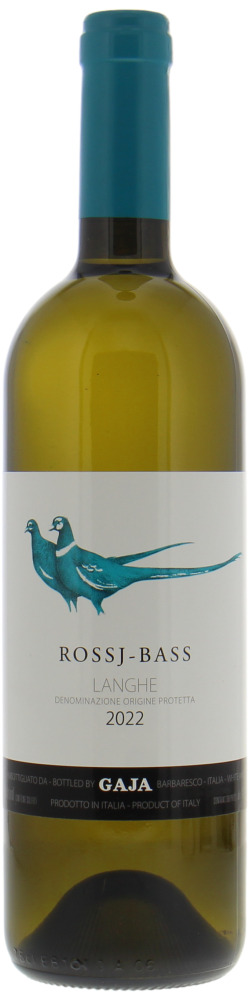
| Wine | Rossj-Bass Chardonnay |
| Vintage | 2022 |
| Country | Italy |
| Region | Piemonte |
| Grape | Chardonnay |
| Volume | 0,75 |
| Condition | Perfect |
| Label | Perfect |
| Drinkable | -2030 |
| Stock | 1 |
The 2022 growing season in Piedmont was warm and dry, one of those times when lack of water was a deciding factor. Lime marl helped retain enough moisture in Gaja's Rossj-Bass wine, which is made from Chardonnay vineyards in the Langhe hills near Treiso and Barbaresco. As a result, the fruit was riper in 2022 than in the cooler vintage, but acidity was unaffected thanks to the high altitude and diurnal change. Expect a fuller-bodied Rossj-Bass than in 2021.
When pouring the 2022 Rossj-Bass, the first impression is of orchards, ripe pear, yellow apple, some peach skin lifted by citrus zest. There's hazelnut and almost siliceous nuances underneath, as you'd expect from a white wine from Langhe grown on marl. The palate is medium-bodied, with a creamy middle (partial fermentation in barriques does this) and then moves into a salty, mineral finish. Drinks well if you let it air out. A little cooler than it sounds, around 11°C.
Rossj-Bass is a varietal Chardonnay. So why does it taste so different from Napa and Australia? It has a lot to do with the terroir of the Langhe. Calcareous marl, altitude of 200-400 meters above sea level, cold nights until harvest time. The wine has a stony backbone, with more green apple and citrus than mango and pineapple. It is a Chardonnay with a Piedmontese accent.
Drink the 2022 Rossj-Bass through about 2028. This is not one of Gaja's Chardonnays designed for long aging; Rossj-Bass can be drunk as early as 4-6 years after harvest. The fruit is fresh, with a slight oak influence. Store at 12-14°C.
Go into any serious wine store and ask for the most important Italian producer of the last 50 years and you'll likely get "Gaja" before you even finish the question. Why? Because of his single vineyard wineries, his French oak barriques and the fact that in 1979 he planted Chardonnay on land that his father thought should have been Nebbiolo. Today, his children Gaia, Rossana and Giovanni run the day-to-day operations. Best of Wines believes that Gaja continues to be the benchmark for what Piedmont should be.
Rossj-Bass is a vineyard in the commune of Barbaresco, situated on calcareous marl mixed with limestone. So why is it suitable for Chardonnay? Limestone retains moisture even in dry conditions and reflects heat at night, thus maintaining acidity even in hot summers. The climate in Langhe is continental, with cold winters and warm summers, as well as the famous fall fog ("nebbia") that delays the ripening of the grapes until October. The altitude ranges from 200 to 400 meters above sea level, which contributes to the diurnal variations that capture the aromas.
The decisive choice here is to ferment the wine in French oak barriques (225-liter barrels) and transfer the wine into stainless steel before bottling. Why this separation? Barrel fermentation creates a creamy texture and allows the oak to merge with the wine rather than layering on top of it. Subsequent aging in stainless steel keeps the wine fresh and prevents the oak from dominating. Aging is approximately 6-8 months in a mix of new and used barrels. The result is a Chardonnay with weight and a polished finish.
With its bright acidity and creamy mid-palate, 2023 pairs well with dishes with rich flavors. There are several directions:
Serve at 10-12°C. Further cooling deteriorates the texture. Decanting is not necessary.
With track & trace code