

Rossj-Bass
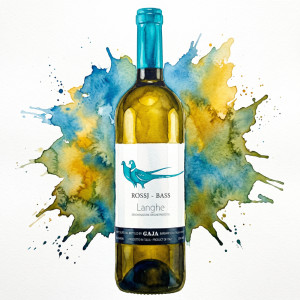
Rossj-Bass is an everyday Chardonnay from Gaja. Or rather, it's an everyday Chardonnay from one of Italy's most famous estates, Gaja. Made from Barbaresco in the Langhe hills of Piemonte, it sits in the shadow of Gaia & Rey, the single vineyard Chardonnay that brought Gaja to white wine fame in the 1980s.
So why get a little brother? Because Rossj-Bass does something that Gaia & Rey doesn't. It's more subtle, more direct and much more approachable. Named after Angelo Gaja's daughter Rossana ("Rossi") and his grandmother, this wine, first produced in 1985, was Gaja's entry into the world of white wines. And for many connoisseurs, it is among the most distinctive white wines produced by Gaja.
About Gaja
Gaja is the first name on the lips of Piemonte specialists. It has a long history of bottling Nebbiolo in individual vineyards, French barriques, temperature-controlled stainless steel tanks and, most controversially, planting Cabernet Sauvignon and Chardonnay in the Nebbiolo region in the late 1970s.
It was the latter decision that made Rossj-Bass possible. Today the estate is managed daily by Angelo's children, Gaia, Rossana and Giovanni. We supply Gaja products because even the smallest wines are taken as seriously as the flagship wines.
History & Heritage
Interestingly, the pivotal year for the estate was not its founding in 1859, but 1979, when Angelo Gaja planted Chardonnay in Piemonte. The locals thought he had lost his mind. The grape had no place in the region, it had no tradition and no obvious market.
That changed: in 1983, Gaia & Rey, Gaja's first Chardonnay, was born, proving the doubters wrong. Rossj-Bass appeared in 1985 as a more accessible Chardonnay made from young vines and additional plots around Barbaresco and Treiso. The family name on the label of this wine shows how seriously Gaja took the project. This was not a side experiment.
Terroir & Climate
The grapes for Rossj-Bass are harvested from plots around Barbaresco and Treiso, located 200-400 meters above sea level on typical Langhe slopes. The soil is calcareous marl (locally known as Sant'Agata Fossili), bluish-grey in color, rich in limestone, with a high clay content.
Why is this important for Chardonnay? Because limestone is exactly what this grape needs. Limestone increases acidity, keeps the wine calcium backed and prevents it from becoming flabby in warm years. The continental climate also helps. Warm summers ripen the fruit, but cold nights, especially in September, keep it fresh. Foggy autumns are slow to finish the job.
Grape Varieties
Rossj-Bass is produced from Chardonnay. Historically, Gaja blended a small amount of Sauvignon Blanc (often said to be around 5%) for flavor. Recent vintages are closer to pure Chardonnay:
- Chardonnay: the dominant grape, giving body, fruitiness and texture.
- Sauvignon Blanc (if used): small percentage, adds top notes of green edge.
Why this approach. Pure Chardonnay, produced from Lange limestone, gives structure and weight. Sauvignon, if present, gives sharpness to the flavors. It adds a Piedmontese accent to the Burgundian structure.
Winemaking
The decisive choice for Rossj-Bass was restraint. While Gaia & Rey is fully aged in barrels, Rossj-Bass is much lighter. Fermentation and aging takes place in French oak barriques (225-liter barrels) that blend new and old barrels, and barrel aging is about 6-8 months. Malolactic fermentation usually takes place before completion, softening the acidity and adding a creamy note that doesn't go to butter.
This is a key point. There's just enough oak to give texture and a hint of toastiness, but not so much that the fruit and limestone minerality is buried.
Tasting Notes
The first thing you notice is the nose. Yellow apple, white peach, lemon zest and soft barrique toast notes that don't come to the forefront but lurk underneath. There is a chalky, almost salty note derived from marl. The palate is medium-bodied, balanced by malolactic cream and real acidity. This is not a fat, buttery California style. It's also not a resolute Chablis.
On the finish, the Rossj-Bass shows its pedigree: long, mineral, with notes of hazelnut. This wine can be drunk young, but in a good vintage it will last for several years.
Food Pairing
The combination of texture and acidity is the driving force behind the pairing. Some suggestions that work really well:
- Vitello Tonnato, a Piedmontese classic. The acidity of the wine shines through the tuna mayonnaise.
- Risotto with seasonal porcini mushrooms and white truffles.
- Agnolotti with butter and sage, malolactic cream meets butter.
- Fried chicken, grilled white fish with lemon.
Piedmontese soft cheese roviola also goes well with wine; serve at 10-12°C.
Serving Suggestions
Serve Rossj-Bass at 10-12°C. Chilling in the refrigerator will result in loss of flavors and smoothing of texture. A standard white wine glass will do, but a slightly wider bowl will make it easier to open the nose. Decanting is not necessary. For bottles that are several years old, remove the cork 20 minutes before bottling.
Vintages
Rossj-Bass is fairly consistent, but Chardonnay from such a meticulous producer is more vintage-dependent than one might expect: warmer years, such as 2022, allow the stone fruit to ripen more, adding weight to the flavor and softening the acid structure; cooler, cooler vintages, such as 2023, allow the fruit to ripen more and the acidity to soften. The fresher vintages are dominated by citrus, green apple and dense minerality.
If you want to drink it now, choose a wine released recently. For more complexity, look for bottles aged for four to five years. These are starting to show notes of toast and hazelnuts.

Cellaring Potential
Rossj-Bass is not a 30-year-old aging wine, nor does Gaja claim it to be. The balance of fruit and development reaches its peak when drunk within 5-7 years of harvest. The acidity and structure due to the limestone will allow it to live comfortably until this time; store horizontally, away from light, in a stable place at 12-14°C. In older bottles, the main fruit flavors are replaced by nutty and honeyed notes.
