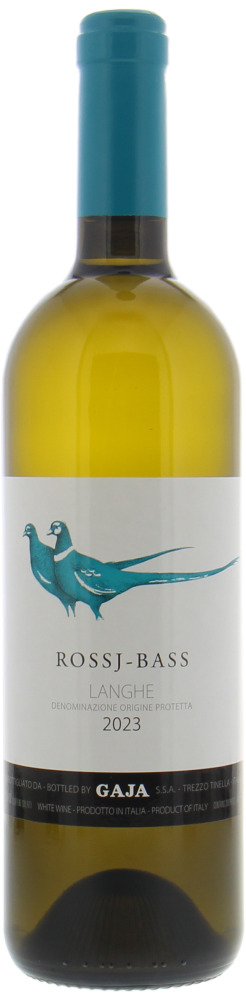

| Classification | Cru Classe |
| Type | White |
| Producer | Gaja |
| Wine | Rossj-Bass |
| Vintage | 2023 |
| Country | Italy |
| Region | Piemonte |
| Grape | Chardonnay |
| Volume | 0,75 |
| Condition | Perfect |
| Label | Perfect |
| Drinkable | -2030 |
| Stock | 23 |
The growing season for Langhe in 2023 was unpredictable. A wet spring delayed flowering, a hot and dry summer and the return of cool nights in late August delayed ripening. For Rossj-Bass at Gaja, this meant that the Chardonnay grapes reached phenolic ripeness while retaining acidity. As a result, the 2023 wine has more nervous tension than the warmer 2022, but has not lost its characteristic fruit lushness.
The first thing you notice is the lift. Yellow apple, white peach, grapefruit peel and something metallic behind that, almost burning. The flavor is medium-bodied, with a small Sauvignon Blanc component adding spice to the edges and barrique aging adding a creamy texture reminiscent of hazelnut rather than outright vanilla. The finish is salty and long. Drink now if you like the supple mineral phase, or wait 2-3 years for the fruit to mature.
Chardonnay makes up the bulk of the Rossj-Bass, about 95% of the blend, bringing the fruitiness and texture of barrique aging. Why then the small amount of Sauvignon Blanc? Sauvignon Blanc pulls the wine to the side, adding a citrus and herbal note that the pure Chardonnay from Langhe lacks. In vintages with high natural acidity, such as 2023, the Sauvignon component does not compete with the freshness of the wine, but rather enhances the freshness.
Best between 2025 and 2031; 2023 Rossj-Bass has the acidity to age, but it's not Gaja & Rey, it's made for medium-term drinking; store horizontally at 12-14°C. Over the next 3-4 years, the citrus fruit softens into more ripe stone fruit and the oak becomes more nutty and honeyed.
Go into any serious wine store and ask for the most important Italian producer of the last 50 years and you'll likely get "Gaja" before you even finish the question. Why? Because of his single vineyard wineries, his French oak barriques and the fact that in 1979 he planted Chardonnay on land that his father thought should have been Nebbiolo. Today, his children Gaia, Rossana and Giovanni run the day-to-day operations. Best of Wines believes that Gaja continues to be the benchmark for what Piedmont should be.
Rossj-Bass is a vineyard in the commune of Barbaresco, situated on calcareous marl mixed with limestone. So why is it suitable for Chardonnay? Limestone retains moisture even in dry conditions and reflects heat at night, thus maintaining acidity even in hot summers. The climate in Langhe is continental, with cold winters and warm summers, as well as the famous fall fog ("nebbia") that delays the ripening of the grapes until October. The altitude ranges from 200 to 400 meters above sea level, which contributes to the diurnal variations that capture the aromas.
The decisive choice here is to ferment the wine in French oak barriques (225-liter barrels) and transfer the wine into stainless steel before bottling. Why this separation? Barrel fermentation creates a creamy texture and allows the oak to merge with the wine rather than layering on top of it. Subsequent aging in stainless steel keeps the wine fresh and prevents the oak from dominating. Aging is approximately 6-8 months in a mix of new and used barrels. The result is a Chardonnay with weight and a polished finish.
With its bright acidity and creamy mid-palate, 2023 pairs well with dishes with rich flavors. There are several directions:
Serve at 10-12°C. Further cooling deteriorates the texture. Decanting is not necessary.
With track & trace code