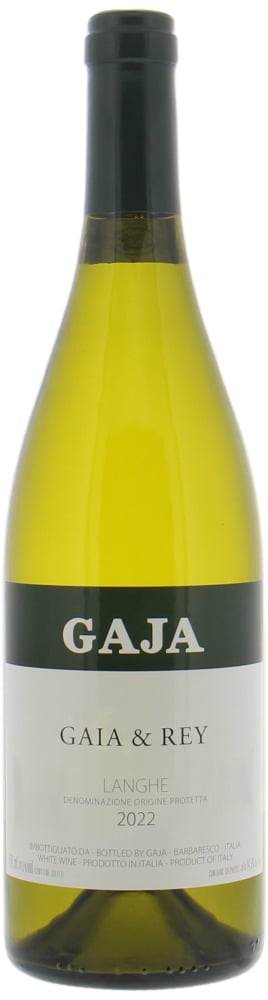

| Classification | Cru Classe |
| Type | White |
| Producer | Gaja |
| Wine | Gaia & Rey |
| Vintage | 2022 |
| Country | Italy |
| Region | Piemonte |
| Grape | Chardonnay |
| Volume | 0,75 |
| Condition | Perfect |
| Label | Perfect |
| Drinkable | -2040 |
| Stock | 8 |
The 2022 growing season in Piedmont was hot and dry, one of the warmest in recent memory. For Gaia & Rey wines grown in the highlands of Treiso (the coolest commune in the Barbaresco zone), altitude played a big role. Chardonnay from the Rey vineyard, located 350-400 meters above sea level, remains quite fresh despite the heat. Gaia & Rey 2022 is more ripe and voluminous than the cooler vintages, but still retains the wine's characteristic tension.
What a beautiful chardonnay, with sliced cooked apples, pears, light cream and pineapple, but so well knit together with a mouthfeel that is caressing and fine textured. So enticing to drink now, but will improve with age. Drink or hold.
First and foremost, the nose is impressive. Yellow stone fruits, peach and a hint of pineapple overlay the toasty, almost hazelnut character resulting from aging in barrique. The flavor is rich but not heavy. It has a sense of lemon oil with a chalky note due to the lime marl beneath Rey's vineyard and a long, slightly creamy finish. James Suckling praised this vintage, "Younger than the 2021, more open and approachable, but with structure that can stand up to aging."
Gaia & Rey is a 100% Chardonnay. So why does its flavor taste so different from Chardonnays from Burgundy and Napa? Terroir. The high altitude and lime marl increase acidity, something you wouldn't expect from a hot harvest like 2022. In addition, Angelo Gaja's decision to plant Chardonnay here in 1979, controversial at the time, still defines the style: it's aged in French oak but has a sense of Italian tension.
Drink between 2026 and 2038; the 2022 can be drunk now, but it needs 2-3 years for the acidity and barrique structure (small French oak barrels give structure and flavor) to integrate; store at 12-14°C. With time, the fruitiness is replaced by notes of honey, beeswax and toasted nuts.
Ask a wine merchant which Italian producer has become the most important in the last 50 years. The answer will be immediate: Gaja. Angelo Gaja took over the company in 1961 and did what no one had done before him at Barbaresco. Temperature-controlled stainless steel. French Barrique. A bottling of single vineyard wine; in 1979 he also planted Chardonnay, which his neighbors thought was crazy. Today, his children Gaia, Rossana and Giovanni are responsible for the day-to-day management of the business. Best of Wines offers Gaja's wines, whose consistency from vintage to vintage is unrivaled.
The Rey vineyard is located in Treiso, one of the highest communes in the Barbaresco zone, at about 350 meters above sea level. Why is altitude important for Chardonnay? Cool nights. The climate in Piedmont is continental, with hot summer days, but at Treiso altitude the temperature drops sharply after sunset, preserving acidity in the grapes that would otherwise be reduced in warmer climates. The soil is calcareous marl from the Tortonian, the same bluish-gray marl that gives the best Langhe wines tension and length.
The decisive choice here is barrel work. Gaja ferments Gaia & Rey in French oak barriques and then ages it for several months in the same wood until malolactic fermentation is complete (turning the pungent malic acid into soft lactic acid and imparting creaminess). Why barriques and not steel? Angelo wanted not only fruitiness, but also texture and length. The barrels, however, are not the screaming, vanilla-soaked California style of the 1980s. The new oak is restrained enough to allow Treiso's fruit and acidity to still drive the wine. It is this balance that is key.
This wine has body and a firm oak backbone, so it needs food that can stand up to it. Try it:
Serve at 11-13°C. The flavors fade when too cold, and become heavy when too warm.
With track & trace code