

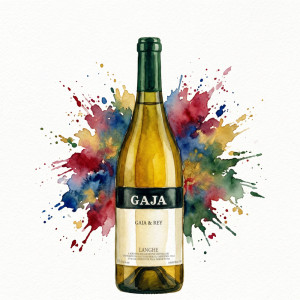
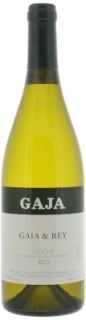
Gaia & Rey
Gaia & Rey was the first Chardonnay produced in Piemonte in a single vineyard. When Angelo Gaja planted Chardonnay in the Treiso vineyard in 1979, it was Nebbiolo country. Barbaresco white wine? Who thought of that?
The first harvest was in 1983, and Angelo named the wine after his oldest daughter Gaia and grandmother Clotilde Rey. So is this just an Italian Chardonnay with a famous name? It isn't. Angelo focused on the white wines of Burgundy, particularly Meursault and Puligny-Montrachet. Forty years later, these wines still are his benchmark.
About Gaja
Most Piemonte producers stick to the Nebbiolo variety. But not Gaja, who succeeded his father in 1961 and for the next two decades did what no one else did at Barbaresco. Temperature-controlled stainless steel tanks, French barriques, bottling in separate vineyards and planting Cabernet Sauvignon in 1978 and Chardonnay in 1979.
Why is this so important? Because Gaja created a template for the entire Piemonte that others eventually followed. Today, the 250-hectare estate, which spans Barbaresco, Barolo, Montalcino and Bolgheri, is run daily by Angelo's children, Gaia, Rossana and Giovanni. No other producer has shaped Italian wine so directly.
History & Heritage
In 1979, planting Chardonnay in Barbaresco was close to heresy. Angelo Gaja did it anyway. He went to Burgundy, tasted Meursault and decided that Treiso (the highest commune in the Barbaresco area), with its calcareous marl and cool nights, was suitable for making serious wine.
So why is such a backstory important for wine by the glass? Because Gaia & Rey was not a marketing exercise. The winemaker bet that the terroir of Piemonte could be told through exotic grapes, and the 1983 debut proved it, and the Rey vineyard, originally planted by Angelo's father Giovanni, has remained its source ever since.
Terroir & Climate
The Rey vineyard is located in Treiso, 350 meters above sea level, on calcareous marl from the Tortonian period. This soil is the same geologic base that provides the foundation for the great Barbaresco, and similarly works for Chardonnay.
Why does altitude matter? Because Treiso is the highest commune in the Barbaresco zone, with cool nights and a long aging period. Chardonnay needs it. If harvested on the warmer plains, it produces tropical flavours. If harvested on cooler limestone slopes at an altitude of 350 meters, however, wines with tension, acidity and aging potential are produced.
Grape Varieties
Blending is simple:
100% Chardonnay from the Rey vineyard in Treiso.
So why does this Chardonnay taste different from California or Australian Chardonnay? There are two reasons. It's cooler here and higher in altitude, which preserves acidity. And Angelo Gaja has always aimed specifically at white Burgundy, not New World style. You get green apple, citrus and stone fruit instead of mango and pineapple, and Chardonnay's minerality is only possible on real limestone soils.
Winemaking
The decisive choice here is oak. Gaia & Rey is fermented and aged in French barriques (225-liter oak barrels, Burgundy standard). However, Gaja does not bury the fruit under the wood. The barriques only add texture and slow oxidation, rather than imparting heavy vanilla or toast.
And what's in the glass? In the glass, the barrique-aged Chardonnay has a creamy middle, but the cool Treiso fruit and bright acidity make themselves known. The flavor is oaky but not woody. Achieving this balance is harder than it looks.
Tasting Notes
The first thing that catches the eye is the tension. Gaia & Rey does not open with big tropical waves. Yellow apple, lemon zest, white peach and notes of oak character - hazelnut, toasted brioche and vanilla. Underneath are limestone and marl minerals that hold everything together.
On the palate, the texture is creamy but not heavy. The acidity does most of the structural work, and the barrique adds length rather than weight. The finish is long and savory, with a slight chalky note. Wines from younger vintages can be a bit closed on release; after 3-4 years, secondary flavors (honey, almond, beeswax) begin to emerge.
Food Pairing
The structure, creamy texture and serious acidity of this wine are suited to rich dishes. Pairing suggestions:
- Vitello Tonnato, a traditional Piedmontese appetizer where the wine's acidity shines through the tuna mayonnaise.
- Fondue with white truffle. The heaviness of oak and Chardonnay stand up to the flavors of cheese and truffle.
- Risotto Castelmagno or roasted chicken in a butter sauce.
- Grilled turbot or langoustine.
Serve at 10-12°C. If the wine is too cold, the oakiness and minerality will disappear.
Serving Suggestions
Pour at 10-12°C. Chilling in the refrigerator will cause the flavors to disappear. For young wines, leave in the glass for 30 minutes or decant quickly. For mature bottles (over 8 years old), slow opening is best. Remove the cork an hour before serving. A medium Burgundy-style glass is better than a narrow white wine flute, as the bowl reveals oak and fruit flavors.
Vintages
Gaia & Rey is more sensitive to the vintage than many people realize: cooler years, such as 2021 and 2022, result in dense, mineral wines that need four or five years to reach their full potential. Warmer years are richer, with more stone fruit and can be enjoyed sooner, but the tension that makes these wines so interesting can be lost.
Our advice? If you want to drink it in the next two to three years, choose warmer and more mature vintages. If you want to age it in the cellar, cooler vintages deserve patience. If older vintages are available, they tend to cost more due to low production volume.
The best vintages of Gaia & Rey
The level and quality of this wine is very high, regardless of vintage, However, some exceptional vintages are: 2012, 2016, 2018, 2019, 2021, 2022, 2023.
Cellaring Potential
Drink now or wait? Young Gaia & Rey is suitable for drinking but have not yet reached their potential. We store most varieties for at least four years after release, and the best varieties can be drunk for eight to fifteen years. Acidity and lime marl are the driving force behind the long aging process; store horizontally at 12-14°C, away from light. Notes of honey, hazelnuts and beeswax emerge with aging.
