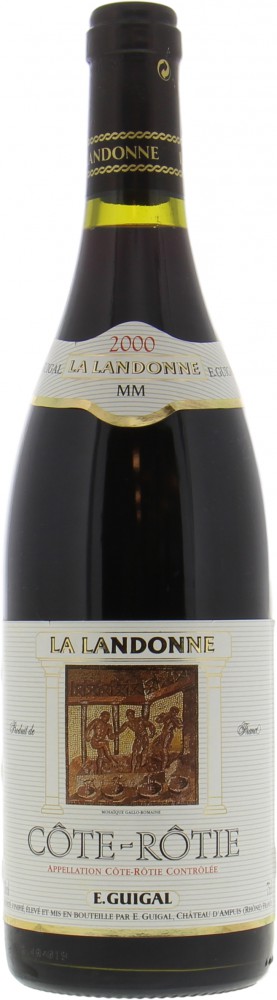

| Classification | Cru Classe |
| Type | Red |
| Producer | E.Guigal |
| Wine | Cote Roti La Landonne |
| Vintage | 2000 |
| Country | France |
| Region | Rhone |
| Appellation | Côte-Rôtie |
| Grape | Syrah/Shiraz |
| Volume | 0,75 |
| Condition | Perfect |
| Label | Perfect |
| Drinkable | -2035 |
| Stock | 1 |
The 2000 harvest in the Northern Rhône was good, but did not compare to the brilliant 1999 vintage that preceded it. Cool and wet conditions made Guigal's approach to late harvesting more important than ever, and the team waited for phenolic ripeness on the steep schist slopes of the Côte Brune. The result? La Landonne 2000 is unmistakably La Landonne, albeit a little more restrained than in previous years.
Another wine that's drinking beautifully today is the 2000 Cote Rotie la Landonne. An upfront, perfumed, complex and ready-to-drink beauty, it offers sexy notes of smoked meats, olive, game, truffle and graphite. These give way to a full-bodied, elegant Cote Rotie that has no hard edges, a soft, forward feel and a great finish. It doesn't have the sheer weight of density of a top year, but excels on its drinkability. It's a beautiful wine
Offers an amazing depth of smoky, espresso-flavored toast that is seamlessly interwoven with bittersweet Valrhona chocolate, black currant and fig fruit, and a great underlying minerality. Supersilky, with a floral finish. Equally lush and captivating on both the nose and palate--a rare feat. Drink now through 2030. 800 cases made. –JM
100% Syrah, clay and calcareous soil, fermented in stainless steel vats, minimum of 4 weeks’ cuvaison, aged in small oak casks for 42 months. Dark crimson. Dumb, though vaguely leathery nose (on both bottles). Some liquorice and definite austerity. This brute doesn’t want to be disturbed…. Really chewy and introvert and muscular. (JR)
First impression is of smoke and ground black pepper, typical of Syrah Côte Brune. The flavor is dense but not heavy. Blackberry and graphite and iron oxide minerality typical of slate soils. The tannins are firm and fine-grained, and 42 months of aging in new oak barrels has already been fully absorbed at this stage. The finish is long, savory and very similar to La Landonne. A wine to be savored.
La Landonne is the outlier among Guigal's "La Las" wines. While La Mouline uses about 11% Viognier and La Turque even less, La Landonne is pure syrah. So why not use white grapes? The iron-rich Côte Brune slate already gives the wine darkness, structure and grip. The addition of Viognier softens a wine that should be the most muscular of the three. Here the syrah speaks for itself.
Drink from now until about 2035; the 2000 has lost its primary fruitiness and is entering its tertiary, savory stage. The tannins are muted but the iron-clay backbone remains firm; store at 12-14°C. Open today rather than waiting another 10 years.
The E. Guigal company was founded in 1946 by Etienne Guigal. He was the chief winemaker at Vidal Fleury for 15 years before setting up his own business. Today, the winemaker is Philippe Guigal, a third generation member. What is it that sets this house apart? It has three Côte Rôtie vineyards that collectors call "La Mouline," "La Landonne" and "La Turque." Together, these three wines have received countless excellent ratings from leading critics. Guigal is the benchmark for Syrah in the Northern Rhône.
La Landonne is located on the Côte Brune, in the northern half of the Côte Rôtie. The soil here is a dark slate mixed with iron oxide, whence the name "Brun". Why it's important: The iron-rich shale on the south-facing 60° slopes yields syrah with more intense fruit, tannins and a stronger structure than the granite and limestone Côte Blond immediately to the south. Mistral cools the slopes. The river reflects the light. The slopes are toasty but not overcooked.
This is the choice that defines La Landonne: about 42 months in 100% new French oak barriques. That equates to three and a half years of aging in new oak, which would be a disaster for most wines. But La Landonne has enough concentration to absorb it completely. Guigal runs a barrel workshop on the estate, and all barrels are made in-house. Long maceration (about four weeks) allows every gram of tannin and pigment to be extracted from the syrah grown from the slate. The oak does not dominate. It is integrated into the wine.
Big tannins, dark fruit, savory note. It needs protein and charring. A wine that can be put on the table:
Decant 2 hours before serving; serve at 16-18°C.
With track & trace code