
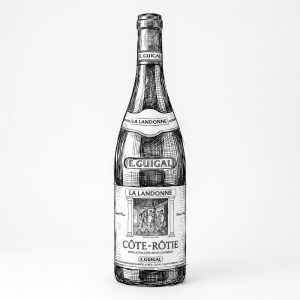
La Landonne
La Landonne is one of E. Guigal's three "la la la" wines, along with La Mouline and La Turque; all three come from the same vineyard at Côte Rôtie in the Northern Rhône, but La Landonne is a heretic. Only La Landonne is 100 percent syrah. The other two have viognier added.
Traditionally in Côte Rôtie Syrah is fermented with a little Viognier to soften the tannins and lift the flavors. La Landonne does not use this method. The wines are from Côte Brune, a darker, iron-rich region that makes up half the appellation, and the wines reflect this. They are dense, structured and suitable for long aging. This is Guigal's claim to what pure Syrah can do on the schist.
About E.Guigal
Ampuis is a small village on the right bank of the Rhône, and Etienne Guigal turned it into the reference point for Côte-Rôtie. Étienne Guigal started the estate there in 1946 after fifteen years working at Vidal-Fleurie, and the family bought that company outright in 1984 (a neat reversal). Today the estate owns around 45 hectares, roughly half in Côte-Rôtie, the rest spread across Condrieu, Saint-Joseph, Hermitage and Crozes-Hermitage. But Guigal is also the valley's leading merchant, handling about 40 per cent of all Côte-Rôtie and around 45 per cent of Condrieu, with total production near seven million bottles a year. Marcel Guigal runs it with his son Philippe, chief winemaker since 1997. Late harvesting is the house habit. They usually pick among the last in the appellation.
History & Heritage
The first vintage of Guigal in La Landonne was harvested in 1978, and its release meant something new. Marcel Guigal decided to bottle the wines of the individual lieux-dits separately, betting that single vineyard Côte Rotie would rival the great wines of Burgundy and the northern Medoc.
He turned out to be right: less than a decade later, Robert Parker tasted the wines and gave them his endorsement as world-class wines. This recognition restored the reputation of Côte Rotie, which had previously been in the shadow of Hermitage. The decision to use 100% new oak and age the wine for over 40 months was radical at the time and remains unusual today. For La Landonne buyers, it means that the wine was made to age from the start, with a track record of over 40 years.
Terroir & Climate
La Landonne is located in the Côte Brune, in the northern part of the Côte Rôtie. The soil is slate mixed with iron oxide, which literally gives Brune its name and its rusty color. Why it's important. Iron-rich shale produces syrah that is darker in color, more tannic and more structured than the granite and limestone of neighboring Côte Blonde.
The slopes themselves are brutal. The gradient reaches 60%, the terracing is done by hand, and the slopes face south-south-east, so the sun shines here all day. It's not for nothing that Côte Rotie translates as "toasted slopes". The local north wind, Bise, keeps the wines from overcooking. The result is a Syrah with La Landonne's characteristic concentration, power and minerality with an iron tinge.
Grape Varieties
The blending of La Landonne is characterized by simplicity: it is 100% Syrah.
Côte-Rôtie law allows viognier to be cofermented with Syrah, and most producers add at least a little. Guigal's La Mouline has 11% viognier, and La Turque has about 5%. La Landonne does not add viognier. This is because the iron-rich Côte Brune shale produces Syrah, which is itself quite dense and structured. Adding viognier softens what should not be softened.
Winemaking
A decisive choice is élevage. La Landonne is aged in 100% new French oak barriques for about 42 months. That's three and a half years in new oak, which is twice the aging time of most First Growth Bordeaux. Does that sound excessive? Perhaps. But La Landonne's concentration is not suppressed by the oak, but rather absorbed by it.
Fermentation beforehand is lengthy, about three weeks in closed stainless steel tanks with regular pumpovers. The harvest for Guigal is late, often the last in the appellation, aiming to achieve phenolic ripeness. All barrels are made in Guigal's own workshop in Ampuis. They manage the wood from forest to bottling.
What are the best vintages of La Landonne
La Landonne is a very consistent scoring wine. Exceptional vintages are (last 4 decades): 1985, 1988, 1991, 1998, 1999, 2005, 2010, 2012, 2015, 2018.
Tasting impression
The first impression is always one of intensity. La Landonne pours almost black and the nose opens up in waves: olives, crushed blackberries, smoked meat, violets and characteristic iron and graphite notes driven by slate. A hint of black pepper is felt underneath, typical of the syrah of the northern Rhône.
In the mouth, a wall of fruit and tannins maintains tension. In youth, the tannins are firm and chewy, but subtle rather than coarse. With age, a savory tapenade reminiscent of leather and undergrowth emerges.
Food Pairing
La Landonne's grip and savory depth tends to supplant oily and greasy flavors. Some points that work well:
- Juniper flavors of roasted venison, wild hare saddle and gibier echo the olive and leather character of the wine.
- The fat softens the tannins.
- Paired with truffle dishes, especially duck or lamb, the earthy notes harmonize in the middle.
- Mature hard cheeses such as Comté and Gruyere, salt and nutty flavors complement the wine's fruitiness.
Serving Suggestions
Serve at 16-18°C. Do not pull the cork at the table as most rooms are warmer. Decant young wines (2019, 2021) for at least 2 hr. A large Burgundy wine bowl is more suitable than a Bordeaux glass.
Vintages
La Landonne is remarkably consistent, but the style of the vintage does define the time frame: warm, ripe years like 2019 produce wines with broad shoulders, dark fruit and tannins that feel almost plump despite their structure. Cooler or classic years tend to produce denser, more flavorful wines that require extended cellar aging before showing themselves; 2016 is a more structured type and should be given time to age; 2021 is still a young wine and is a cellar wine; 2023 is a cellar wine.
If you're drinking now, look for wines that are at least 15-20 years old; 2000 is for example just right. If you want to keep wine in the cellar, anything made in the last 10 years deserves patience. Older varieties tend to cost more, and justifiably so.
E.Guigal
2000
€ 329,00 € 398,09 (in Vat) more info
E.Guigal
2021
€ 285,00 (ex Vat) € 344,85 (in Vat) more info
E.Guigal
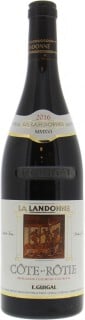
2016
€ 269,00 € 325,49 (in Vat) more info
E.Guigal
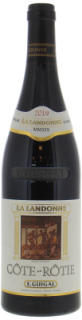
2019
€ 309,00 (ex Vat) € 373,89 (in Vat) more info
Cellaring Potential
La Landonne is made to age for 25-40 years from strong vintages. This wine has a lot going for it: dense Syrah tannins, high concentration, structural lift thanks to 42 months in new oak and iron-rich acidity from the Côte Brune schist. Over time, the oak flavors will blend and a third note such as leather, tapenade or forest floor will emerge.
FAQ
Is La Landonne a pure Syrah?
Yes, it is the only one of Guigal's three "La La" wines that does not contain Viognier.
How long is La Landonne aged?
25 to 40 years with a good vintage
Is La Landonne an investment wine?
Yes, it is. Production is small, 500-700 cases per year, and demand from collectors is stable. Old vintages are always highly valued.
How does La Landonne compare to La Mouline and La Turque?
La Landonne is the most structured and tannic of the three, produced on the Côte Brune. La Mouline (Côte Blonde, 11% Viognier) is the most aromatic and silky. La Turque is somewhere in the middle.
