
| Classification | Troisième Cru Classé |
| Type | Red |
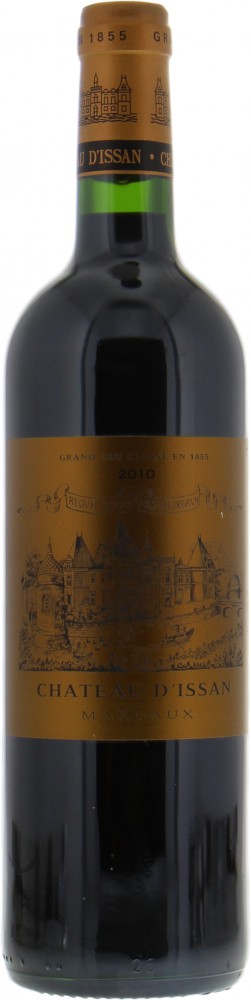
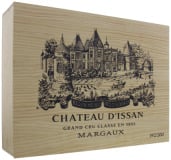
| Producer | Chateau D'Issan |
| Vintage | 2010 |
| Country | France |
| Main region | Bordeaux |
| Region | Margaux |
| Grape | Cabernet Sauvignon, Merlot, Bordeaux Blend |
| Volume | 0,75 |
| Condition | Perfect |
| Label | Perfect |
| Drinkable | -2040 |
| Stock | 4 |
The 2010 growing season in Margaux produced grapes with small berries, thick skins, and concentrated juice. The combination of a dry summer and cool nights resulted in one of the best vintages in Bordeaux in recent years—with a well-defined structure and pronounced acidity. For Château d'Issan, Cabernet played the leading role, resulting in a wine with a powerful structure and a long finish. It caught the attention of both Robert Parker and *Wine Spectator* magazine. Compared to the rounded 2009 vintage, this year's d'Issan appears more restrained and refined, but it will undoubtedly be a wine capable of withstanding long-term aging.
A complete, medium to full-bodied, exquisite Margaux from this medieval, moat-encircled, compellingly beautiful estate in the southern Medoc, D’Issan’s 2010 is a blend of 60% Cabernet Sauvignon and 40% Merlot. The deep, gravelly soils mixed with clay have provided extraordinary aromatics. The yields were ridiculously low (22 hectoliters per hectare) and the wine tips the scaled at 13.7% natural alcohol. Production was small after the selection for the grand vin, and the result is a dense, purple-colored wine with beautiful aromatics of spring flowers, blueberries and black raspberries as well as hints of cassis, tar and charcoal. The wine is gorgeously pure, well-balanced, and soft enough to be approached in 4-5 years or cellared for 25-30.
This red offers a grippy, charcoal-laced feel, cloaked by very fleshy plum, currant and blackberry confiture flavors. The long, tarry spine drives the finish, with extra bay leaf, maduro tobacco and warm stone notes.
Rene Gabriel rates this wine 19/20 points.
Notes of black currant and rich plum come to the fore, while the aroma reveals hints of cedar, graphite, and the light violet scent characteristic of Margaux. Although Merlot lends the wine body in the mid-palate, the 2010 is, without a doubt, a wine with a Cabernet backbone. Firm yet refined tannins coat the palate, while vibrant acidity provides a solid foundation for the entire composition. The finish is long and rich, with hints of iron and tobacco in its depths. If you plan to open the bottle right away, let the wine breathe in a decanter for about two hours. You can enjoy this wine right now, while it’s still young.
The blend for the 2010 vintage consists of approximately 61% Cabernet Sauvignon and 39% Merlot. Here, Cabernet plays the leading role, giving the wine structure, black currant aromas, and a long finish. Merlot adds a plum-like flavor and softens the wine’s sharp edges. The deep gravel soils of the Cantenac plateau are ideal for growing Cabernet, and thanks to good drainage, the roots penetrate deep into the ground. And in vintages with a robust structure, such as 2010, it is the Merlot component that prevents the wine from becoming overly harsh.
Best enjoyed between 2025 and 2045. The balance of acidity and tannins in the 2010 vintage allows the wine to age easily for 20 years, and d'Issan possesses the concentration necessary for this. Store at a temperature of 12–14 °C in a horizontal position, protected from light. As the fruity notes mellow, aromas of cedar, leather, and truffle will come to the forefront.
Wine has been produced at d'Issan since the Middle Ages, and the current château, surrounded by a moat, was built in the 17th century. The walled "Clos" vineyard was completed in 1644. However, d'Issan's modern history truly began in 1945, when the Cruz family acquired the neglected estate and replanted the vineyards. In 1998, management passed to Emmanuel Cruz, who achieved a significant improvement in quality, and in 2012, the Lorenzetti family joined the business as co-owners. We offer d’Issan wines because, despite their third-growth-level pricing, they always deliver the aromas of Margaux.
The vineyards are located on a gravelly hill in the very heart of the Margaux AOC, between Château Palmer and Château Margaux. The croupe (a gravelly rise) is well-drained and warms up quickly, forcing the vines to send their roots deep into the underlying clay layer in search of moisture. This is precisely where the wine’s richness comes from. The mouth of the Gironde River moderates temperature fluctuations, and since this estate is located almost exactly on the 45th parallel north, it enjoys long, warm summers and mild winters. For the Cabernet Sauvignon variety, these are, in essence, the typical conditions of the Left Bank.
The hand-harvested grapes undergo a two-stage sorting process (first by hand, then on a vibrating sorting table) and flow by gravity into stainless steel tanks, separated by vineyard plot. Fermentation and maceration last between 18 and 24 days. The blend is determined in January and February in consultation with consultant Éric Boissenot, after which the wine is aged in French oak barriques (225-liter Bordeaux barrels) for 16–18 months. About half of the barrels are new. This proportion of new barrels is sufficient to impart structure and spicy notes to the wine without detracting from the floral nuances characteristic of Margaux. Each year, the chateau ships approximately 100,000 bottles of grand vin.
Tannins require proteins and fats. Examples of successful pairings:
Serve at 16–18 °C. Young vintages, such as the 2022, should be decanted for at least an hour before serving to allow them to breathe.
With track & trace code