| Classification | Cru Classe |
| Type | Red |
| Producer | Verite |
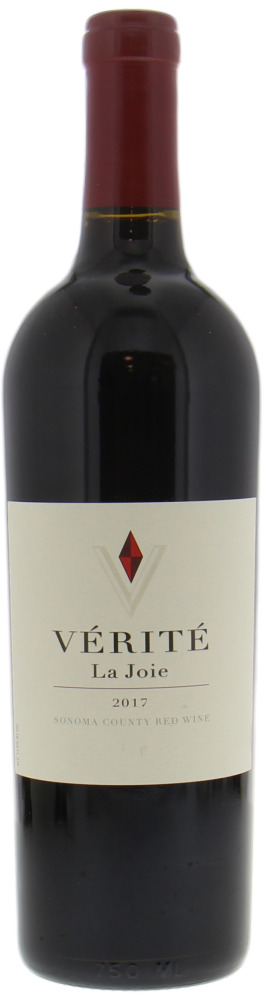
| Wine | La Joie |
| Vintage | 2017 |
| Country | United States |
| Region | California |
| Appellation | Sonoma County |
| Grape | Cabernet Sauvignon, Merlot, Cabernet Franc, Bordeaux Blend |
| Volume | 0,75 |
| Condition | Perfect |
| Label | Perfect |
| Drinkable | 2027-2040 |
| Stock | 6 |
The 2017 growing season in Sonoma ended under the headline of the Tubbs and Nuns fires, which occurred on October 8. Verité largely escaped the effects on fruit. Pierre Seillan stated that most of the La Joie lots had been delivered by then. Bottles are filled with warm-season Cabernet Sauvignon from the Alexander and Knights valleys, picked at full ripeness and blended from 27 lots of micro-cru. The 2017 La Joie leans more toward richness than the cooler vintages.
“The Cab Franc was quite spectacular in 2017. There is a bit more in the blend this year,” Pierre Seillan told me during the tasting of the 2017s with his daughter and one day successor, Helene.
A blend of 70% Cabernet Sauvignon, 16% Cabernet Franc, 10% Merlot and 4% Petit Verdot, the 2017 La Joie has a very deep garnet-purple color. It opens a little closed and broody, giving glimpses of blackcurrant cordial, espresso, charcoal and black truffles to begin, before blossoming out to a whole array of preserved black and blue fruits, dusty soil, crushed rocks and iron ore scents plus a waft of roses. The medium to full-bodied palate is built like a brick house, with firm, grainy tannins and a lively backbone supporting the muscular fruit, finishing very long and mineral laced. The alcohol weighed in at just 13.9% this year (14% on the label), making for a particularly elegant but no less impactful La Joie! 2,500 cases were made.
An elegant, complex red with currants, blackberries and hints of cedar, graphite and lead-pencil shavings. It’s full-bodied with polished, velvety tannins and a fresh, bright finish. Fluid and refined. 70% cabernet sauvignon 16% cabernet franc, 10% merlot and 4% petit verdot.
Crème de cassis comes first, followed by graphite and cedar, with an aromatic spiciness typical of Seillan wines. The flavor is dense but not heavy. The Cabernet Sauvignon tannins are firm, framed by the roundness of Merlot and the violet notes of Cabernet Franc. Espresso and dark chocolate in the new French oak finish. Decant and drink now or wait.
La Joie is predominantly Cabernet Sauvignon, 76-82% in most vintages, blended with Merlot and Cabernet Franc. Why this particular blend? Cabernet gives structure and cassis. The Merlot softens it. Cabernet Franc adds aromatic lift. Petit Verdot gives color and a peppery note. The same grape varieties as Pauillac, but with a different hour of sunshine.
We think the 2017 La Joie must be kept until about 2027, and then it will be drinkable until about 2040. The tannins are still firm, and a wine aged for 24 months in French oak (mostly new oak) needs bottle aging to unify; it should be kept at 12-14°C. With aging, the blackcurrant transitions to tobacco, leather and dried herbs.
Verité was founded in 1998 by Jess Jackson of Kendall-Jackson in partnership with French winemaker Pierre Seillan, who spent decades in Gascony, the Loire and Bordeaux. The idea was simple: apply Bordeaux techniques to Sonoma fruit without compromise. Seillan calls his philosophy "droit du sol" (right to the soil) and uses grapes from more than 50 micro plots in four Sonoma appellations. His daughter Hélène Seillan is now working with him. Verité is one of the most consistent Bordeaux type wine producers in California.
La Joie uses grapes from the steep slopes of the Alexander Valley, mostly from Knights Valley, Bennett Valley and Chalk Hill. Why is this important? Because there are more than 40 soil types between these four Sonoma appellations, ranging from volcanic loams at the foot of Mount Saint Helena (Knights Valley) to red clay loams in Alexander Valley. Elevations range from 60 meters above sea level on Chalk Hill to nearly 700 meters on Mount Saint Helena. Cool nights, warm days and fog from the Pacific Ocean.
Each micro-cru is harvested separately and fermented separately. This allows Seillan to handle hundreds of elements in blending. The decision to harvest? The decision is based on flavor, not lab values. Lab analysis is used to confirm decisions, not to make them. Aging takes place in French oak barriques (small 225-liter barrels), usually about 20 months, with a high proportion of new oak. The level of toasting varies from batch to batch. Although the percentage of new oak is high, the fruitiness endures.
Cabernet tannins crave fat and protein. La Joie 2019 is no exception. Taste:
Serve at 16-18°C. Decant for at least one hour, two hours for young bottles.
With track & trace code