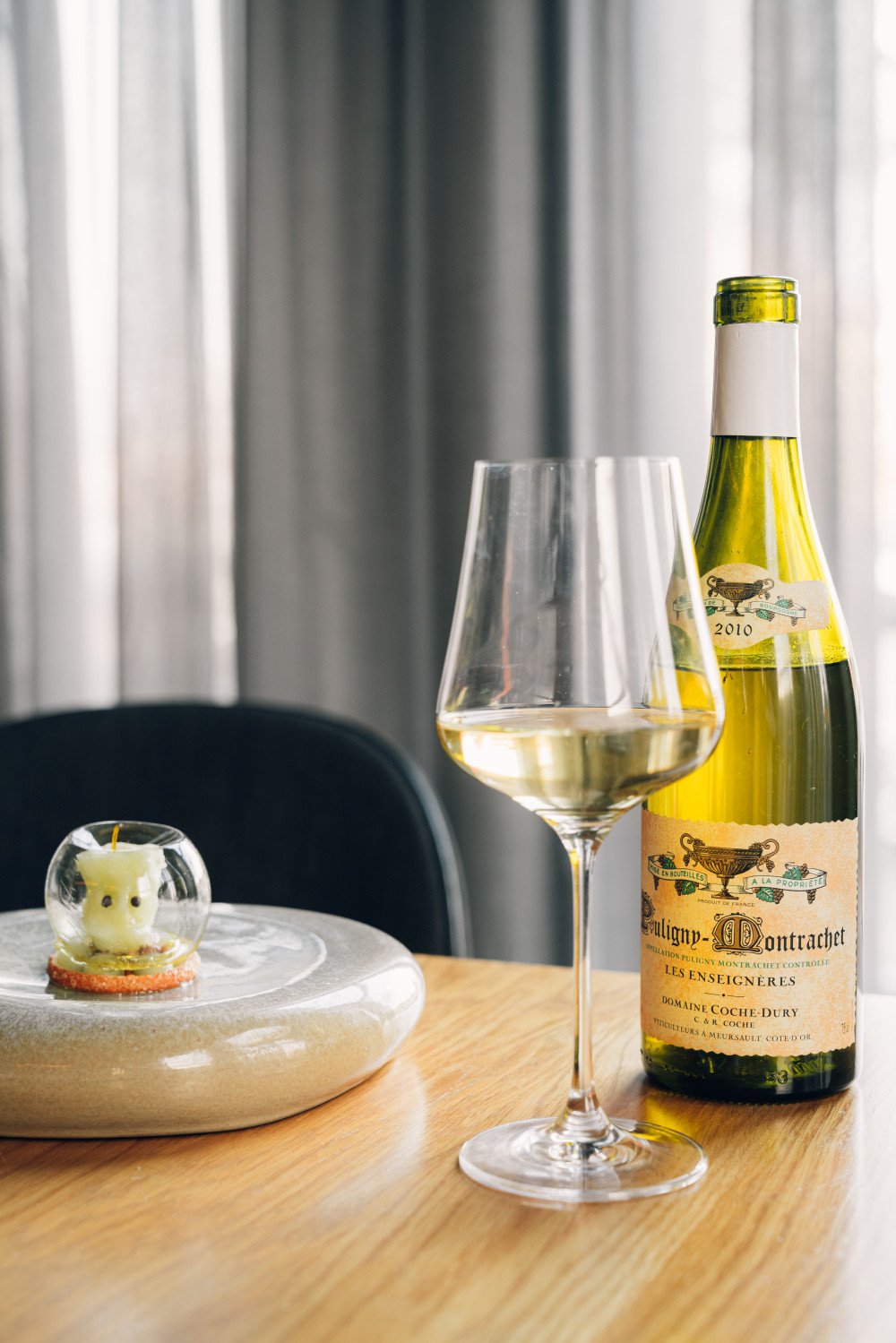

Coche Dury
Domaine Coche-Dury produces some of the very greatest white wines in Burgundy, probably the most sought-after of all white Burgundy estates. It has even achieved a cult status, especially the last 30 years.
The winery does not have a website or a tasting room and do not receive any visitors at all, as they closed their visitors' book years ago.
Coche Dury produces around 4,000 cases of wine from approximately ten hectares in Meursault and the surrounding area, and these bottles sell for more than most of the other fine and rare white wines in the world.
History
Léon Coche bought his first plots in the area Meursault in the early 1920s. At that time the estate was called Coche-Bouillicaut, after his wife's family.
Léon’s land was divided amongst his three children. Georges inherited his share in 1964 and continued to purchase new plots. One of Léon’s other sons founded Domaine Coche-Debord, whilst his daughter’s line married into the Domaine Roulot family, so these three renowned wine-producing estates in Meursault share the same roots.
Georges’s son, Jean-François, inherited the estate in 1972. In 1975, he married Odile Dury, combined the two surnames, and spent the next three decades building the reputation the estate enjoys today. In 1986, he acquired the leasehold rights to the Corton-Charlemagne plot and produced his first vintage that same year.
Raphaël Coche joined his father in the late 1990s and took over the winemaking in 2010 when Jean-François retired. The handover was more of a gradual transition than a sudden break.
Vineyards
Around ten and a half hectares under production, spread across six communes in the form of small plots. Virtually none of them exceed one hectare, which is why so little of each wine variety is produced.
The largest single plot is the Meursault village, covering around 4.25 hectares, spread across five or six separate plots, which are usually fermented and bottled separately. Above these lie the Meursault Premier Crus: Perrières, the very one everyone wants to get their hands on, comprising two plots in the upper part of the vineyard; Caillerets and Genevrières, which only became part of the estate in 2003. There are two vineyards named after the village of Meursault: Les Rougeots, covering around 0.7 hectares, and the much smaller Les Chevalières.
Outside Meursault there is 0.5 hectare in Puligny-Montrachet. Les Enseigneres, and several vineyards planted with the red grape variety pinot noir in Auxey-Duresses, Monthey and Volnay, as well as Corton-Charlemagne, which has been cultivated under a lease since 1986 and whose area approximately doubled in 2012.
Terroir
The vineyards of the Meursault wines typically consist of layers clay soil on limestone, and the ratio of these layers varies as one ascends the slope. The vineyards in the lower part of Meursault contain more clay, which gives the wine density and roundness. The Premier Cru vineyards higher up, especially Perrieres and Caillèrets, rest on a thinner layer of soil on solid limestone. Corton-Charlemagne is a completely different terroir and vineyard: clay-limestone soil on the upper slope above Aloxe-Corton.
Working in the vineyard is based on great care in stead of some ideology or historical commitment. No pesticides are used, pruning is carried out very carefully to reduce yields and the vines are replanted one by one using cuttings from the estate’s own old vines, in stead of clones from outside. Raphaël has also reintroduced the ploughing across all of the vineyards.
Grape varieties
Predominantly Chardonnay. There is a small amount of Aligoté, which produces a wine that most people have never encountered, as well as a little Pinot Noir in less prestigious appellations outside Mersault.
The red wines are good, but they go virtually unnoticed, which is entirely reflective of market priorities.
Winemaking
The grapes are harvested by hand, sorted, and then crushed quite thoroughly before pressing, which yields a ‘greener’ and more acidic juice than when whole bunches are pressed. This largely defines the style of Coche Dury, and it is this acidity that make the wines age so well.
The juice is immediately transferred to barrels for fermentation using the wine’s own yeasts. The wine is then aged for a long time on fine lees with regular bâtonnage. Ageing lasts from 15 months to almost two years, depending on the vintage and the variety. In July, the barrels containing each cuvée are racked and blended, then returned to the barrels for a second winter, and in April of the following year, the wine is bottled from each barrel.
The use of new oak sued to be the winery’s hallmark. Jean-François increased the proportion of new oak to 50 percent in the finest wines. Raphaël has reduced it to around 20–25 percent for most cuvées, and the wines now have less pronounced oaky notes and undergo bâtonnage slightly less frequently than before.
Wines
Coche Dury produces around fifteen wines, most of which are produced in batches of a few hundred cases or fewer.
The White wines
- Bourgogne Aligoté. The only Aligoté wine of Coche Dury made from old vines.
- Bourgogne Blanc. From plots surrounding the house and winery, covering an area of approximately 1 to 1.5 hectares.
- Meursault. A village wine and the largest cuvée, covering around 4 hectares spread across five or six separate plots, including Les Narvaux, Les Vireuils and La Barre. It is usually blended, although wines from individual plots are sometimes bottled separately.
- Meursault Le Rougeots. Covering an area of around 0.7 hectares, with vines planted in 1940, 1962 and 1973.
- Meursault Les Chevalieres. A tiny plot, approximately 0.12 hectares, planted in 1958.
- Meursault 1er Cru Les Pierreres. The flagship Meursault, covering around half a hectare, comprising two sections in the upper part of the vineyard; the vines were planted in 1950, 1970 and 2005.
- Meursault 1er Cru Les Caillèrets. Also a tiny plot.
- Meursault 1er Cru Les Genevrières. The newest of the 1er Crus, added to the domaine’s range in 2003.
- Puligny-Montrachet Les Enseigneres. Around 0.5 hectare, with vines planted between 1930 and 1952.
- Corton-Charlemagne Grand Cru. The estate’s only ‘Grand Cru’ wine, first produced in 1986; cultivated on leased land, with vines planted in 1960. It is by far the most expensive wine produced by this estate.
The red wines
- Bourgogne Rouge. An area ranging from 0.35 to 0.75 hectares on clay-sand soils.
- ‘Meursault Rouge’. Approximately 0.12 to 0.23 hectares, planted in 1980. A true rarity, as red ‘Meursault’ is not produced often.
- ‘Auxey-Duresses’. Half a hectare, planted in 1982.
- ‘Montelie’. Around a quarter of a hectare, planted in 1987.
- Volnay 1er Cru. Around 0.33–0.39 hectares, vines from 1962 and 1987.
One wine has disappeared: Meursault Casse-Tetes, bottled in the 1980s, is no longer produced. If you manage to find it, it will be a wine from Jean-François’s early period.
What these wines have in common is a certain ‘green’ quality in their youth, which people either recognise straight away or find strange, lying beneath truly ripe fruit, as well as the ability to age for decades.
Read moreRegions
Countries
Other wine producers