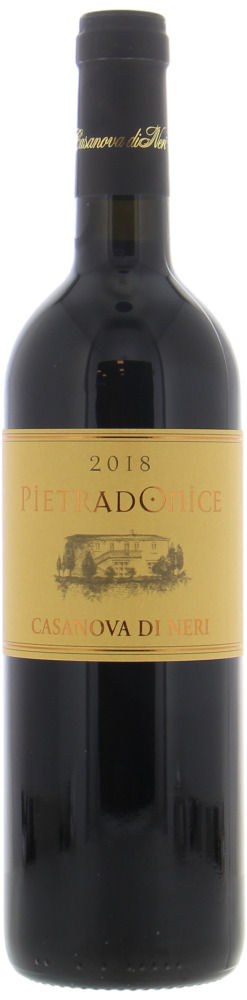
| Classification | I.G.T. |
| Type | Red |
| Producer | Casanova di Neri |
| Vintage | 2018 |
| Country | Italy |
| Region | Tuscany |
| Appellation | Bolgheri |
| Grape | Cabernet Sauvignon |
| Alcohol % | 14.5% |
| Volume | 0,75 |
| Condition | Perfect |
| Label | Perfect |
| Drinkable | -2038 |
| Stock | 6 |
The 2018 growing season in Montalcino was cooler and wetter than the warm years that preceded it. Spring rains reduced yields and the mild summer resulted in Cabernet Sauvignon ripening slowly. Casanova di Neri's Pietradonice IGT is a pure Cabernet from vineyards in the southern part of the commune, fresher and more lifted than the more concentrated 2015 and 2016 vintages. Expect more elegance than power.
Aromas of blackberry, plum, dark chocolate, mushroom, earth and five spice. Full-bodied with fine tannins. Chewy and structured on the palate with a chalky texture. Balanced, layered and well defined. Long, savory finish.
The 2018 Pietradonice, a varietal Cabernet Sauvignon from the south-east of Montalcino, is dark as it grumbles up from the glass, showing dusty rose, currents, cherries and smoke. This is velvety in feel yet wonderfully lifted and fresh, steadily building in tannic heft yet packed full of graphite-like mineral-tinged black fruits and dark inner florals. A hint of sour citrus keeps you coming back for more even as the Pietradonice flexes its structural heft. Give the 2018 five to seven years before attempting to enjoy the full potential buried within.

Blackcurrant notes come first, but this is a wine from a cooler vintage. Bright without being cloying. Behind the black currants are notes of graphite, tobacco leaf, dried Mediterranean herbs and cedar, aged in French oak barriques (small 225-liter barrels). Medium to full on the palate, with firm but not coarse tannins, the 2018 wine has bright and powerful acidity. Drink with food, not as a stand-alone wine.
Pietradonice is pure Cabernet Sauvignon, which is why it is labeled IGT Toscana and not Brunello DOCG (Brunello requires 100% Sangiovese). So why plant Cabernet in Montalcino? The warm and dry climate ensured good Cabernet ripening, and in the cooler 2018 season, the ripening curve allowed for a restrained Cabernet like Bordeaux.
The 2018 Pietradonice will be drinkable from about 2026 to 2038. It still needs a few years for the tannins to settle, and the acidity of the cool harvest gives this wine a longer finish than the alcohol would suggest. Store lying down at 12-14°C. Notes of blackcurrant pass into notes of tobacco, leather and cedar.
Giovanni Neri acquired Podere Casanova in 1971. The Sangiovese vines on the property needed replanting, so he started virtually from scratch. The estate now covers 63 hectares in seven vineyards, each with its own soil, sun exposure and age of vines. The flagship wine, Brunello Cerretalto, has received 100 points from several critics. Casanova di Neri is one of the most reliable wineries in Montalcino, and Pietradonice is their bet for Cabernet.
Casanova di Neri's Pietradonice vineyards are located between 200 and 450 meters above sea level. Why is altitude important? Because the Tuscan sun allows the Cabernet grapes to fully ripen the skins, and the temperature difference between day and night preserves acidity at the cool nights of high altitude. The soils on the estate are a typical Montalcino mixture with variations of sandy, calcareous, marl, clay and stone. This calcareous element gives Pietradonice a savory, almost iron note that is rarely found in Cabernet from warmer, flatter areas.
Hand-harvested, de-stemmed and fermented exclusively with indigenous yeasts, without the use of commercial strains. Stainless steel is used for fermentation and temperatures are controlled so that the warm Tuscan climate doesn't pressure the yeast and ruin the flavors. The wine is then decanted into wooden barrels. Pietradonice is aged for 37-43 months, depending on the vintage and cuvée, and then bottle aged for 6-24 months before release. This long aging period gives the Pietradonice wine its luster upon release.
Cabernet tannins call for protein and fat. Tuscan cuisine handles them with ease:
Serve at 16-18°C. Decant an hour before serving, especially in 2020.
With track & trace code