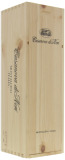
| Classification | Cru Classe |
| Type | Red |
| Producer | Casanova di Neri |
| Vintage | 2018 |
| Country | Italy |
| Region | Tuscany |
| Appellation | Bolgheri |
| Grape | Sangiovese |
| Volume | 0,75 |
| Condition | Perfect |
| Label | Perfect |
| Stock | 24 |
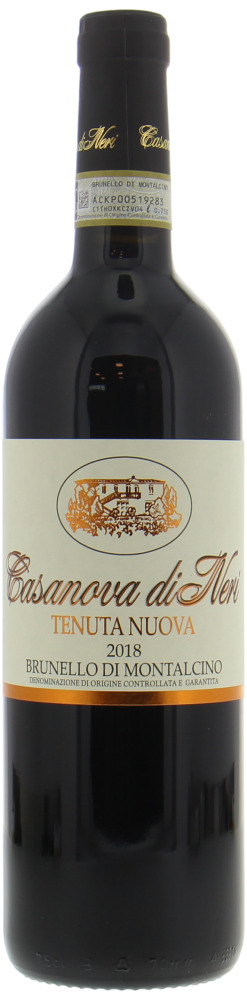
Montalcino's 2018 growing season returned to its classic form. A rainy spring, a milder summer than the scorching 2017, and a crop that rewarded producers who waited until full ripeness. The consortium rated it 4 stars out of 5. For Casanova di Neri's Tenuta Nuova, that means Brunello has freshness and exuberance rather than power. Expect a more elegant and flavorful style compared to the riper 2015 and 2016.
Here's a treat from Casanova di Neri. Aged in tonneaux for 30 months, the 2018 Brunello di Montalcino Tenuta Nuova is fleshed out and rich with pretty layers of dark fruit, dried blackberry, spice and cured tobacco. There is a point of sour cherry in this vintage that folds into crushed flower, balsam herb, licorice and crushed stone. The bouquet is classic, but the Casanova di Neri magic touch comes through thanks to the wine's balance and pretty intensity. I can't, however, overlook a powerful 15% alcohol content that leaves its mark.
Bright and focused, offering cherry, raspberry, rose hip, mushroom, iron and tobacco aromas and flavors. Pure and expressive, with fine harmony, an elegant frame and a lingering aftertaste. Gains support from a firm structure. Best from 2025 through 2042.
Elegant and perfumed nose of dried roses, violets, lemon zest, slate, cherries, aniseed and truffles. Very fine, tight and precise tannins. Medium to full body. I like the floral and saline undertones. So precise and fresh with a tight finish. Crushed stones at the end. Try in 2025, but already attractive to taste and drink.
There is more depth to the 2018 Brunello Di Montalcino Tenuta Nuova, with light smoky earth, black cherry, licorice, and black pepper. It is polished with fresh crunchy fruit yet retains a good amount of concentration, with notes of black raspberry, turned fresh soil, and graphite. Mouthwatering, with salinity, fresh acidity, and great length, it has fine tannins and warming spice on the finish. Drink 2024-2044.
Intense, bright ruby red, with a garnet sheen. On the nose, wild raspberries and black cherries, lovely savoury notes, violets. Substantial and dense on the palate, with really wonderful, compact tannins, multi-layered, notes of cloves, rich and chewy on the finish.

First and foremost, the nose is impressive. Bright cherry, wild herbs, hints of pipe tobacco and the dusty, ferruginous notes that emerge when Sangiovese is grown in galestro. The palate is medium-bodied, firmer than the 2016, with firm but not drying tannins. Acidity provides a long and savory finish. Requires decanting. Delicious now, let it air for an hour and the hidden dark fruit will reveal itself.
Only one grape variety is allowed in Brunello di Montalcino DOCG: Sangiovese, popularly called Brunello. So why is it so important to Tenuta Nuova? Sangiovese is transparent. It shows the soil, the harvest and the winemaker's skill. Casanova di Neri grows clones of Sangiovese Grosso, which give it structure and aromatic complexity rather than weight.
Drink between 2026 and 2040; the 2018 wine can be drunk earlier than warmer vintages, but the acidity and fine tannins will easily persist for 20 years; store lying down at 12-14°C, away from light. Over time, the cherry fruitiness will give way to leather, dried roses and forest floor.
Giovanni Neri purchased Podere Casanova in 1971. He renamed the estate, planted Sangiovese, and began construction. Today, the estate has approximately 63 hectares and seven vineyards, each with its own soil and exposure to the sun. The estate's flagship wine, Cerretalto, has received top marks from international critics for many years. Critics consider Casanova di Neri one of the most consistent addresses in Montalcino, and Tenuta Nuova is the place where this consistency is most accessible.
Tenuta Nuova's vineyards are located in the eastern part of Montalcino, on soils that are a mixture of galestro (thin schist) and more rocky, stony areas and traces of marine deposits. Why are these soils important for Sangiovese? Galestro drains quickly and stresses the vines, thus concentrating the fruit. The estate's vineyards are located between 200 and 450 meters above sea level, and the difference in day and night temperatures due to the altitude allows Sangiovese to maintain its acidity even during Montalcino's hot summers. Without these conditions grapes might get overripe.
The grapes are harvested by hand, destemmed, and only natural yeasts are used. Fermentation takes place in temperature-controlled stainless steel to preserve fresh fruit flavors. The wine is then aged in a mix of large wooden casks and barriques (small 225 liter French oak barrels) for about 30 months. The format is important. Using large barrels allows for a slow exchange of oxygen without adding vanilla to the wine. The wine is then aged for 6-24 months in bottle before release.
Sangiovese's acidity and persistent tannins need fat and protein. The Tuscan method is perfect:
Serve at 16-18°C. Decant one hour before serving.
With track & trace code