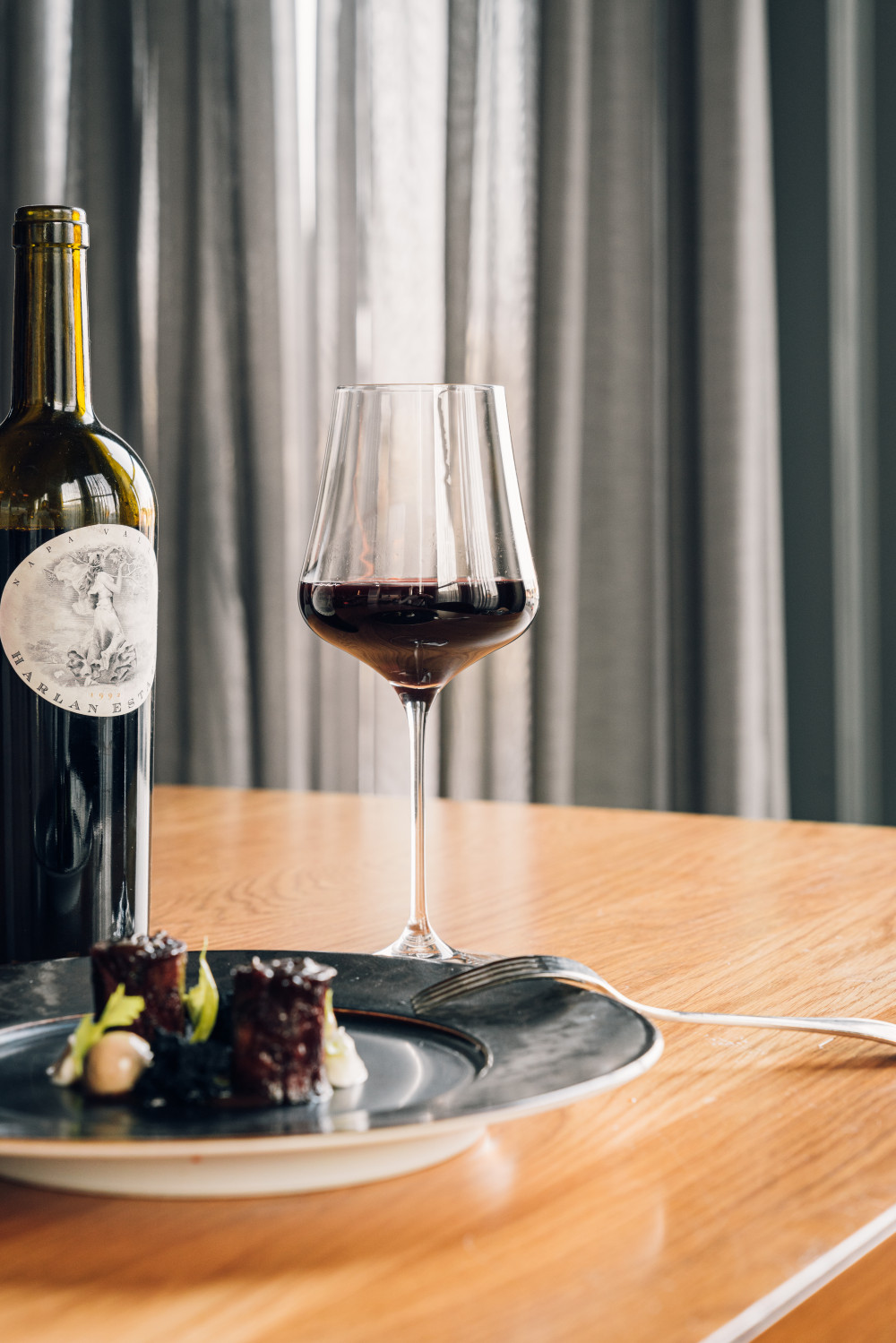

Harlan Estate
Oakville's reputation was literraly built from the valley floor up. Harlan Estate, on the other hand, moved in the opposite direction, up the hills west of the appellation, where the vines are situated on terraces or densely planted in thin soil layers atop broken rock.
Bill Harlan built this through an operational approach focused on a single goal: the Cabernet Sauvignon blend, made exclusively from grapes produced on a single hillside plot located in Napa Valley, and even then, in relatively small quantities. At the time, small-batch, high-end wines produced on mountain slopes were rare in California, so Harlan Estate became one of the leading examples of what people began calling cult Cabernet.
Bob Levy is the winemaker. In addition to the main wine, there is a second selection.
The buildings were designed with as much meticulous attention to detail as was given to the vineyard's layout.
The history
Bill Harlan came to the wine business by a roundabout route. In his youth, he played poker for three years at a casino in Lake Tahoe, and later founded one of the most successful real estate development companies in California. He says that a visit to Robert Mondavi Winery during its opening week in 1966 was what led him to start the wine business.
Money came first, and the vineyard followed. In 1978, Harlan and his partners purchased the Napa Valley Country Club, known as Meadowood, and transformed it into the valley's first luxury resort. Three years later, he voluntarily offered the property for the first Auction Napa Valley event, which led to regular interactions with the valley's grape growers. Merryvale, which he co-founded, opened in 1986.
Harlan Estate itself is recorded as having been established in 1984 on a site on the western hillside of Oakville.
His subsequent career unfolded within the same valley. Bond, Napa Valley Reserve, and Promontory all evolved from the same Napa Valley foundation, and Harlan's policy of limited production and high prices contributed significantly to defining the cult-status Cabernet category within California.
The vineyards
The Harlan Estate's farm spans 97 hectares across the hills above the Oakville Benchland, of which only 17 hectares are planted with vineyards. The rest of the property consists of woodlands, olive groves, and open hillsides. There isn't a single flat spot here.
The elevation across the entire property ranges from 68 meters to 374 meters, each plot faces in a different direction. Harlan Estate describes this as 360-degree exposure, which is quite accurate. This is because the vines are not planted in rows facing a single direction but are instead planted in a way that wraps around the slopes.
Two planting methods coexist side by side. Some plots were created by building terraced steps into the hillside, while others feature vines densely planted in open spaces; in all plots, the vines are trained on vertical trellises, and the branches are carefully arranged to regulate the density of the foliage.
The terroir
A lot of Napa properties sit on a single type of bedrock. In contrast, the Harlan Estate property features an unusual topography where two types of bedrock, igneous and sedimentary rock, coexist beneath the same hillside, prompting the owners of this property to commission a written report on its geological characteristics.
The soil layer is thin and rests on fractured bedrock. Vines in this terrain have limited access to nutrients, and due to the steep slope, drainage is rapid; consequently, the vines must work hard which translates in high quality wines.
The defining characteristic of this vineyard is concentration rather than quantity. While the warm climate typical of Oakville is evident, the varying altitudes and exposures mean that ripening rates differ from block to block, so the harvest is conducted sequentially, block by block.
Four Bordeaux grape varieties, one blend
Harlan Estate is a variation of the classic Left Bank combination, with Cabernet Sauvignon accounting for the majority of production:
- Cabernet Sauvignon, 70%
- Merlot, 20%
- Cabernet Franc, 8%
- Petit Verdot, the remaining 2%
No white varieties are planted on the Oakville farm.
The winemaking
Bob Levy has described the role of a winemaker at Harlan Estate as listening to the potential the land offers and striving to capture it. While this statement may seem quite simple, it aptly illustrates the winery's priorities. In other words, the work in the vineyard lays the foundation for the wine, and the winery exists solely to avoid interfering with that process.
The grapes are harvested by plot, and the winery's fermentation room was purpose-built rather than converted from an existing space. Bill Harlan has described architecture as a matter of time, place, and function, and the winery buildings were designed according to these principles, with the same level of meticulous attention paid to the workspaces as to the exterior spaces.
Production volumes are intentionally kept low. Harlan Estate was one of the California wineries that viewed small-scale production not as an end result but as a starting point; its selection criteria are so strict that there is even a separate second wine made from grapes that fall short of the standards.
What comes out of the cellar
Harlan Estate is a red Cabernet Sauvignon-based blend made from grapes grown on the Oakville hill, and this wine bears the winery's name. This wine is the very reason the winery exists, and it is the only wine made exclusively from the finest grapes carefully selected from the vineyard.
Next is The Maiden, the estate's second selection wine. Harlan Estate describes this wine as having a delicate yet rich flavor and explains that its character is closely related to that of the main wine. This is a characteristic one would naturally expect from a wine made from grapes harvested from the same 17-hectare vineyard managed by the same team.
Both wines are red, made from the same Bordeaux varieties, and produced from the same vineyard. Bill Harlan's other projects, notably Bond and Promontory, are not included under the Harlan Estate label; each has its own distinct vineyard and wine.
Frequently asked questions
Which AVA is Harlan Estate in?
Oakville AVA, within Napa Valley, California. The vineyards are in the western hills above the Oakville benchland, not on the valley floor.
What is Harlan Estate best known for?
Helping to create the California cult Cabernet category: very small production, hillside fruit and prices to match, from a single Oakville property.
Does Harlan Estate have a second wine?
Yes, The Maiden, made from the second selection of the same vineyard.
Is Harlan Estate connected to the Mt. Harlan AVA?
No. Mt. Harlan is a separate appellation in the Gabilan Range, well south of Napa Valley, and has nothing to do with Harlan Estate in Oakville.
Regions
Other wine producers