| ex Vat | € 895,00 |
| in Vat | € 1.082,95 |
| Volume | Magnum |
| Classification | DOC |
| Type | Red |
| Producer | Gaja |
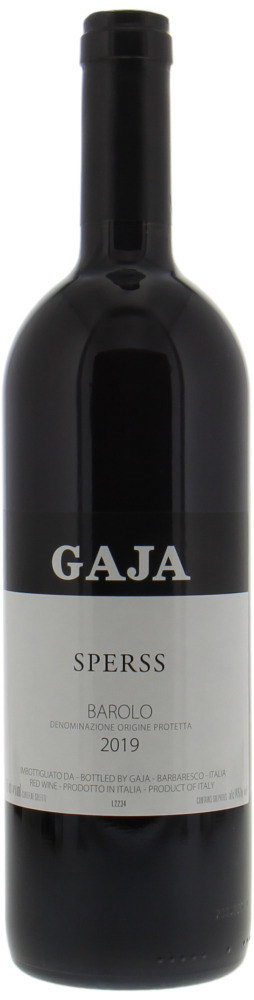
| Wine | Sperss |
| Vintage | 2019 |
| Country | Italy |
| Region | Piemonte |
| Appellation | Barolo |
| Grape | Nebbiolo |
| Alcohol % | 14.5% |
| Volume | 0,75 |
| Condition | From Original Wooden Case |
| Label | Perfect |
| Drinkable | 2026-2050 |
| Stock | 8 |
| Volume | 1,5 |
| Condition | From Original Wooden Case |
| Label | Perfect |
| Drinkable | 2026-2050 |
| Stock | 1 |
In 2019, the growing season in Langhe was characterized by a stable, classic pattern. The days were warm and the nights were cool, ensuring a long and even ripening period that lasted until October. Thanks to these conditions, Gaja's "Sperss" wine, produced in Serralunga d'Alba, boasts a deep color, firm tannins, and a structure characteristic of Serralunga. This will be a powerful Barolo, intended more for long-term aging than for immediate consumption.
This wine offers a delicate embroidery of earth, crushed rose, rusty nail and dark currant. The Gaja 2019 Barolo Sperss also has hints of smoke or camphor ash, and the entire wine is very polished and seamless with underripe dark fruit or sottobosco (undergrowth) that carries through to the end. This is one of the most powerful of Gaja's latest releases, yet the wine is also profoundly elegant.
Very well integrated tannins that spread across the palate and give tension and form to the wine. Medium to full body. Chewy and juicy.
Serralunga d’Alba. Vineyard blend of Marenca and Rivette.
Lustrous mid ruby. Compact and pretty much closed on the nose, with saline, minerally notes. With aeration, a deep layer of spice and liquorice wood reveals itself. Complex but still pretty much locked. Elegant palate weight combined with bags of fine, gravelly tannins and crunchy, youthful red-berry fruit. Long and precise and cool. Finesse and power. (WS)
A wine of stature and breeding, the 2019 Barolo Sperss is pure Serralunga power. Dark toned fruit, lavender, licorice, gravel and crushed rocks soar from the glass. There is plenty of the brooding intensity and tannic heft that are such signatures, but the 2019 is also wonderfully refined.
Number 21 in the Top 100 from 2023
The 2019 Barolo Sperss is rich with dark mineral earth, black cherry, and Earl Grey tea. Long and mouthwatering, it has a powerful structure while retaining finesse. It is fantastically balanced, with gripping tannins, fresh acidity, and notes of forested earth and ripe red berries. A wine for the long haul, this is another great and noble wine to drink over the coming three decades.The Gaja estate was founded in 1859, although it was Angelo Gaja, the fourth-generation winemaker of this Barbaresco estate, who made the innovations that would help shape the region as it is today. The entire family shares responsibilities across their estates. Great attention is paid to their practice of sustainable and regenerative farming. I met with Giovanni Gaja for this tasting at the estate in Barbaresco and also made a visit to the nearby region of the Alta Langa, only 16 kilometers away from the original estate. The latest major development for the estate in Piedmont is a brand new winery exclusively dedicated to their still white wine production in Alta Langa, designed by the Italian architect Giovanni Bo, who the family have worked with since 1982. The vineyards of Gaia & Rey and Brassica will remain the same, but fermentation and production will move to this location. There is greater biodiversity in Alta Langa compared to Barolo and Barbaresco, with 60% of the land being undeveloped land and hazelnut farms, and only 40% vineyards, compared to Barbaresco, which has 80% of the land under vine. For this reason, as well as the higher elevations, this area is seeing an influx of attention across the region. In 2015, they purchased 30 hectares of land that had been planted to hazelnut trees, at an average elevation of 650 meters, which they have converted to vineyard and indigenous plants of the area. The winery, which I toured in March of 2023, will be completed in time to begin production for this year’s harvest. Cascina Langa, the historical name for the property, has soils that are rich in sand and tuff, which they believe will be well-suited for adding structure for the white varietals of Chardonnay and Sauvignon Blanc. They also planted several other experimental vines to learn what will work well in the region.
The initial aroma notes feature tar, dried roses, and dark cherries; along with salty, almost iron-like nuances characteristic of Nebbiolo from Serralunga. Hidden in the depth of the aroma are hints of truffle and a light hint of licorice. The palate is rich, with a refined structure. The tannins are dense and fine-grained, the acidity is high, and the finish is long, with barely perceptible sweet, spicy notes characteristic of oak barrels. This is a powerful wine with a robust structure that is still very young. If you plan to open it right away, pour a generous amount into a decanter.
"Sperss" is 100% Nebbiolo. Starting with the 2013 vintage, Angelo Gaja has stopped adding a small amount of Barbera to the blend, so Gaja's best crus now bear the DOCG "Barolo" and "Barbaresco" designations rather than the lower-tier Langhe DOC designation. The calcareous marl and sandstone soils of Serralunga give the local Nebbiolo a robust structure and a long finish. Therefore, "Sperss" is not so much a bright and light wine as it is a powerful and structured one.
Best enjoyed between 2026 and 2050. As of 2024, the tannins are still quite dense, and they will require time in the bottle to soften. Store the bottle horizontally at a temperature of about 12–14 °C. As it matures, the aromas of tar and rose will deepen and evolve into notes of truffle, leather, and dried mushrooms. This wine is well worth the wait as it matures.
If you ask any fine wine shop which Italian producer has shaped the development of the wine industry over the past 50 years, the answer will be the same: “Gaja.” In 1970, Angelo Gaja took over management of the winery and brought Piedmont into the modern era by introducing innovations such as temperature-controlled stainless-steel tanks, French barriques, and the bottling of wines from individual vineyards. Today, the day-to-day management is handled by his three children: Gaia, Rossana, and Giovanni. The "Sperss" wine, first released in 1992, was the result of Angelo’s return to Barolo after several decades of focusing on Barbaresco. We offer wines from this winery because no other producer has contributed as significantly to the revival of this region as the Gaja family.
"Sperss" is produced in Serralunga d'Alba, located in the eastern part of the Barolo DOCG zone, where wines with the most robust structure are produced. The soils of this region consist mainly of higher proportions of sandstone; since they contain less limestone than those in La Morra, the wines produced here are distinguished not so much by their bright aromas as by their robust structure and potential for long-term aging. The south-facing slopes, at an elevation of 300–450 meters, are bathed in abundant autumn sunlight. A series of hot days is followed by cool nights, which helps preserve acidity. It is Serralunga that has earned Barolo its reputation as the “king.”
At Gaja, fermentation takes place in temperature-controlled stainless-steel tanks. Angelo was the first to introduce this technology in Piedmont. The "Sperss" is then aged for about a year in 225-liter French barriques (small Bordeaux-style oak barrels), after which it is transferred to larger oak barrels from Slovenia for further aging. This two-stage aging in oak barrels is intentional. The barriques in the initial stage give the wine structure and a subtle spicy note, while the larger barrels allow the wine to “breathe” and harmonize its flavor without overpowering it with woody aromas. The wine is then aged in bottles before being released to the market.
To highlight Nebbiolo’s tannins and acidity, the wine requires richness and depth of flavor. It pairs best with traditional Piedmontese dishes:
Serve at 18–20 °C. The 2021 vintage should be decanted at least 3 hours before serving, and sooner if possible. The tannins need to be exposed to air.
With track & trace code