
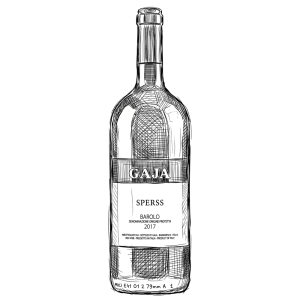
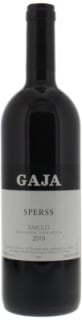
Sperss
“Sperss” means “nostalgia” in the Piemontese language, and the name speaks for itself. When Angelo Gaja released the first “Sperss” wine in 1988 (officially in 1988, although it didn’t hit the market until 1992), he sought to return to what the family had once abandoned: the production of Barolo. The Gaja family had made its name in Barbaresco. The acquisition of vineyards in Serralunga d’Alba, the commune where Barolo’s most powerful wines are produced, meant for Angelo a return to this appellation, which his grandfather Giovanni II had sought to enter in the 1960s.
“Sperss” is a wine made from 100% Nebbiolo from Serralunga; this village produces the richest and most age-worthy Barolo in the region. Alongside “Conteisa” from La Morra, this wine sits at the top of Gaja’s Barolo lineup. Two communes, two completely different wines, and one winery with a steadfast philosophy.
About Gaja
If you walk into a fine wine shop and ask who has been the most important Italian producer over the past 50 years, the answer will come immediately: “Gaja.” Angelo Gaja, having studied in Alba, Montpellier, and Turin, joined the family business in 1961, and by 1970 he had been entrusted with its management. He was the first in Piemonte to introduce stainless-steel tanks with a temperature-control system. At a time when locals were still using large Slavonian oak barrels, he purchased 225-liter French barriques. In an era when blending was considered the norm, he bottled Nebbiolo from a single vineyard. We work with “Gaja” wines precisely because there is no other producer who has done so much to preserve the taste of Piemonte while simultaneously bringing the region into the modern era.
History & Heritage
The name “Gaja” is inextricably linked to Barbaresco. That is precisely why the purchase of vineyards in Serralunga d’Alba, to be honest, was a statement of sorts. Angelo’s grandfather, Giovanni II, became famous for gradually buying up plots in Barbaresco in 1960, and “Sperss” was Angelo’s attempt to complete the family’s connection to the Nebbiolo grape by reintroducing Barolo into the wine portfolio.
For many years, the “Sperss” labels did not bear the “Barolo DOCG” designation, but rather “Langhe DOC.” This was because Angelo added a very small amount of Barbera to the blend, a practice that infuriated traditionalists. With the 2013 vintage, this dispute was resolved. “Sperss” became a 100% Nebbiolo wine and returned to the “Barolo DOCG” category.
Terroir & Climate
Serralunga d’Alba is the harshest commune in the Barolo region. The soil here has a high sandstone content and contains little of the soft calcareous marl characteristic of the La Morra area. These characteristics are directly reflected in the wine’s flavor. Compared to other Nebbiolo wines from this region, Sperss is distinguished by greater power, intensity, and tannic richness, as well as a longer aging period. The vineyards are located on southern slopes at an elevation of 300 to 450 meters, allowing this late-ripening variety, which often matures as late as mid-October, to fully benefit from the autumn sun. Hot days give way to cool nights, which helps preserve high acidity. It is precisely this long and gradual ripening process that gives “Sperss” its power and the ability to age for several decades.
Grape Varieties
“Sperss” is 100% Nebbiolo, and this policy has remained unchanged since 2013. Prior to that, the blend contained a small amount of Barbera, which is why the wine was classified as “Langhe DOC” for many years. Nebbiolo is a labor-intensive grape variety. It is characterized by high acidity, is rich in tannins, ripens slowly, and is very demanding in terms of growing conditions. Seralunga offers precisely the conditions this variety requires.
It is this single grape variety and this single commune that give “Sperss” its characteristic aroma, reminiscent of tar, roses, and truffles.
Winemaking
The main feature of Gaja is the two-stage aging in oak barrels. “Sperss” is first aged for about a year in 225-liter French barriques (small Bordeaux-style barrels), and then transferred to larger Slovenian oak barrels (botte grandi), where it ages for another year before being bottled. The barrique imparts structure and a refined flavor to the wine, while the botte plays a role in allowing the Nebbiolo to “breathe” and returning it to a more classic style. This is a deliberate compromise between the modernist approach, pioneered by Angelo in the 1980s, and the traditional Barolo style. Thanks to high planting density, strict pruning, and green harvesting, yields are kept low. The result is a rich wine that doesn’t feel heavy.
Food Pairing
They say, “What grows together goes well together,” and in Seralunga, that means white truffles from Alba. Serving tagliolini with white truffles (Tagliolini al Tartufo Bianco) with a spoonful of aged Spelsu is a local tradition, and the pairing is perfectly harmonious. In addition, the following are suitable pairings for this wine:
- Brasato al Barolo (beef braised slowly in red wine)
- Roasted rabbit or wild boar ragout, served with pappardelle
- Aged “Castelmagno” or hard “Parmigiano-Reggiano” with a nutty flavor
- Sautéed white mushrooms with garlic and parsley
Protein and fat are needed to soften the tannins.
Serving Suggestions
Serve at 16–18 °C. At higher temperatures, the alcoholic flavor will become too pronounced. Young vintages should be decanted for at least 2–3 hours, and preferably longer. Air is essential for the tannins. As for bottles that have been aged for 20 years, they should be placed upright one day before serving, and about 30 minutes before pouring, the sediment should be carefully removed and the wine decanted. Large Burgundy-style glasses are ideal.
Vintages
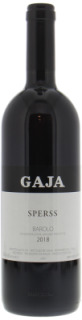
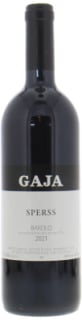
Sperss is a wine that is strongly influenced by the vintage. Sperss from warm vintages are distinguished by a more intense and direct flavor, and the tannins take on a rounded character. At the same time, wines from cool, classic vintages have a more firm and intense flavor and require extended aging in the cellar. The 2019 vintage for example has a classic structure for Piemonte, is suitable for long-term aging, and exhibits the robust framework characteristic of Seralunga. The 2021 vintage features a more concentrated fruit flavor and rich tannins.
A general rule for this wine: don’t open bottles released less than 10 years ago. Sperss typically begins to reveal its true potential only after 15–20 years of aging. For everyday enjoyment, it’s best to choose older bottles. If you plan to age the wine in your cellar, you’ll need to be patient with more recent vintages and wait.
The best vintages of Gaja Sori San Lorezo
The level and quality of this wine is very high, regardless of vintage, However, some exceptional vintages are: 1989, 1990, 1997, 2004, 2007, 2015, 2019, 2021.
Cellaring Potential
Sperss barolo can age for decades. Nebbiolo from Seralunga is characterized by high acidity and rich tannins, and it simply takes time for these elements to come together harmoniously. When stored properly (at a temperature of 12–14 °C, lying horizontally, with stable humidity), Sperss will easily retain its qualities even beyond the 30 years after release. Over time, the initial aromas of cherry and rose give way to notes of truffle, tar, dried herbs, and forest soil. Patience is simply essential with this wine.
FAQ
Is “Sperss” a Barolo?
Yes, starting with the 2013 vintage, it officially falls under the Barolo DOCG designation. Prior to that, because the blend contained a small amount of Barbera, the label indicated the DOC Langhe designation.
What does “Sperss” mean?
In the Piemontese dialect, this word means “nostalgia.” It symbolizes Angelo Gaja’s return to Barolo after the Gaja family had focused primarily on Barbaresco for several decades.
How does “Sperss” differ from Gaja’s Barbaresco wines?
It is more powerful, intense, and rich in tannins. Nebbiolo from Seralunga d’Alba has a heavier structure than grapes from the Barbaresco vineyards, so “Sperss” requires a long aging period.
Is “Sperss” a good wine for investment?
Gaia’s finest wines, including “Sperss,” consistently retain or increase their value, especially in the case of outstanding vintages and large-format bottles.
