
Marcel Deiss

While nearly all wineries in Alsace list the grape variety on their labels, Marcel Deiss has omitted this information.


Located in Bergheim, right in the heart of the Ribeauvillé fault zone, this winery cultivates 32 hectares of vineyards using biodynamic farming methods. A defining feature of this vineyard is complantation. In other words, it involves planting multiple grape varieties together in the same plot, harvesting them together, pressing them together, and fermenting them together. The reasoning behind this is very simple: true terroir speaks louder than any single variety planted on that land.


The Deiss family may be called pioneers of Alsace field blends and non-varietal wines, noting that these wines have taken on an even more distinctive character since varietal names disappeared at the end of the last century. Low yields, a process with no shortcuts, and the 13 varieties of Alsatian grapes planted in the vineyard.

filters

Type 0x
price
 - 
country 0x
region 0x
subregion 0x
appellation 0x
producer 1x
grape 0x
Vintage 0x
1999 2022
Volume 0x

When the grape name came off the label

Long before Field Blend became the symbol of this winery, Deiss had already made a name for itself. 


The turning point came in the late 1990s, when the family began removing varietal names from their labels. In a region that had grown by adopting Riesling, Gewurztraminer, and Pinot Gris as brand names, this was a truly risky decision from a commercial standpoint.


However, this strategy proved successful. Subsequently, more Alsatian growers also followed the same path of returning to the roots, and Deiss wines are credited with elevating this concept to the mainstream of the serious Alsace wine world.


The winery's explanation of this is free of emotional bias. The method they call Complantation is not an invention, but rather the oldest known form of viticulture, the way vineyards were established before clone selection and the resulting reduction in biodiversity took place.

32 hectares in Bergheim

Marcel Deiss cultivates 32 hectares of farmland at and around the center of the Ribeauvillé fault zone. This fault zone is precisely why the geological characteristics of this area vary dramatically from one plot to another, and the vineyard's property spans two zones: Premier Cru and Grand Cru.


Biodynamic farming practices are applied not only to the top-tier plots but to the entire vineyard. No synthetic products are used at all, and rather than supplying nutrients to the surface, the focus is deliberately on encouraging the vines to develop deep roots.


Yields are kept low. While this is partly due to biodynamic farming practices, it is also the core objective of all these efforts. In other words, complantation is intended to yield a stable and complex harvest from a diverse plant community, rather than harvesting as much as possible from a single clone.


This winery speaks candidly about what this entails. According to their explanation, a winemaker is, above all, a farmer, someone who works hard for a single plot of land.

The terroir

Bergheim is located in the Ribeauvillé fault zone, which is an area where different geological strata are tightly packed together and fractured. As a result, a variety of soils are intermingled like a mosaic even within a short distance, and it is precisely this feature that supports the consistency of the Deiss approach.

Their argument is that true terroir is always more powerful than the varieties planted there. If thirteen different varieties are planted together in a single vineyard, over time, it is the characteristics of that vineyard, not the grape varieties, that come through in the flavor.

The conclusion is that the stability of these characteristics stems from the vineyard, not the grape variety. With the same soil, the same slope, and the same combination of grape varieties, the grapes must be harvested and pressed all at once for each vintage.

Thirteen grape varieties, planted together

The Marcel Deiss vineyard is planted with 13 varieties of Alsatian grapes. Rather than being divided into separate plots, the grapes grow intermixed within each plot.


- The grapes are grown, harvested, and pressed together.
- Vinification is not blended with other varieties later on; it is made into a single wine.
- The differences in ripening between varieties are embraced rather than corrected.


Because the varieties are planted and harvested together, this winery does not disclose the exact varietal proportions for its terroir wines. This is an intentional choice, not an omission. Some cuvées are Riesling-led, but the field blend approach is in most cases consistently applied across the entire product line.

Winemaking

The winemaking process at Marcel Deiss is described in terms that are almost stubbornly simple. It involves crafting wine with patience and without artificial intervention. All grapes from a single plot are gathered together, and the entire harvest is pressed at once.


As a result, blending after fermentation, a common tool for winemakers to adjust the wine, is eliminated. This means that all critical decisions are made in the vineyard: specifically, what to plant where and when to harvest.


Not all of the wines produced here are dry white wines. 

The wines

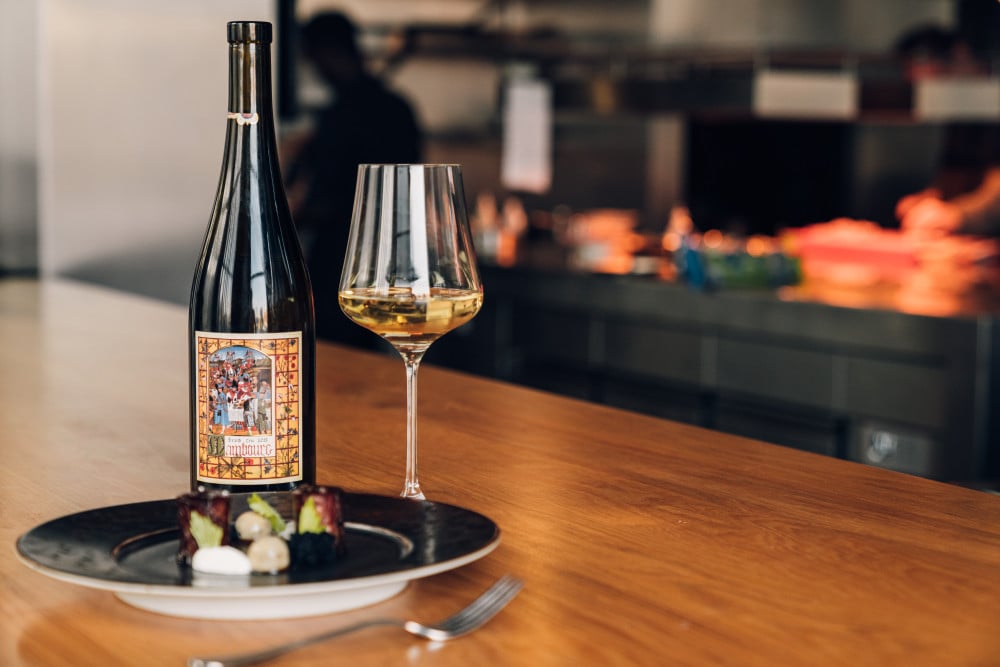
Grand Cru bottled wines are the category where the debate over field blends is most intense. Schlossberg Grand Cru is the newest release in this series, and Pigott praised it as a wine that has finally reached the level of the established vineyards. Schoenenbourg Grand Cru, Altenberg de Bergheim, and Mambourg round out the top-tier lineup.


Below these are Langenberg, a named vineyard that does not qualify for the Grand Cru grade, and Burlenberg. 


Coffret Les Climats is a box set designed to allow side-by-side comparisons of wines from various terroirs, offering the most direct way to see how terroirs actually differ.


The winery produces many other wines as well. The bottled wine Engelgarten has been featured in critics' reviews, and its total production spans the Bergheim vineyard and the surrounding Premier Cru and Grand Cru vineyards.


Frequently asked questions

Where is Marcel Deiss based?

In Bergheim, Alsace, in the middle of the Ribeauvillé fault field.

What is complantation?

Planting several grape varieties together in the same plot, then harvesting, pressing and fermenting them as one wine. Marcel Deiss uses it across the estate as the oldest known form of viticulture, predating clonal selection.

Why is there no grape variety on the label?

The family stopped naming varieties in the late 1990s, on the view that the terroir defines the wine more than the grape does. It made them pioneers of non-varietal Alsace, and others have followed.

Is the estate organic or biodynamic?

Biodynamic, across all 32 hectares, farmed without synthetic products.

Deiss Alsace Mambourg

A Tasting at Marcel Deiss

We were warmly welcomed by Marie-Helene Deiss, who immediately introduced us to the vineyards, their location and the general philosophy. And then the tasting started right away, the best choice: here we talk about the soil, the location, the terroir. As Marie-Helene herself described it: "a grape variety is like paper: it says nothing. So what you write on it is what matters".

A mixture of grape varieties grows on each plot, as in the past. In this way, the varieties compete with each other, which leads to an improvement in the quality of the individual grapes. The Marcel Deiss Estate stimulates the vines to take root deep enough to make the most of the terroir. We therefore try to get the character of the soil into the grapes, so that each wine is an expression of its origin.

During our tasting, the location of the vineyard was indicated for each wine and real pieces of soil were used to illustrate the soil conditions. Each wine was clearly different, even though the wines had exactly the same grape variety composition. This was the case for Engelgarten and Rotenberg, which we tasted side by side in 2 glasses. The plots were right next to each other. Engelgarten is located on an old river bed with pebbles and gravel, Rotenberg is an old Jurrassic soil (oolitic limestone). Both wines were completely different, but each with its own specific touch. And when we asked what grapes the wine was made of, Marie-Hélène looked at us quizzically: "But that doesn't matter at all, does it? It turned out to be a combination of Riesling, Pinot Gris, Pinot Beurot, Muscat and Pinot Noir.

The tasting was a journey of discovery of the terroir and showed what Alsace and the different grape varieties can produce in terms of quality. The Grand Cru Schoenenbourg was briefly compared by Marie-Hélène to Romanee Conti. A popular wine in Europe since the 12th century because of its excellent conservation due to the composition of the soil. Schoenenbourg wines can become very old. A winemaker must consciously choose to make this wine. Unfortunately, according to Marie-Hélène, this happens too little, so that Schoenenbourg no longer has the appeal of the past, but the potential remains unchanged. And we were able to taste it afterwards, alongside the Grand Cru Altenberg and the Mambourg. What fantastic wines.

We tasted 18 wines that afternoon and came to the conclusion that we should have visited Marcel Deiss much earlier. The philosophy of winemaking, the intention with which the wines are made, the quality and certainly the value for money, all appeal to us. And to come back to the importance of the grape varieties and to want to do things differently: Domaine Marcel Deiss managed to get rid of the obligation to indicate the grape variety on the label a few years ago. Indeed, here we do things differently.

Added to favorites.