
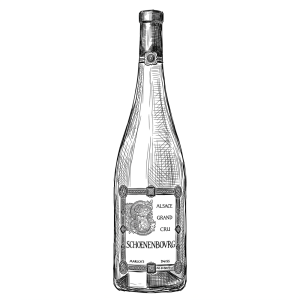
Schoenenbourg Grand Cru
Voltaire owned a vineyard in Schoenenbourg. This shows how long this hillside above Riquewihr has been considered serious Riesling territory. Marcel Deiss owns one corner of it and produces some of the most attractive Grand Cru Rieslings from Alsace.
What makes Domaine Marcel Deiss' Grand Cru Schoenenbourg so remarkable? It has to do with two reasons. First, the soil: layers of gypsum marl, dolomitic limestone and Vosges sandstone. Secondly, the philosophy. Jean-Michel Deiss prioritizes terroir over grape variety. This is unusual in Alsace, where historically everything depends on the grape variety. Here, however, location is of paramount importance. Riesling is just an ambassador.
About Marcel Deiss
Almost every Alsace producer puts the grape variety on the label. Marcel Deiss does not, and that has been the case since the late 1990s, when the family dropped varietal names in a region that had built its reputation on Riesling, Gewurztraminer and Pinot Gris. The estate farms 32 hectares around Bergheim, in the Ribeauvillé fault zone, where soils change from one plot to the next like a mosaic. Everything is biodynamic, yields are low, and the vineyards are planted by complantation: 13 Alsatian varieties growing intermixed, picked together, pressed together, fermented together. No blending afterwards. Writing for James Suckling, Stuart Pigott called the Deiss family pioneers of field blends and has been visiting Bergheim since the late 1980s. Grand Crus include Schlossberg, Schoenenbourg, Altenberg de Bergheim and Mambourg.
History & Heritage
The Deiss family has been growing grapes in Bergheim since 1744, but the modern story began in 1947 when Marcel Deiss returned from the war and started his own winery. The turning point came in 1973. Jean-Michel, a recent graduate of the School of Oenology, took charge and began to question all the assumptions that Alsace held dear.
Why is the bottle in front of you so important? Because the Schoenenbourg you see is the product of this debate. Co-growing, biodynamics, no filtration or purification in the highest cuvée - these are not marketing decisions, they are the result of 50 years of persistent persuasion.
Terroir & Climate
Schoenenbourg is located above Riquewihr in the Haut-Rhin, classified as a Grand Cru in 1992 and covers an area of about 53 hectares. It faces south to southeast and is 265-380 meters above sea level. So far, this sounds like typical Alsace. What sets it apart is what lies beneath.
The soil is gypsum marl with bands of Vosges sandstone and mica overlying dolomitic limestone. This gypsum is the key. The gypsum gives the local Riesling a particular heaviness and salty grip that the granitic Grands Crus does not have. The marl also retains moisture, so the vineyards are not stressed even in dry years. Powerful, structured and capable of long aging. That's what Schoenenbourg is all about.
Grape Varieties
Riesling on the label, Riesling in the bottle. A grape that, more than any other, conveys what lies beneath. Schoenenbourg's marl and gypsum soils produce heavy and salty wines from Riesling, not citrusy with bright flavors like granite and schist soils. They show stone fruit, beeswax and the famous petrol notes that arise from aging. This aromatic complexity arises from the singular character of the terroir expressed through Riesling.
Winemaking
Deiss cellar work is based on one principle: "do not disturb". Whole cluster pressing, fermentation with indigenous yeasts (wild yeast already on the grape skins) and slow aging in old large foudres rather than new barriques. Why exactly in old barrels? Because the new oak barrels add vanilla and toast, masking the character of the soil. Old foudres allow the wine to breathe slightly without interfering with the flavor.
Long aging on lees builds texture. The highest cuvée is bottled without filtration. This also means that more wine is poured into the glass.
Tasting Notes
The first sensation is weight. This is not a thin, pungent riesling. The nose shows ripe yellow peach, quince, beeswax and smoky mineral notes of gypsum. Bottling aging reveals classic petrol notes as well as dried apricots and honey.
On the palate, the wine is salty rather than sharply acidic. The structure supports the fruit, and the long, slightly bitter mineral finish. A wine made for eating. Ages with time. Young bottles need airing, but in older bottles a third complexity emerges that is worth the wait.
Food Pairing
This wine favors food with weighty, salty notes, richer than most Alsatian Rieslings. Taste:
- A classic choucroute garni, sausages and pork need a bite of wine.
- Pike or pike-perch from the Ill River in a creamy sauce.
- Coq au Riesling, made with this wine if you're feeling generous.
- Munster cheese, matured.
Serve at 11-13°C. Too cold a wine will weaken the flavors. If served much warmer, the wine will struggle against the Munster cheese.
Serving Suggestions
At 11-13°C, slightly warmer than the temperature at which most people pour white wine. Take out of the refrigerator 20 minutes before opening the bottle. Decant young bottles within 30-45 minutes. A standard white wine glass will do. Aged bottles are best served in a Burgundy wine glass.
Cellaring Potential
The best vintages of Deiss Schoenenbourg can be aged for 20 to 30 years without problems. It is driven by acidity, a mineral structure derived from gypsum, and concentration due to low yields and biodynamic farming: the wine is stored horizontally, away from light, at a stable temperature of 12-14°C. With time, the fruitiness changes from peach to dried apricot and honey, with petrol and smoke. Do not open cold from the cellar. Reheat.
